
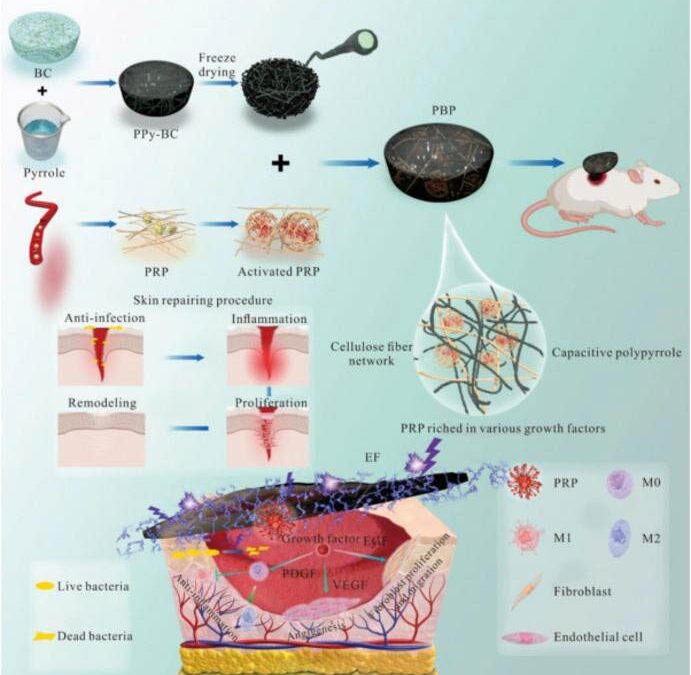








Image courtesy of Department of Biomedical Engineering, College of Life Science and Technology, Huazhong University of Science and Technology, Wuhan, China.
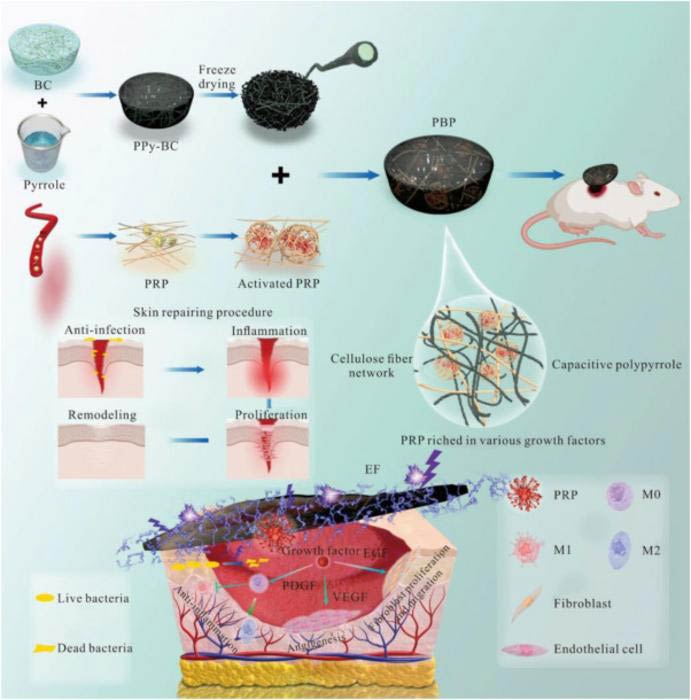
Researchers have engineered a smart hydrogel dressing that replicates the skin’s natural healing process to promote faster and more effective wound closure. The study introduces a composite hydrogel that integrates bacterial cellulose (BC), conductive polypyrrole (PPy), and platelet-rich plasma (PRP) into a single multifunctional platform. The hydrogel, referred to as PBP (polypyrrole/bacterial cellulose/platelet-rich plasma), is designed to address the key barriers to diabetic wound healing: persistent inflammation, bacterial infection, and poor tissue regeneration. BC provides a porous, biocompatible scaffold that mimics the extracellular matrix, while PRP–rich in growth factors like VEGF, EGF, and PDGF–supports cell proliferation and angiogenesis. PPy, a conductive polymer, not only enhances the hydrogel’s antibacterial properties through capacitive charging but also enables electrically triggered release of growth factors.
In laboratory tests, the charged PBP hydrogel demonstrated over 98% antibacterial efficacy against both E. coli and S. aureus, common pathogens in diabetic wounds. The hydrogel’s electrical stimulation capability further boosted its performance, promoting fibroblast and endothelial cell growth while modulating macrophage polarization from a pro-inflammatory (M1) to a pro-healing (M2) phenotype.
In a diabetic mouse model, wounds treated with the PBP hydrogel–especially when combined with electrical stimulation–showed significantly faster healing. By day 14, nearly complete wound closure was observed, with enhanced collagen deposition, vascularization, and epidermal regeneration. The hydrogel also maintained a moist microenvironment, absorbed exudate, and reduced inflammatory cytokines, all critical for optimal wound repair.
What sets this dressing apart is its ability to mimic the physiological phases of skin repair: inflammation control, tissue formation, and remodeling. Unlike conventional dressings that offer passive protection, the PBP hydrogel actively participates in the healing process. Its electroresponsive nature allows for on-demand drug release, making it a potential platform for personalized wound care.
By integrating bioinspired design with smart material functionality, the PBP hydrogel offers a promising, clinically translatable solution for diabetic wound healing. Future work will focus on refining the material’s mechanical properties, extending growth factor release duration, and validating its efficacy in larger animal models and human trials.