








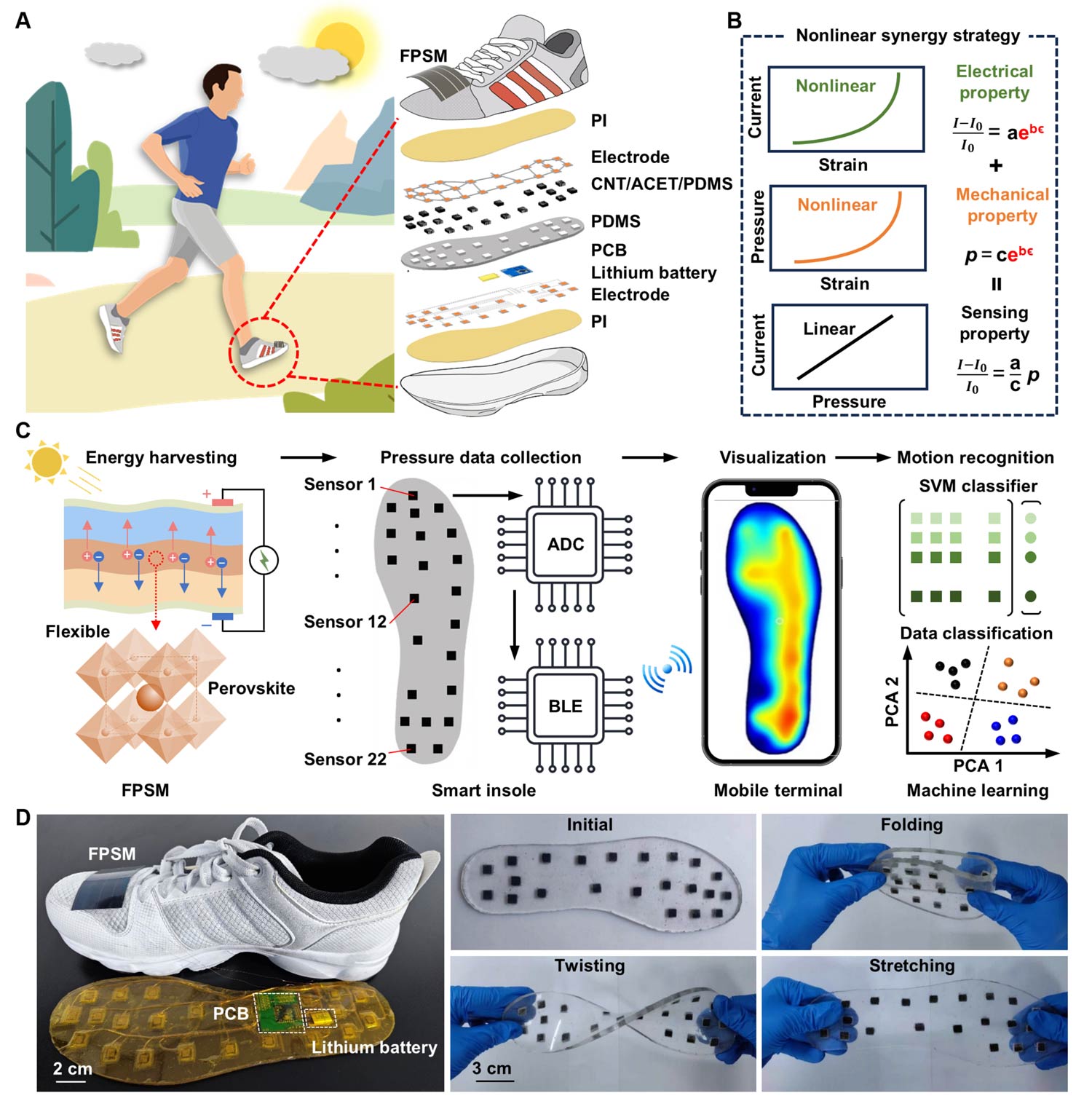
Overview of the self-powered smart insole.
A new smart insole system that uses machine learning to learn and classify 8 different types of motion states, including static ones like sitting and standing to more dynamic movements such as running and squatting, monitors how people walk in real time could help users improve posture and provide early warnings for conditions from plantar fasciitis to Parkinson’s disease. That offers opportunities for personalized health management, including real-time posture correction, injury prevention, and rehabilitation monitoring. Customized fitness training may also be a future use, the researchers said.
Constructed using 22 small pressure sensors and fueled by small solar panels on the tops of shoes, the system offers real-time health tracking based on how a person walks. This data can then be transmitted via Bluetooth to a smartphone for quick and detailed analysis, said Jinghua Li, co-author of the study and an assistant professor of materials science and engineering at The Ohio State University (Ohio State).
Li and Qi Wang, a materials science and engineering PhD student at Ohio State, sought to ensure that their wearable is durable, has a high degree of precision when collecting and analyzing data, and can provide consistent and reliable power.
Since the materials the insoles are made of are flexible and safe, the device is low-risk and safe for continuous use. For instance, after the solar cells convert sunlight to energy, that power is stored in tiny lithium batteries that don’t harm the user or affect daily activities. Because of the distribution of sensors from toe to heel, the researchers could see how the pressure on parts of the foot is different in activities such as walking versus running.
According to the study, these smart insoles showed no notable deterioration in performance after 180,000 cycles of compression and decompression, showing their long-term durability.