






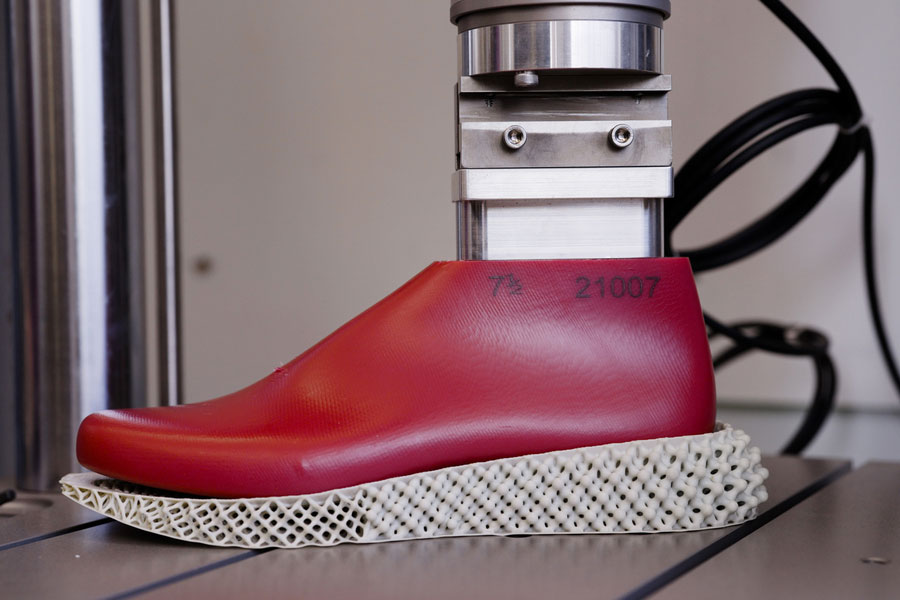
Researchers measure the stiffness of midsole designs using an Instron machine to mimic footsteps. Image courtesy of MIT.
Engineers at the Massachusetts Institute of Technology have developed a new model that predicts how certain shoe properties will affect a runner’s performance. The model represents a runner as a center of mass, with a hip that can rotate and a leg that can stretch. The leg is connected to a box-like shoe, with springiness and shock absorption that can be tuned, both vertically and horizontally. The simple model incorporates a person’s height, weight, and other general dimensions, along with shoe properties such as stiffness and springiness along the midsole. With this input, the model then simulates a person’s running gait in a particular shoe. This allows researchers to simulate how a runner’s gait changes with different shoe types. They can then pick out the shoe that produces the best performance, which they define as the degree to which a runner’s expended energy is minimized.
As part of their work, the team sought to identify a biological cost function that is general to most runners, which could then allow them to predict not only a person’s gait for a given shoe but also which shoe produces the gait corresponding to the best running performance. They found that most runners tend to minimize 2 costs: the impact their feet make with the treadmill and the amount of energy their legs expend. As a final step, the researchers simulated a wide range of shoe styles and used the model to predict a runner’s gait and how efficient each gait would be for a given type of shoe.
While the model can accurately simulate changes in a runner’s gait when comparing 2 very different shoe types, it is less discerning when comparing relatively similar designs. Thus, the researchers envision the current model would be best used as a tool for shoe designers. However, the team is planning to improve the model, in hope that consumers can someday use a similar version to pick shoes that fit their personal running style.