







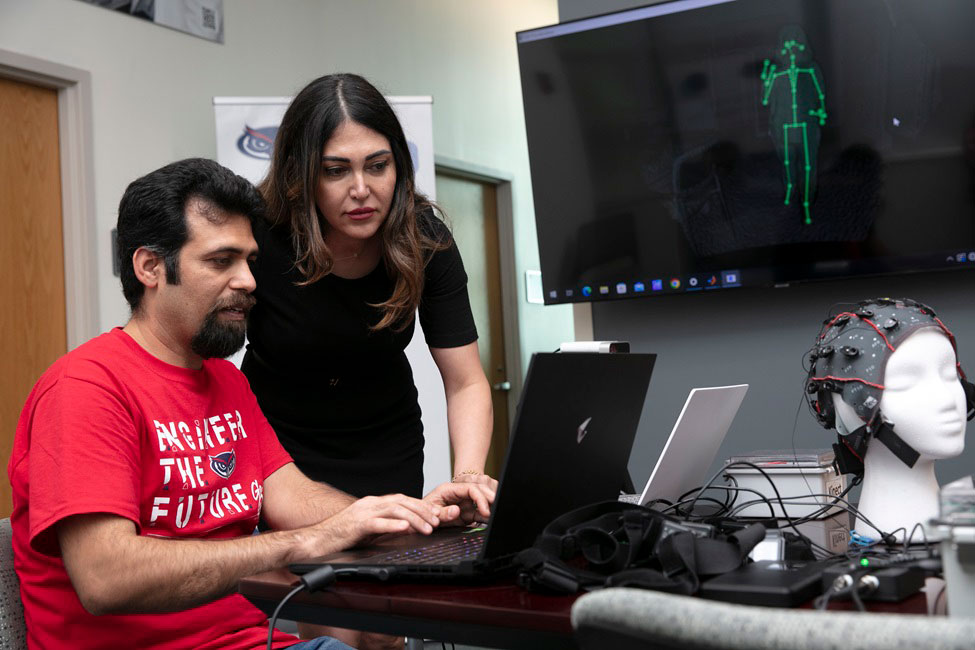
Mahmoud Seifallahi (seated) and Ghoraani review the performance of straight walking using a depth camera, which can detect and track 25 joints of body movement. Image courtesy of FAU College of Engineering and Computer Science.
Gait analysis is emerging as a valuable, non-invasive complement to cognitive assessments that aid in early diagnosis and management. In clinical settings, gait and balance tests typically focus on a straight walking path. However, researchers at Florida Atlantic University (FAU) have ventured into a different realm—curved path walking—a more natural yet complex activity. Straight walking is a rhythmic and simpler activity, whereas walking on a curving path requires greater cognitive and motor skills such as a transition time to change directions and correct balance.
College of Engineering and Computer Science researchers at FAU are the first to quantitatively compare the performance of healthy older adults versus older adults with mild cognitive impairment (MCI) in straight and curve walking. MCI is the early stage of cognitive decline and people with MCI have a much higher risk of transitioning to Alzheimer’s disease (AD).
For the study, researchers used a depth camera, which can detect and track 25 joints of body movement, to record study participants’ gait while performing the 2 different walking tests (straight versus curve). Signals from the 25 body joints were processed to extract 50 gait markers for each test, and these markers were compared between the 2 groups using descriptive statistical analyses.
Results showed curve walking resulted in greater challenges for the MCI group and outperformed straight walking in detecting MCI. Furthermore, several gait markers showed significant differences between healthy controls and MCI patients.
Gait markers included 2 macro markers (average velocity and cadence), 24 micro temporal markers (duration of feet for various subphases of the gait cycle, such as stance, swing, step, and stride phases), micro spatial markers (location changes of feet for various sub-phases of the gait cycle), and 6 micro spatiotemporal markers (velocity of feet for various sub-phases of the gait cycle). These markers provided detailed information on the functional performance of the participants during the gait tests.
Findings showed that 31 out of 50 gait markers were greater for the MCI group than healthy control older adults when the walking tests changed from straight walking to curve walking, and 13 markers showed significant differences between the 2 study groups.
“The MCI group exhibited a markedly lower average step length and speed during curve walking, coupled with higher variability across most micro-gait markers,” said Behnaz Ghoraani, PhD, an associate professor, FAU Department of Electrical Engineering and Computer Science, co-director of the FAU Center for SMART Health, and a fellow, FAU Institute for Sensing and Embedded Network Systems Engineering (I-SENSE). “The MCI group showed diminished symmetry and regularity in both step and stride lengths for curved walking. They also required extended double support time in various areas, especially while changing directions, which resulted in reduced step speed.”
AD typically manifests as a decline in cognitive function with a gradual decline in an individual’s ability to perform daily activities such as walking. Accurate and early clinical detection of AD remains a challenge. Typical clinical evaluations include a detailed history, comprehensive physical and neurological examination, cognitive testing, blood work and brain imaging. However, depending on the clinical setting, these methods can be time-consuming, costly, and outside some clinicians’ comfort level. These finding fill the gap by using a novel system to record gait in older adults employing a non-invasive, low-cost, non-wearable, and easy-setting depth camera, which is a crucial step in enhancing patient care and intervention strategies.