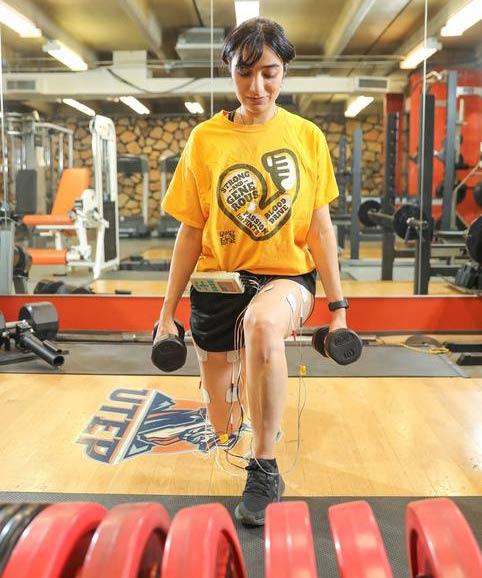
Zahra Fatahimeiabadi, a graduate student in Bajpeyi’s lab, demonstrates a resistance workout while using NMES. Image courtesy of UTEP.
Neuromuscular electrical stimulation (NMES) uses electrical currents to contract muscles. The stimulation devices are easy to use and widely available on the market, according to Sudip Bajpeyi, PhD, a professor in the Department of Kinesiology at The University of Texas at El Paso (UTEP), but he has often wondered, “Can these stimulators offer any benefits when used during resistance training? What does the research say?”
Well, the results are in–and they are promising. In a new meta-analysis study, Bajpeyi found that using NMES while doing resistance training leads to greater muscle mass and strength compared to resistance training alone.
Bajpeyi and his team conducted the meta-analysis, comprising more than a dozen studies that used NMES, and reviewed their results. The analysis focused on studies where participants performed traditional resistance exercises, such as bench presses or squats, while using NMES devices. The studies compared the results of participants using electrical stimulators while exercising to those who did the exercises with no electrical stimulation. Participants’ muscle mass and strength were assessed at the beginning and the end of each study. Training periods for participants ranged from 2 to 16 weeks, with longer durations yielding better results.
“Under normal conditions, the brain activates muscles by sending signals through the nervous system.” Bajpeyi said. “NMES mimics this process by delivering external electrical currents to the nerves, causing the muscles to contract, without input from the brain. Think of it as though your muscles are contracting involuntarily.”