







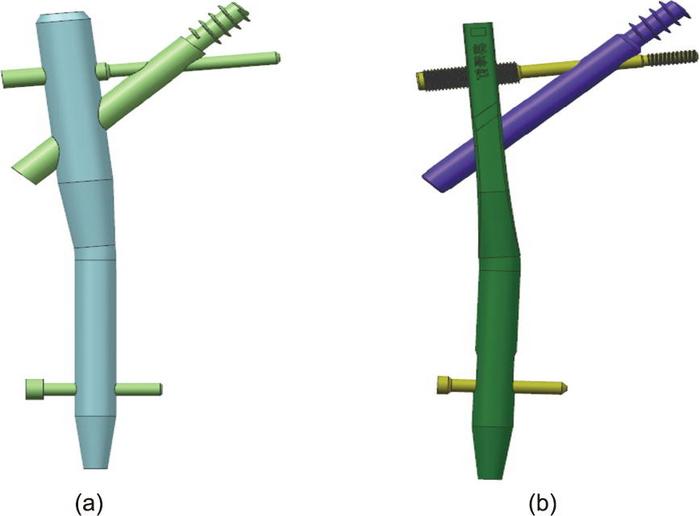
Schematic of (a) the proximal femur bionic nail (PFBN) and (b) its modified version for preventing bone nonunion, Yingze nail. Image courtesy of Kaixuan Zhang, Wei Chen, and Yingze Zhang.
A research team from various universities and health institutes in China have announced a new innovation as a potential panacea for unstable intertrochanteric femur fractures in the elderly: the Proximal Femur Bionic Nail (PFBN). With the aging population, intertrochanteric femur fractures have become a critical public health concern, prompting a surge in research focused on trauma orthopedics.
Traditional internal fixation techniques have often fallen short in addressing the mechanical challenges posed by these fractures, leading to prolonged recovery times and increased complication rates for patients. However, the development of the PFBN, incorporating the lead researcher’s N triangle theory to provide triangular supporting fixation, represents a paradigm shift in the treatment of these fractures.
The key innovation of the PFBN lies in its ability to significantly reduce the occurrence of complications, leading to improved patient outcomes and faster recovery times. Through the use of an equivalent biomechanical model, the research team demonstrated that the PFBN outperforms existing solutions such as the proximal femoral nail antirotation (PFNA) and InterTan, by dramatically decreasing the maximum strain in the proximal femur. Furthermore, the PFBN has been shown to regulate the local mechanical environment in the proximal femur, creating a state of physiological overload that favors post-operative recovery for elderly patients with intertrochanteric femur fractures. This promising outcome offers hope for a transformative approach to internal fixation, with the potential to revolutionize treatment not only for this specific type of fracture but for other fractures as well, based on elastic deformation.