Image courtesy of the researchers and MIT News.
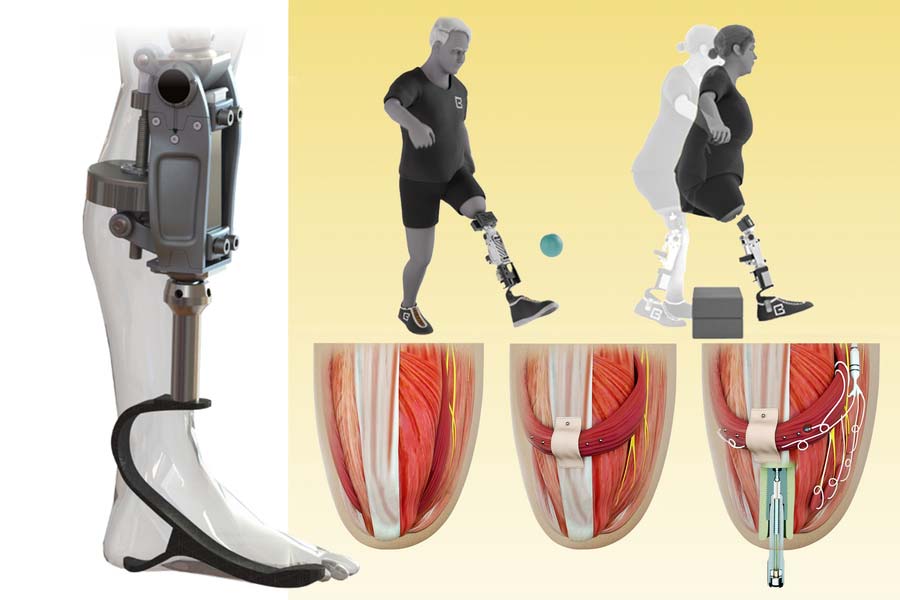
Massachusetts Institute of Technology (MIT) researchers have developed a bionic knee that can help people with transfemoral amputations walk faster, climb stairs, and avoid obstacles more easily than they could with a traditional prosthesis. Their innovation is now being used in conjunction with a new surgical approach they also developed, known as agonist-antagonist myoneuronal interface (AMI), during which muscle pairs are reconnected during surgery so that they still dynamically communicate with each other within the residual limb. This sensory feedback helps the prosthetic wearer decide how to move the limb and also generates electrical signals that can be used to control the prosthetic limb.
In a 2024 study, the researchers showed that people with transtibial amputations who received the AMI surgery were able to walk faster and navigate around obstacles much more naturally than people with traditional transtibial amputations.
In their new study, the researchers extended the approach to those with transfemoral amputations by creating a system that could read signals from the muscles using AMI coupled with an osseointegrated implant, offering more stability and better sensory feedback, mechanical control, and load bearing than a traditional prosthesis. The implant contains 16 wires that collect information from electrodes located on the AMI muscles inside the body, which enables more accurate transduction of the signals coming from the muscles. This bone-integrated system, known as e-OPRA, transmits AMI signals to a new robotic controller, developed specifically for this study, which uses this information to calculate the torque necessary to move the prosthesis the way that the user wants it to move.
The 2 subjects who received the combined AMI/e-OPRA system, known as an osseointegrated mechanoneural prosthesis (OMP), were compared with 8 who had the AMI surgery but not the e-OPRA implant, and 7 who had neither AMI nor e-OPRA. All took a turn at using the experimental powered prosthetic knee, and their ability to perform several types of tasks–including bending the knee to a specified angle, climbing stairs, and stepping over obstacles–was measured. In most of these tasks, users with the OMP system performed better than those who had the AMI surgery but not the e-OPRA implant, and much better than users of traditional prostheses. The researchers also discovered that the participants with the OMP showed much greater increases in their feelings of agency and ownership of their prosthesis than the other subjects.
The combined OMP system will need larger clinical trials to receive US Food & Drug Administration approval for commercial use, which may take about 5 years.