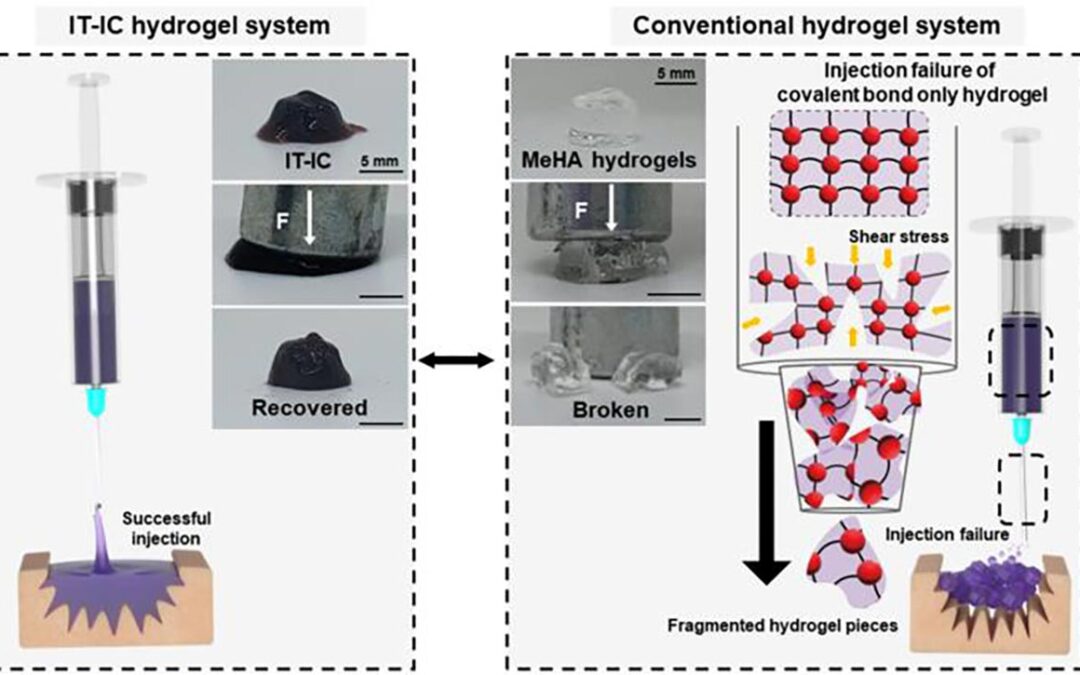








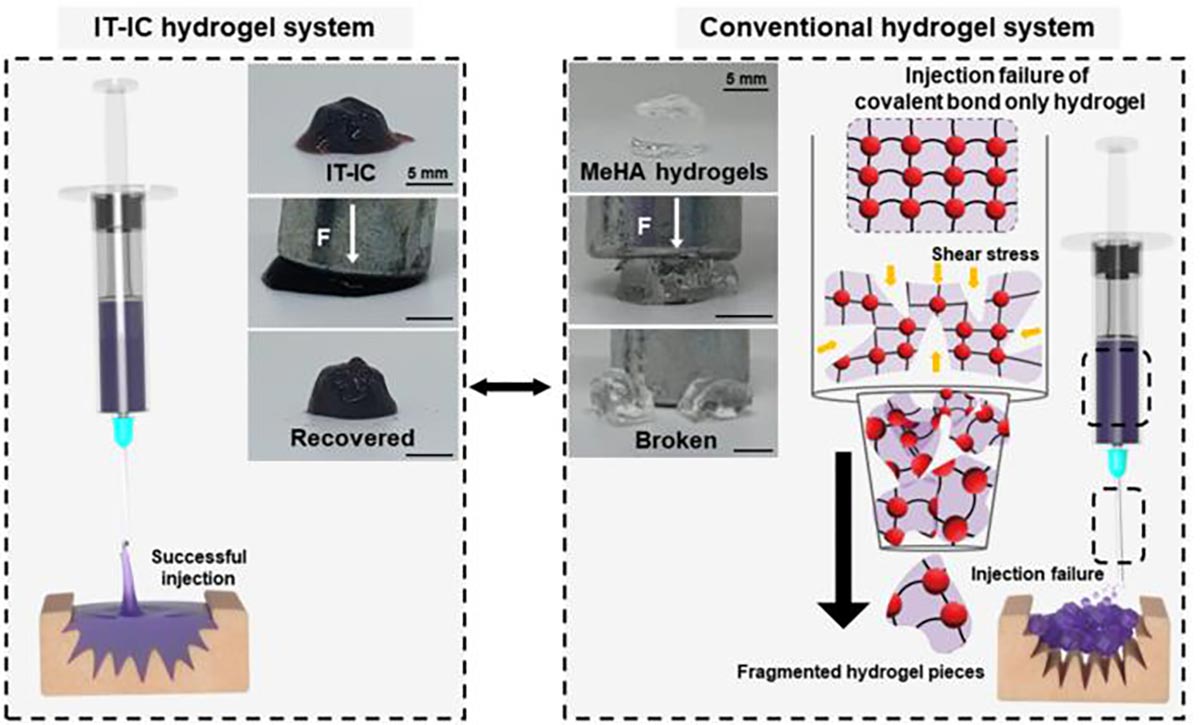
This new hydrogel system (it-ic) can protect the gel from destruction by external forces. In conventional covalently crosslinked hydrogels (eg, methacrylated hyaluronic acid, referred to as meha), fragmentation occurs due to the destruction of covalent bonds during the injection process, but it-ic hydrogels maintain covalent bonds due to stress dissipation with multiple bonds containing biphenyl structure and allow injection into narrow areas. Image courtesy of IBS
Researchers from the Institute of Basic Science (IBS) in South Korea have developed a novel approach to healing muscle injury by employing “injectable tissue prosthesis” in the form of conductive hydrogels and combining it with a robot-assisted rehabilitation system.
Let’s imagine you are swimming in the ocean. A giant shark approaches and bites a huge chunk of meat out of your thigh, resulting in a complete loss of motor/sensor function in your leg. If left untreated, such severe muscle damage would result in permanent loss of function and disability.
Traditional rehabilitation methods for these kinds of muscle injuries have long sought an efficient closed-loop gait rehabilitation system that merges lightweight exoskeletons and wearable/implantable devices to aid the patient through the process of recovering sensory and motor functions linked to nerve and muscle damage. Unfortunately, the mechanical properties and rigid nature of existing electronic materials are incompatible with soft tissues, leading to friction and potential inflammation, and thus stalling rehabilitation.
To overcome these limitations, the IBS researchers turned to a material commonly used as a wrinkle-smoothing filler, called hyaluronic acid. Using this substance, an injectable hydrogel was developed for “tissue prostheses,” which can temporarily fill the gap of the missing muscle/nerve tissues while it regenerates. The injectable nature of this material gives it a significant advantage over traditional bioelectronic devices, which are unsuitable for narrow, deep, or small areas, and necessitate invasive surgeries.
Thanks to its highly “tissue-like” properties, this hydrogel seamlessly interfaces with biological tissues and can be easily administered to hard-to-reach body areas without surgery. The reversible and irreversible crosslinks within the hydrogel adapt to high shear stress during injection, ensuring excellent mechanical stability. This hydrogel also incorporates gold nanoparticles, which gives it decent electrical properties, allowing for the transmission of electrophysiological signals between the 2 ends of injured tissues. In addition, the hydrogel is biodegradable, so an additional surgery is unnecessary.
With mechanical properties akin to natural tissues, exceptional tissue adhesion, and injectable characteristics, researchers believe this material offers a novel approach to rehabilitation.
Testing in rodent models has proved to be promising. The research team is currently working to develop new materials for nerve and muscle tissue regeneration that can be implanted in a minimally invasive manner. They are also exploring the potential for recovery in various tissue damages through the injection of the conductive hydrogel, eliminating the need for open surgery.