October 2026
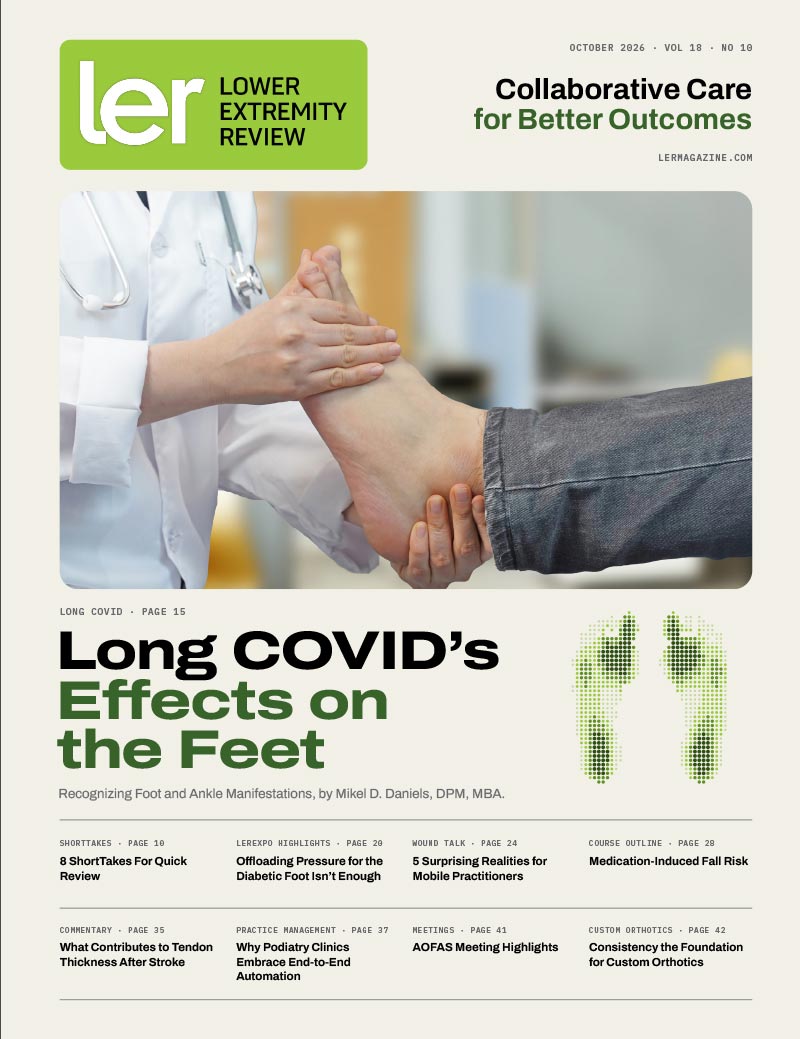
Click on image to download the issue in PDF format
Cover Story
A Patient walks into the office with generalized foot pain. Taking a history, you learn the patient has fatigue, or myalgias in other muscles, or feels weak all the time. What are the usual diagnoses? Long COVID has changed how I approach foot and ankle pain in these patients. I no longer believe we can safely evaluate lower-extremity symptoms without at least considering its potential role. When patients tell me their feet “haven’t been right” since having COVID, I don’t dismiss the comment. I treat it as a meaningful clinical clue. This does require some outside-the-box thinking, and we all need to start taking a deeper dive.
By Mikel D. Daniels, DPM, MBA, President and Chief Medical Officer, WeTreatFeet Podiatry
Meeting Highlights
More than 1,260 foot and ankle orthopaedic surgeons, advanced health practitioners, orthopaedic residents, and medical students across the globe attended the American Orthopaedic Foot & Ankle Society® (AOFAS) Annual Meeting and the International Federation of Foot & Ankle Societies (IFFAS) 9th Biennial Meeting on September 16–19, 2026. The meeting was held in-person in Seattle, Washington, as well as virtually.
Features
In the quiet halls of the Gillis W. Long Hansen’s Disease Center in Carville, Louisiana, the legendary Dr. Paul Brand once faced a clinical mystery. He was conducting a study with a hypothesis that seemed like a mathematical certainty: total bed rest should heal a foot ulcer faster than any other intervention. By removing the variable of weight-bearing pressure entirely, the skin should have had the perfect environment to repair itself.
By Dr. Dennis Janisse
The current landscape of healthcare regulation is no longer a series of predictable updates. It has evolved into a “tornado” of shifting policies, reimbursement challenges, and administrative complexity. For mobile wound care practitioners, the outlook for 2026 remains promising, provided they pivot from a volume-based mindset to a meticulous, documentation-driven business model. As veterans of regulatory compliance and mobile clinical operations, we outline the essential realities for surviving and succeeding in the coming year.
By Windy Cole, DPM, CWSP, FACCWS, FFPM RCPS (Glasg) and Martha R. Kelso, RN, CWHS, DAPWCA, HBOT
Wild et al. defined “fall” as “an unintentional change in position resulting in coming to rest at a lower level or on the ground.” Falls and fall-induced injuries among older individuals represent a worldwide problem with substantial clinical and public health implications. More than 14 million U.S. adults aged 65 years or older report falls annually, leading to significant morbidity, mortality, and healthcare expenditures.
By Robert G. Smith, DPM, MSc, R.Ph.
For many podiatrists, the workday doesn’t end when the last patient leaves. It continues through documentation, claim reviews, prior authorizations, patient messages, billing questions, and a growing list of administrative tasks that have become as much a part of practice as diagnosing plantar fasciitis or treating diabetic foot ulcers.
By Hersh Solanki, Chief Business Officer, Athelas
ShortTakes From the Literature
Mobility disability is associated with functional decline in older adults. Resistance training (RT) improves mobility disability, but adherence to national RT guidelines is poor. Researchers evaluated the effects of a 12-week brief, home-based functional RT program, FAST (Functional Activity Strength Training)-2, on adherence and functional impairment in older, inactive adults ≥ 65 years of age, with pre-existing walking difficulty.
First metatarsophalangeal (MTP) joint fusion is a frequently employed surgical treatment option for hallux rigidus and hallux valgus. Implant-related complications are common, necessitating further investigation into predisposing factors. The altered mechanics of pes planus may influence surgical outcomes; however, its direct impact on implant removal rates post-fusion remains unclear.
Peroneal muscles are the primary stabilizers against ankle inversion movements associated with lateral ankle sprains. Individuals with chronic ankle instability (CAI) demonstrate peroneal muscle deficits including decreased strength, slower nerve conduction velocity, and reduced cross-sectional area. Ultrasound (US) imaging provides a valid, cost-effective method to assess peroneal muscle size and quality following rehabilitation.
Deltoid ligament (DL) injuries are common in ankle trauma, yet their optimal management remains debated. Most trauma literature considers DL injury as an isolated ankle problem, whereas foot-and-ankle specialists view the ankle and the foot as a complex problem. This disconnect leaves a critical knowledge gap that these researchers’ work aims to address.
Corticosteroid injections are commonly used to manage foot and ankle conditions. There is limited evidence guiding corticosteroid selection, dosing, imaging guidance and injection techniques. This study aimed to describe current corticosteroid injection practices among Australian podiatrists and podiatric surgeons.
Acute Achilles tendon rupture may present intraoperatively with severely frayed and macerated tendon ends (“mop-end”), which can compromise primary repair strength and increase the risk of gap formation. Case report: A 43-year-old male sustained a right Achilles tendon rupture during recreational football. Ultrasound confirmed a complete rupture. Open surgical repair was performed 6 days after injury.
Diabetic foot ulcers complicated by peripheral arterial disease are associated with poor wound healing and an increased risk of amputation. Heel wounds are particularly difficult to reconstruct because of their weight-bearing function and limited soft-tissue coverage. While revascularization is commonly performed for critical limb ischemia, limited evidence guides its use prior to reconstructive surgery in patients with preserved in-line arterial flow.
The Zadek osteotomy (ZO) is a surgical option for insertional Achilles tendinopathy. By modifying the position of the posterior calcaneal tuberosity, ZO may reduce posterosuperior calcaneal prominence, mechanical conflict at the Achilles insertion, and tensile stress on the tendon. A weightbearing computed tomography (WBCT)-based virtual simulation was performed on 60 asymptomatic feet, categorized as cavus (n = 20), neutral (n = 20), or planus (n = 20).
Custom Orthotics
For years, I believed that the art of making a great custom orthotic began with experience. The more feet I evaluated, the more I realized that even the best prescription could only be as good as the information I sent to the laboratory. Like many clinicians, I worked through the evolution of plaster casts, foam boxes, and eventually digital scanning. Digital technology made the process faster, but I still found myself asking the same question: Am I consistently capturing the foot in the position I want the laboratory to build from?
By Dr Robert Conenello, DPM
A Foot Forward for Optimum Health

“A Foot Forward for Optimum Health” is a column designed to enlighten the old guard in a new way about lower extremity impairment as it pertains to foot drop. The intent is to challenge evidence-based research and practice so that it addresses real world issues shaped by social determinants of health. For every common issue is an uncommon response that will provide insight to improve health outcomes by putting one foot forward at a time–efficiently and effectively.
April, August, and December are months reserved to address comments made to articles written for “A Foot Forward for Optimum Health”. However, I did not have any comments from May, June and July and I wanted to make some comments and pose clinical questions from the article titled, “Changes in Lower Extremity Tendon Thickness After Stroke Rehab (Balance and Outcomes)” in the series “From The Literature” for June 2026.
By Dr. Jennifaye V. Brown
Industry News & Updates
Effective October 15, 2026, the Centers for Medicare & Medicaid Services (CMS) will implement a nationwide one-year probationary prior authorization (PPA) process for newly enrolled suppliers and suppliers undergoing a change of ownership. Additionally, prior authorization will be required as a condition of payment for certain durable medical equipment, prosthetics, orthotics, and supplies...
The Centers for Medicare & Medicaid Services (CMS) has recently released their final determinations from the First Biannual 2026 Healthcare Common Procedure Coding System (HCPCS) code application meetings. The final determinations resulted in one new lower-limb code, which will be active and valid for claims with dates of service on or after October 1, 2026.
A new study developed a mineralized DNA hydrogel called “Cap-gel” that combines immune regulation with sustained bone regeneration. Using tetrahedral DNA nanostructures and calcium phosphate mineralization, researchers created a scaffold that promotes healing-friendly macrophage activity while supporting bone-forming stem cells. In animal models, the material accelerated bone repair, improved tissue mineralization, and prolonged structural stability.
Researchers at the University of Johannesburg’s (UJ) Laser Research Centre are investigating the potential of photobiomodulation (PBM), also known as red light therapy, as a promising approach to improving diabetic wound healing. Led by Professor Nicolette Houreld from UJ’s Faculty of Health Sciences, the study examined whether near-infrared light at an 830 nm wavelength could assist in repairing wounded diabetic skin cells in a laboratory setting.
A research team from Zhejiang University, Tencent Robotics X Laboratory, and Shanghai Jiao Tong University has developed a walking-support robot that uses large-area tactile contact at the human torso as its main channel for physical interaction. Large-area tactile interfaces embedded in the robot’s two arms measure not only how much force is applied, but also where the contact occurs and how pressure is distributed.
While total knee replacement is generally highly successful, up to one in five patients continue to experience pain or reduced function after surgery. Many of these poor results are thought to relate to the movement between the kneecap and the underlying knee replacement. One potential solution is kneecap resurfacing, which involves replacing the damaged underside of the kneecap with a smooth artificial surface during knee replacement surgery.
Researchers at Tampere University, Finland, have developed a 3D-printed ceramic implant material that closely mimics real human bone. The findings advance the development of personalized bone regeneration and may lead to more effective and accessible treatments for bone defects. The research led by Antonia Ressler, PhD, Postdoctoral Research Fellow at the Tampere Institute for Advanced Study, has successfully used hydroxyapatite, the same compound that forms the mineral structure of natural bone, to create bone-like scaffolds that support the body’s own capacity for tissue regeneration.
Featured Products