







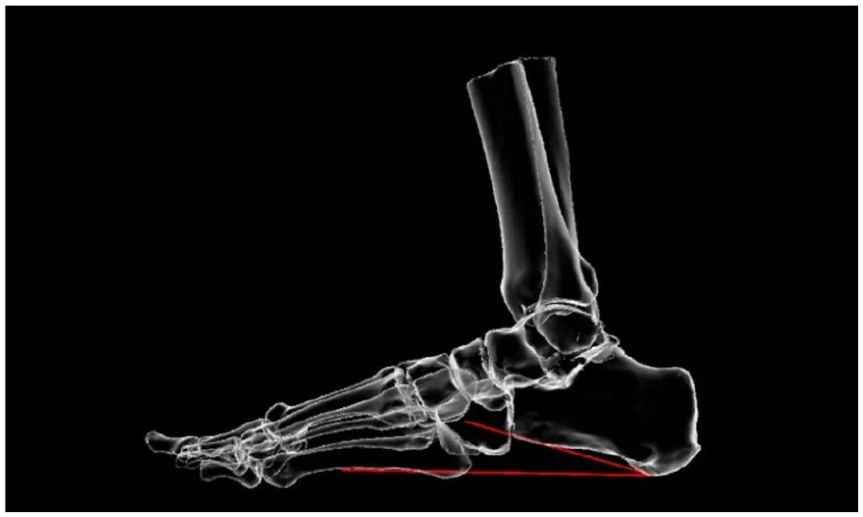
The Zadek osteotomy (ZO) is a surgical option for insertional Achilles tendinopathy. By modifying the position of the posterior calcaneal tuberosity, ZO may reduce posterosuperior calcaneal prominence, mechanical conflict at the Achilles insertion, and tensile stress on the tendon.
A weightbearing computed tomography (WBCT)-based virtual simulation was performed on 60 asymptomatic feet, categorized as cavus (n = 20), neutral (n = 20), or planus (n = 20). Nine ZO configurations were modeled by combining three hinge positions (posterior, A; mid-tuberosity, B; anterior, C) with three wedge inclinations. Pre- and post-simulation measurements were compared for calcaneal inclination angle (CIA), talocalcaneal angles, hindfoot moment arm (HMA), hindfoot alignment angle (HAA), Fowler-Philip (FP) angle, X/Y ratio, and plantar fascia (PF) length.
Wedge inclination showed no significant influence on any variable (P ≈ .99). Hinge position markedly affected sagittal alignment. Hinges B and C significantly reduced CIA (hinge B -0.5° [95% CI -0.66° to -0.4°]; hinge C -2.1° [95% CI -2.26° to -1.96°], both P < .001). Hinge B showed the largest reduction in FP angle (-7.6° [95% CI -8.63° to -6.59°], P = .16) and produced the greatest increase in X/Y ratio (+0.57 [95% CI +0.46 to +0.68], P = .007). In the pre- to post-simulation analysis, HMA increased slightly with hinge B (P = .03), and PF length increased only with hinge C (P < .001). Subgroup analysis revealed that cavus feet exhibited the greatest sagittal correction.
ZO significantly affected the Fowler-Philip angle, the primary radiographic outcome. These changes occurred predominantly in the sagittal plane while sparing coronal and axial alignment.
Source: Gardini G, Carfì C, Grün W, et al. The impact of hinge position and wedge orientation in zadek osteotomy across different foot morphologies: a virtual surgical simulation study. Foot Ankle Orthop. 2026 Aug 27;11(3):24730114261472894. doi: 10.1177/24730114261472894.
Related posts:
Effectiveness of Sandals and PT vs PT Alone on Pain and Function in Plantar Fasciitis

Evaluating FAST Walk System for Neuromodulation-Assisted Gait Recovery in Chronic Stroke
Getting Your Feet Fit: A Conversation With Rich Rhodes and Dr. Doug Childs, Founders of pushpül

Researchers Explore AFOs for Treating Achilles Tendinopathy
CAGA 101: The 12 Dirty Truths of Foot Mechanics