








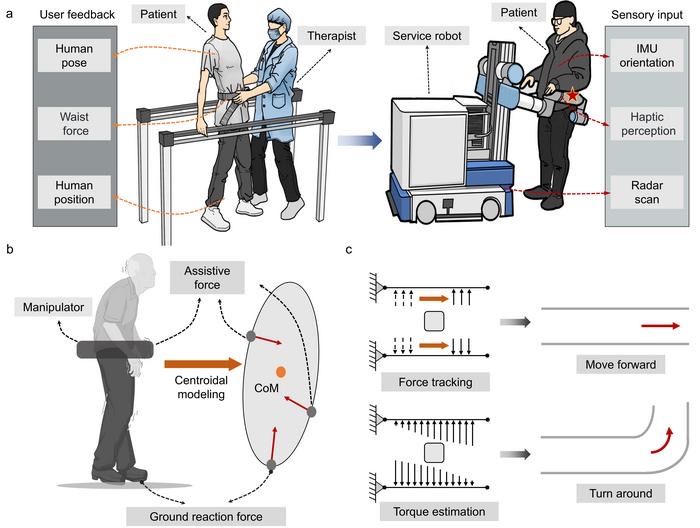
Rather than waiting for an instruction or an emergency event, the robot can remain continuously engaged with the user’s movement through touch. Image courtesy of Science China Press; image provided by Yu Sun et al.
A research team from Zhejiang University, Tencent Robotics X Laboratory, and Shanghai Jiao Tong University has developed a walking-support robot that uses large-area tactile contact at the human torso as its main channel for physical interaction. Large-area tactile interfaces embedded in the robot’s two arms measure not only how much force is applied, but also where the contact occurs and how pressure is distributed. A forward or backward shift of the contact region reflects the user’s movement tendency. An asymmetric distribution between the two sides creates a turning signal. These changing tactile patterns directly modulate the robot’s motion, rather than first being converted into discrete labels such as “move forward” or “turn left.”
In experiments, users walked forward and backward and turned left and right without issuing explicit commands. The spatial distribution of tactile contact changed systematically with each movement, and the robot adjusted its base and arm motion smoothly. During sudden lateral balance disturbances, the robot first repositioned its arms toward a more mechanically effective support region and then increased the supporting force. As the user recovered, the force gradually decreased and the system returned to normal walking assistance without a separate fall-detection trigger.
The researchers also evaluated physiological and subjective responses in six healthy adult participants under three conditions: normal walking without robotic support, handle-based robotic assistance and torso-level tactile assistance. Hamstring surface electromyography showed a significant overall effect of walking condition. Torso-level assistance produced lower muscle activity than handle-based assistance in all six participants, with a statistically significant paired comparison. Five of the six participants also showed lower activity than during normal walking, although this comparison did not reach conventional statistical significance.
The study suggests that tactile sensing can play a deeper role than simply detecting contact. By coupling the robot to the torso over a broad area, touch becomes a bidirectional physical communication channel: the user continuously influences the robot’s motion, while the robot continuously redistributes contact and support in response. The findings provide a path toward assistive robots that act less like command-driven devices and more like physically cooperative partners.
Related posts:
Talocrural Joint Laxity and Range-of-Motion Following an Acute Lateral Ankle Sprain

Electric Bandage Holds Promise for Treating Chronic Wounds

Strategic Protection from Shear Forces

Hanger Institute Publishes 2023/24 Annual Report

Trial to Determine Most Effective Treatment for Hip Fracture in Older Adults