









By Windy Cole, DPM, CWSP, FACCWS, FFPM RCPS (Glasg) and Martha R. Kelso, RN, CWHS, DAPWCA, HBOT
The current landscape of healthcare regulation is no longer a series of predictable updates. It has evolved into a “tornado” of shifting policies, reimbursement challenges, and administrative complexity.

Windy Cole, DPM, CWSP, FACCWS, FFPM RCPS (Glasg)

Martha R. Kelso, RN, CWHS, DAPWCA, HBOT
For mobile wound care practitioners, the outlook for 2026 remains promising, provided they pivot from a volume-based mindset to a meticulous, documentation-driven business model. As veterans of regulatory compliance and mobile clinical operations, we outline the essential realities for surviving and succeeding in the coming year.
1. The Ghost of Regulations Past: The Rescinded LCDs and the AI Watchdog
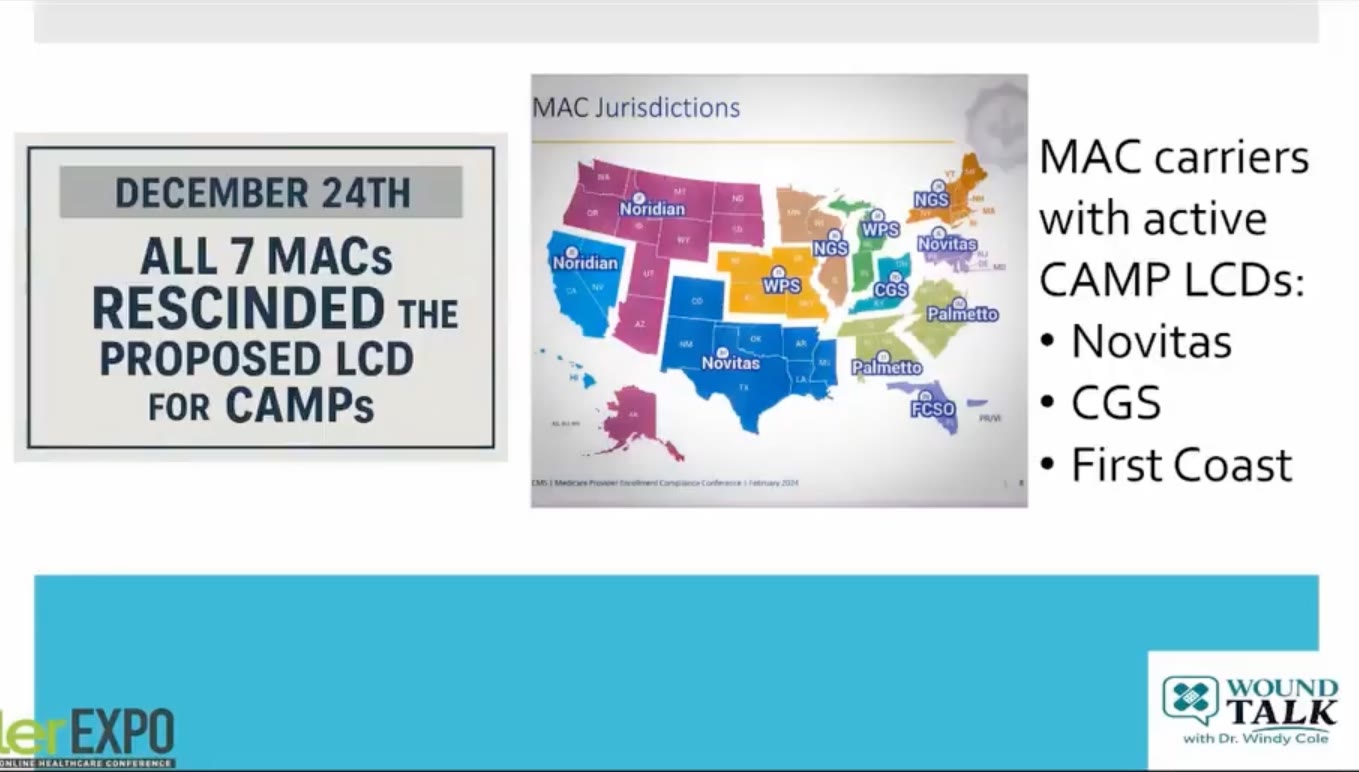
In a surprising reversal on December 24, the seven Medicare Administrative Contractors (MACs) rescinded the highly restrictive proposed Local Coverage Determinations (LCDs) for cellular and acellular matrix-like products (CAMPs). While this provided temporary relief, it also forced the industry to revert to existing coverage policies. For providers practicing in Novitas, CGS, and First Coast jurisdictions, current LCDs remain the primary guide for coverage and documentation. In other regions, such as WPS territories where LCDs have retired, clinicians must rely heavily on demonstrating medical necessity for every application.
The introduction of the WISER model adds another layer of scrutiny through AI-assisted review processes. Interestingly, Site of Care 12 (Home) is currently excluded from the model, despite longstanding concerns about fraud and abuse in home-based services. However, the growing use of federal AI platforms presents another challenge: data security. Clinicians and staff may be required to provide personal information during registration processes, creating potential identity theft and privacy risks that traditional liability policies may not fully address.
“Medicare was breached at least three times last year. It’s not a far stretch to think that our federal government can’t be breached from a HIPAA standpoint. If you are one of those people who had to give out your personal data [to register with WISER], please make sure you are checking your credit report frequently.”
—Martha R. Kelso
2. The “Race to the Bottom”: Navigating the New $127 Reality

The Physician Fee Schedule (PFS) has fundamentally reshaped the economics of CAMP utilization. Regardless of the site of service, Medicare reimbursement has moved toward a standardized payment of approximately $127.14 per square centimeter. This shift creates a “race to the bottom,” where financial incentives increasingly favor lower-cost products rather than outcome-driven product selection.
Additionally, reimbursement variation based on Geographic Practice Cost Index (GPCI) adjustments may create geographic barriers to care. Providers in lower-cost regions may receive substantially less reimbursement than colleagues performing the same service in higher-cost areas, despite facing many of the same operational expenses.
To maintain financial viability, clinicians must account for several automatic reductions in reimbursement:
- 15% Advanced Practice Provider Reduction: Nurse practitioners and physician assistants receive 85% of the physician allowable rate.
- 20% Medicare Cost Share: Medicare pays 80% of the allowable amount, with the remainder collected from the patient or secondary insurance.
- ~2% Sequestration Reduction: An additional reduction applied to Medicare payments.
“The cheaper the graft, the bigger the profit. But it doesn’t necessarily mean that we’re using the quality grafts. We’ve really taken a machete to an issue that only needed a scalpel.”
—Martha R.Kelso
3. From Dead Time to Billable Time: The Mobile Efficiency Hack
In mobile wound care, windshield time remains one of the greatest threats to profitability. To succeed in 2026, many practitioners are transitioning from traditional Evaluation and Management (E/M) models to time-based billing strategies.
When appropriately documented, clinicians may capture qualifying time spent on activities such as clinical phone calls, care coordination, communication with pharmacists, and discussions with facility staff. These services can add meaningful value to patient care while improving operational efficiency.
Importantly, qualifying billable activities must occur on the same date of service as the patient encounter. Administrative planning, chart reviews, or other work completed the night before generally cannot be incorporated into the following day’s visit.
High-efficiency mobile practices are also investing in “trunk-to-bed” technologies, including near-infrared spectroscopy (NIRS) and bacterial fluorescence imaging. These tools provide actionable bedside information and when appropriately documented, may contribute to the overall complexity and time associated with patient management when appropriately documented.
“To me, the most expensive part of your practice is that windshield time.”
—Martha R. Kelso
4. The Death of Wastage and the Wedge Advantage
Medicare’s heightened focus on utilization has effectively ended reimbursement for routine product wastage. Clinicians are expected to closely match graft size to wound dimensions and carefully justify any excess product use. Many providers aim to minimize product beyond the wound margins and thoroughly document any clinically necessary overage.
In addition, grafts are expected to function as wound coverings. Practices such as rolling, tucking, or layering multiple products may not meet coverage requirements unless clearly supported by medical necessity and payer policy.
 To help offset declining CAMP-related revenue, many mobile practitioners are expanding their use of bedside biopsies. While punch biopsies remain common, wedge biopsies often provide larger and more representative tissue samples, which may improve diagnostic yield. Depending on payer policy and geographic location, wedge biopsies may also be reimbursed at higher rates than punch biopsies.
Successful biopsy programs require close communication with pathologists before specimen collection. Understanding preferred tissue handling techniques and storage media is essential, as improper specimen preservation can compromise diagnostic accuracy.

Clinicians must understand and follow applicable Medicare policies, LCDs, and documentation requirements to reduce audit exposure and recoupment risk.
5. Conclusion: The Onus Is on the Clinician
The 2026 regulatory environment represents a shift from administrative oversight to clinician-led accountability. Medical necessity should be viewed not only as a coverage requirement but also as a critical risk-management strategy. Documentation should clearly describe the patient’s condition, the rationale for treatment, and the clinical risks associated with non-treatment, including infection, hospitalization, limb loss, or other serious complications when clinically appropriate.
At the same time, mobile wound care providers have an opportunity to influence future policy. By conducting research, publishing case studies, presenting posters, and generating real-world evidence on advanced therapies delivered in the home setting, clinicians can help shape future coverage decisions and reimbursement policies.
“It’s up to us as clinicians to lead the charge. We don’t want the regulators and the administrators to lead the charge. It should really be us.”
—Windy Cole
Windy Cole, DPM, CWSP, FACCWS, FFPM RCPS (Glasg) is a double board-certified podiatric physician and internationally recognized wound care expert with more than 25 years of clinical experience in limb preservation and advanced wound management. She serves as Adjunct Professor and Director of Wound Care Research at Kent State University College of Podiatric Medicine and is Chief Research Officer for Capsicure Clinical Research Organization.
As the founder of Cole Collaborative Consulting, Dr. Cole partners with biotech and medical device companies to develop evidence-generation strategies, strengthen market access pathways, and deliver high-quality scientific and medical communications.
A leader in the integration of emerging technologies into wound care, Dr. Cole has directed numerous clinical trials and contributes her expertise to advisory boards across the biotech and medical device sectors, providing insight on FDA strategy, clinical trial oversight, medical monitoring, and protocol development with real-world implementation.
A sought-after speaker at national and international symposia, she is dedicated to advancing patient outcomes through evidence-based practice, interdisciplinary collaboration, and innovation in the management of complex, hard-to-heal wounds.
Martha R. Kelso is an internationally recognized wound care expert, healthcare executive, and pioneer in advanced wound care innovation, with more than 30 years of experience shaping clinical practice, reimbursement strategy, and patient-centered care across the continuum. Her work has redefined wound care protocols, influenced billing and compliance frameworks, and advanced a more integrated, outcomes-driven approach to patient care and advocacy. She continues to lead efforts focused on evidence-based practice, improved outcomes for complex patient populations, and integrating emerging technologies into clinical decision-making.
From 2016 through 2026, Martha served as the Founder and Chief Executive Officer of Wound Care Plus, LLC, one of the nation’s largest mobile wound care providers during its operation. Under her leadership, the organization established scalable, nontraditional care delivery models that expanded access to advanced wound care across diverse patient populations. In this role, her work emphasized clinical quality, operational efficiency, and measurable outcome improvement.
Martha is an internationally recognized educator and speaker who has presented at professional conferences, executive forums, and clinical programs anywhere there is a need. Her work focuses on advancements in wound diagnostics and treatment, including platelet-rich plasma, near-infrared spectroscopy, bacterial fluorescence, and other emerging technologies that continue to shape modern wound care practice.
In addition to her executive and educational work, Martha is a published author, clinical editor for peer-reviewed publications, legal nurse consultant, and expert witness in wound-related litigation. She serves on national advisory boards and provides strategic guidance to healthcare organizations and medical technology companies on clinical adoption, reimbursement strategy, and regulatory alignment.
Related posts:
A Case for Hypochlorous Acid Solution as a Replacement for NSS in Wound Hygiene: A Review

Evaluating FAST Walk System for Neuromodulation-Assisted Gait Recovery in Chronic Stroke

Surgery Versus Watchful Waiting for First Metatarsophalangeal Joint Osteoarthritis

Surgical Treatment of Ingrown Toenails Part 1: Recurrence and Relief

Making Diabetic Foot Care Financially Sustainable