








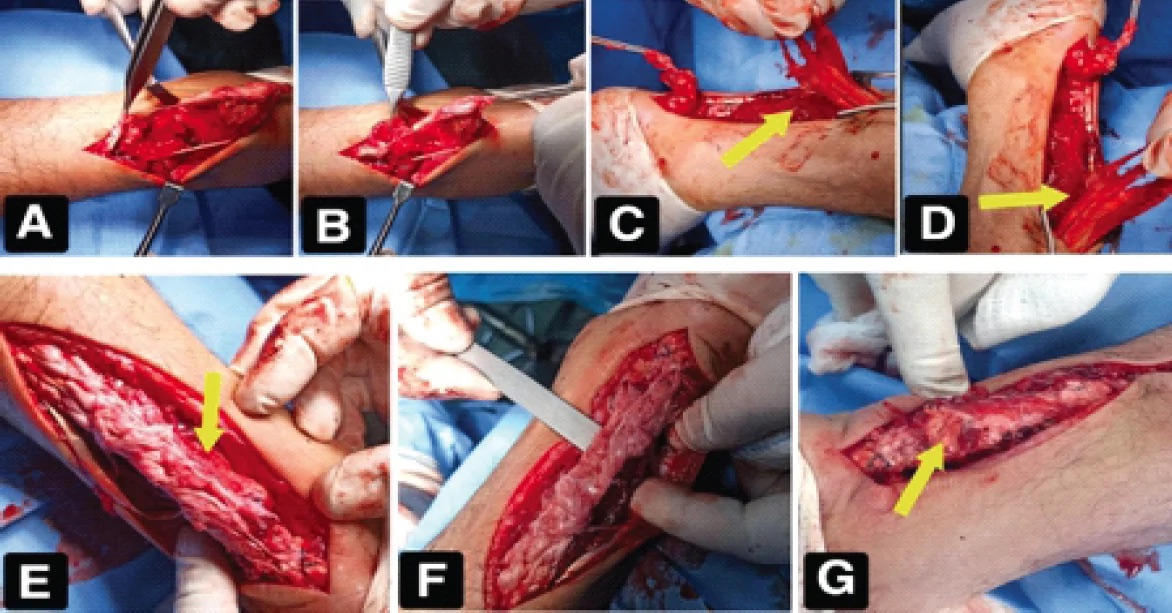
Intraoperative sequence: (a and b) complete rupture with severely frayed “mop-end” tendon ends; (c and d) macerated and poorly defined rupture margins; (e and f) Krackow locking-loop repair with circumferential polypropylene suture reinforcement and overlying preserved viable local soft-tissue sutured over the repaired tendon as a biological onlay augmentation layer; (g) layered wound closure. Yellow arrows indicate the viable local soft tissue (biological onlay augmentation layer): (c and d) the tissue identified in situ between the repaired tendon and the posterior tibial surface before mobilization; (e and g) the repair site following biological augmentation with the preserved viable local soft tissue.
Acute Achilles tendon rupture may present intraoperatively with severely frayed and macerated tendon ends (“mop-end”), which can compromise primary repair strength and increase the risk of gap formation.
Case report: A 43-year-old male sustained a right Achilles tendon rupture during recreational football. Ultrasound confirmed a complete rupture. Open surgical repair was performed 6 days after injury. Intraoperatively, both tendon ends were severely frayed with a classic “mop-end” appearance. Repair was performed using the Krackow locking-loop technique with non-absorbable polypropylene sutures, reinforced with a circumferential running polypropylene suture. A viable interposed local soft tissue, consistent with traumatically avulsed tissue arising from the distal gastrosoleus musculotendinous complex, was identified. Rather than discarding this tissue, the tissue was preserved and sutured directly over the repaired tendon, where it served as a biological onlay augmentation layer—a strategy researchers termed “opportunistic biological augmentation,” defined here as the preservation and utilization of viable local soft-tissue encountered intraoperatively that would conventionally be discarded.
At 3-year follow-up, the patient achieved full return to competitive football with no pain or functional limitation. The Achilles Tendon Total Rupture Score was 100/100. Krackow repair with circumferential suture reinforcement combined with preservation of viable local soft tissue may provide additional biological support for healing in selected cases with poor tendon tissue quality, while avoiding donor-site morbidity and additional tissue harvest.
Source: Albeshlawy AAA. Opportunistic biological augmentation during acute achilles tendon repair: a novel surgical concept with three-year follow-up-a case report. J Orthop Case Rep. 2026 Sep;16(9):367-373. doi: 10.13107/jocr.2026.v16.i09.8096.
Related posts:
Sports- and Recreation-Related Toe Fractures
The Effects of Exergaming in Improving Physical Health and Well-Being
Magnesium Cream with Lavender for Sore Muscles

IS CHANGE ON THE HORIZON? Congress Proposes Reforms to the Stark Law

Clinical Perspective: Posture and Autism: Sitting. Standing, and Toe-Walking Behavior