January 2023

Click on image to download the issue in PDF format
Cover Story
Asking patients for a number to describe their pain provides the most minimal of information. These authors are calling for a comprehensive, cross-platform, multidisciplinary solution. A patient walks into a doctors’ office, shares their concerns, and the doctor asks...
By Jay Segel, DPM; Sally Crawford, MS; and Jason Kraus, BS
Publisher’s Memo
I don’t know about you all, but I think – I think – that just maybe that COVID door is closing and the world is waking up to today’s new reality. Today’s reality may look a lot like pre-COVID, but I can say for sure, we are not going back to that former reality. COVID served as a major disruptor to healthcare, to business, to life in general, and those who...
By Rich Dubin, Publisher
Features
Researchers have developed a decision tree algorithm that they propose can be used to accurately and easily prescribe customized foot orthoses to patients with pes planus. Pes planus, one of the most common foot deformities, includes the loss of the medial arch, misalignment of the...
By Ji-Yong Jung, Chang-Min Yang, Jung-Ja Kim
Physical exercise induces spatially heterogeneous adaptation in bone. However, it remains unclear where the changes in bone mineral density (BMD) and geometry have the greatest impact on femoral neck strength.
By Dermot O’Rourke, Belinda R. Beck, Amy T. Harding, Steven L. Watson, Peter Pivonka, Saulo Martelli
Stingrays are cartilaginous fish related to sharks with round, flattened bodies and whip-like tails. Stingrays are common to shallow intertidal areas of tropical and subtropical oceans around the world, although some rays inhabit cooler waters and freshwater. While there are approximately 150 species of ray worldwide, one to two dozen stingray species are...
By Mathias B. Forrester, BS
One of the most perplexing issues I deal with in biomechanics is trying to take asymmetrical functioning bodies and make them more symmetrical when I think it will help the patient’s symptoms and function. However, asymmetry is part of who we are as people, so some thought has to be put into deciding exactly what needs to be changed because...
By Richard Blake, DPM
ShortTakes From the Literature
Osteochondral lesions of the talus (OLT) are often associated with ankle pain and dysfunction. They can occur after ankle trauma, such as sprains or fractures, but they usually present as a continued ankle pain after the initial injury has resolved. Chronic ankle ligament instability and subsequent microtrauma may lead to insidious development of an OLT. Medial-sided lesions are more common (67%) than lateral-sided lesions.
Candidaemia is the most common fungal bloodstream infection in hospitalized patients. Diabetes is one of the risk factors for mortality from candidaemia. A group of researchers from Queen Elizabeth University Hospital in Glasgow, Scotland, compared the epidemiology, clinical characteristics, and...
For patients undergoing foot and ankle surgery, preoperative oral antibiotics are standard of care. Yet, there is no consensus on the efficacy of this postsurgical protocol. For this study, researchers from the University of Tennessee Health Science Center in Memphis wanted to know whether postoperative oral antibiotics reduce the rate of surgical site infections (SSIs) in patients, with...
Writing in the 50th anniversary edition of the journal Age and Ageing, researchers Avan Sayer and Alfonso Cruz-Jentoft express optimism that a newly formed Global Leadership Initiative on Sarcopenia will develop international consensus on definition and diagnosis.
Using data from the Lifescan server, researchers sought to provide real-world evidence, that their products—the OneTouch Verio Reflect (OTVR) meter which provides ColorSure Dynamic Range Indicator (DCRI) and Blood Sugar Mentor (BSM) features that are complemented by the OneTouch Reveal (OTR) mobile app—support improved blood glucose control.
Researchers from the University of Nottingham have discovered a new class of polymer that can provide instructions to both immune and non-immune cells to aid healing in hard-to-treat diabetic wounds. The findings have been published in Advanced Materials.
Patient Point of View
In 1997, at age 50, I started experiencing strange pains in my feet. It varied from lumps in my shoes to a hot poker stabbing my feet. Sometimes it was so intense that I could hardly stand up. I went from doctor to doctor getting treated for one guess to another. After 5 years, a new doctor said it was peripheral neuropathy and...
By Deborah Ann
Industry News & Updates
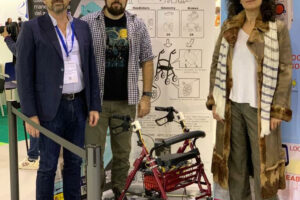
Researchers from the University of Malaga in collaboration with the Polytechnic University of Catalonia, both located in Spain, have created an ‘intelligent’ rollator that evaluates patient movements to improve rehabilitation. With this system based on a standard model called Walk-IT, healthcare professionals receive better information about the progress of patients under treatment, allowing...
Biomaterials, such as mycelium bound composites, present a promising alternative to conventional smart insoles. They exhibit sensing and responsive capabilities without requiring additional space and external inputs to operate, using their own bioelectric activity. Fungal sensors offer increased biodegradability.
Illinois Institute of Technology (Illinois Tech) professor of biomedical engineering Georgia Papavasiliou, PhD, and her team are developing a novel ointment to treat chronically infected diabetic wounds that fail to heal, such as diabetic foot ulcers (DFUs). They have received a second round of funding from the Pilot and Feasibility Program at...
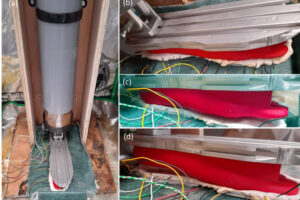
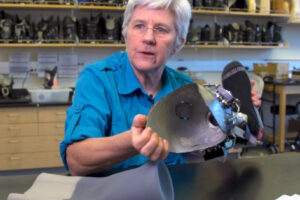
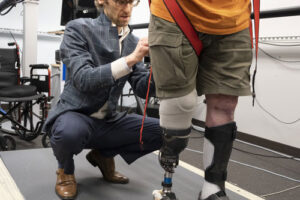
University of Washington (UW) Professor Joan Sanders, PhD, and her team are creating a new type of prosthetic leg: one that automatically adjusts its fit throughout the day. Her group, housed within the Department of Bioengineering, designs, builds and tests prostheses for people with transtibial amputations.
The National Institute of Diabetes and Digestive and Kidney Diseases awarded Rosalind Franklin University (RFU) of Medicine and Science scientists Noah Rosenblatt, PhD, and Ryan Crews, PhD, a 3-year, $848,596 grant to evaluate the impact of removable cast walker (RCW) designs on diabetic foot ulcer (DFU) healing.
The Last Word
We have previously observed substantially higher oxygen uptake in soldiers walking on terrain at night than when performing the same walk in bright daylight. The aims of the present study were to investigate the influence of vision on mechanical efficiency during slow, horizontal, constant-speed walking, and to determine whether any vision influence is modified by load carriage.
Featured Products