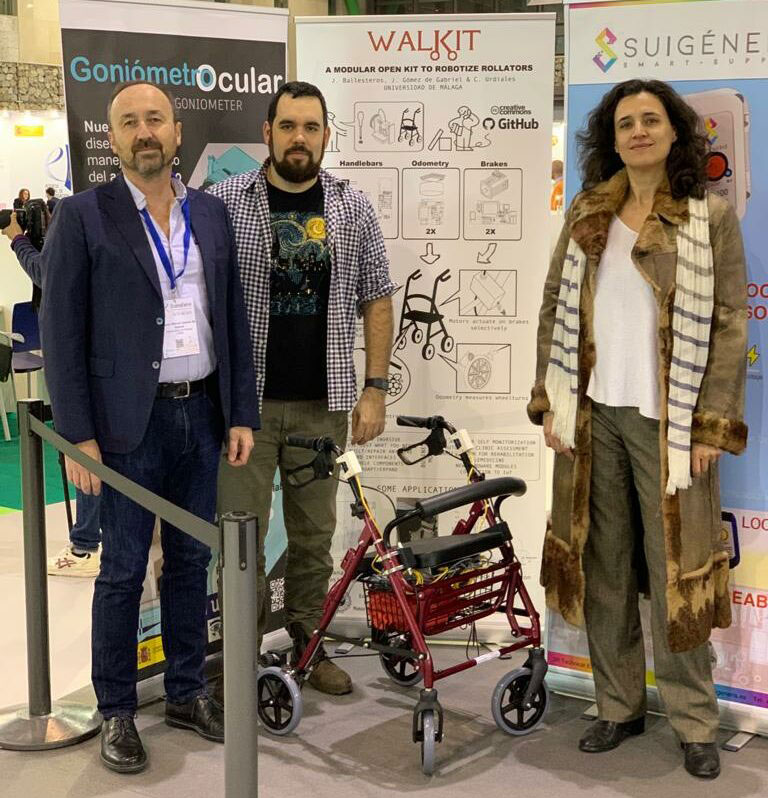
The open-source ‘intelligent’ rollator evaluates patient movements to improve rehabilitation.
Researchers from the University of Malaga in collaboration with the Polytechnic University of Catalonia, both located in Spain, have created an ‘intelligent’ rollator that evaluates patient movements to improve rehabilitation. With this system based on a standard model called Walk-IT, healthcare professionals receive better information about the progress of patients under treatment, allowing them to attend to a greater number of users with more accurate assessments.
The researchers started from a rollator commonly used in rehabilitation clinics and added modules that measure different parameters needed to monitor patients, such as cadence, step velocity or time, and stride length. In addition, the system can directly measure rollator position, speed, and applied forces. In addition to a control system, the researchers attached load gauges to the handles to measure the support exerted on each handle during walking. Encoders are also included on the rear wheels of the rollator to measure user speed and estimate stride length. A laser sensor detects feet movement, gait phases, or whether there are any nearby obstacles.
The experts have confirmed that the data obtained from 11 patients undergoing treatment match and even improve the accuracy of those collected by therapists using the traditional observation method. The only drawback encountered is that visibility of the patient’s legs is required for an adequate observation by the laser, since when wearing long skirts, for example, the data are not captured appropriately.
Both the hardware and the software are licensed open-source, which reduces the cost considerably and allows its widespread implementation. The system is available for consultation and download at github.com/TaISLab/WalKit.