December 2025
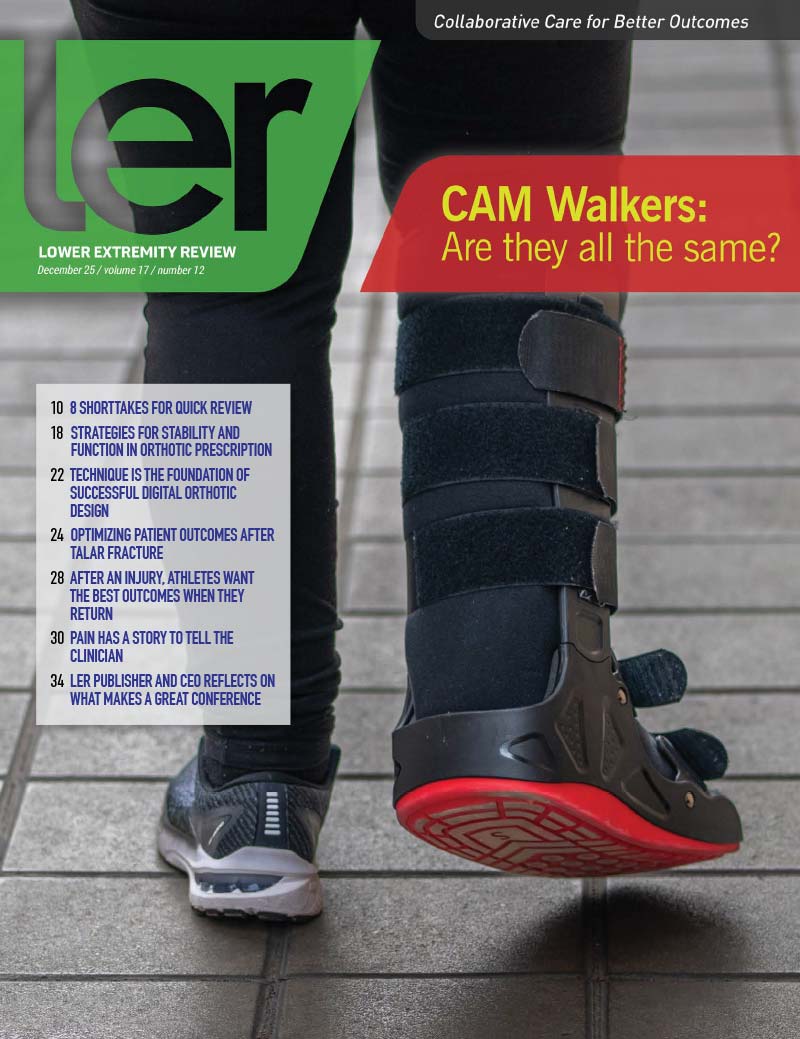
Click on image to download the issue in PDF format
Cover Story
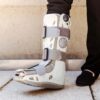
Controlled Ankle Motion walkers (CAMs) are prefabricated ankle-foot interventions commonly used to address a broad range of orthopedic and vascular diagnoses. Variants of these intervention types appear to have differing kinematic features despite being described by the same billing codes and regarded as belonging to the same intervention strategy.
By Michael S. Ginzburg PsyD, CO; Rachel White CPO
Messages from the Publisher and Editor
In the world of medicine, there are few conferences that stand out to me because of the values they embody. VEITHsymposium (Vs) is one of those. It is so much more than just an informative conference. It is a pulse check on where vascular and endovascular medicine is, where it is headed, and what it takes to get there together to change lives.
By Richard Dubin, Lower Extremity Review founder, publisher and CEO
Recently our publisher attended a conference where he was so impressed by the collaboration and the shared vision of the sponsor and all who attended. That’s how I feel about my new position as LER editor. I am so amazed and inspired by the collaboration and warm welcome I’ve received. I could never have done it without all of you.
By January Shoaf, ler Magazine Editor
Features
Orthotic prescription involves a nuanced understanding of various modifications designed to influence lower extremity biomechanics, particularly focusing on the rear foot, midfoot, and forefoot. For lower extremity clinicians, mastering these options allows for tailored patient solutions, enhancing stability, addressing discrepancies, and improving overall function.
By Karen A. Langone DPM
Technique is not merely a procedural afterthought—it is the foundation of successful digital orthotic design. A well-executed scan captures the anatomical subtleties of the foot and lower limb in the intended corrected position, ensuring the final device conforms precisely to the patient’s morphology.
By Dr. Dean Hartley (Podiatrist & Adjunct Engineering Fellow–University of Queensland)
Avascular necrosis (AVN) of the talus presents one of the most complex and challenging problems in foot and ankle surgery, particularly in the aftermath of talar fractures. As podiatric specialists, understanding its nuances–from its unique anatomical predisposition to the evolving landscape of its management–is crucial for optimizing patient outcomes.
By Christy M. King DPM, FACFAS
Returning to a sport after an injury involves healing tissue while restoring strength, stability and confidence. Athletes face the challenge of balancing physical recovery with mental readiness, and their decisions carry significant implications for long-term health and the risk of reinjury. Understanding which criteria best predict successful outcomes helps clinicians support athletes effectively.
By Jack Shaw
ShortTakes From the Literature
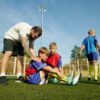
Chronic ankle instability (CAI) is prevalent among soccer players, often resulting from recurrent ankle injuries (RAIs). Despite its impact on performance and long-term joint health, the associated risk factors remain insufficiently explored. This study aimed to identify the key risk factors for CAI among soccer players. A cross-sectional study was conducted among 310 soccer players from...
Regular physical activity is essential for improving cardiovascular health and overall well-being, yet many sedentary women struggle to meet exercise recommendations due to time constraints and low enjoyment. This study compared the effects of reduced-exertion high-intensity training (REHIT) and short moderate-intensity continuous training (SMICT) on...
Diabetic foot ulcers (DFU) are a major complication of diabetes, often leading to impaired mobility and increased risk of recurrence due to persistent biomechanical alterations. Understanding the mechanical properties of foot muscles, tendons, and fascia may provide insight into ulcer development, prevention and rehabilitation strategies.
Nerve injury is the most common complication following foot and ankle surgery, with painful neuroma reported in up to 10% of procedures. Current treatment often yields varying degrees of pain relief. Electrical stimulation (ES) through peripheral neuromodulation is an emerging technology associated with improvement in nerve related pain and acceleration of neural regeneration.
Data from the National Electronic Injury Surveillance System were analyzed for soccer players ≤18 years old sustaining lower extremity injuries from January 2013 to December 2022. Patient data collected included age, sex, mechanism of injury, setting (practice vs game), diagnosis, lower extremity injury, and disposition.
Diabetic peripheral neuropathy (DPN) is a common and serious complication of diabetes mellitus, affecting sensory, motor, and autonomic nerves. It increases the risk of foot ulceration and falls. Management typically involves preventive strategies like patient education, risk stratification, and regular foot screenings.
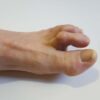
Hammertoes are one of not the most common deformities that afflicts the diabetic foot and leads to increased risk of diabetic foot ulcers. Flexor tendon tenotomy treatment of the diabetic hammertoe has gained increased interest and is now recommended in international guidelines as a treatment of hammertoes to prevent diabetic foot ulcers.
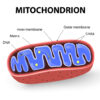
Mitochondrial trifunctional protein deficiency (MTPD) is an inherited disorder of fatty acid β-oxidation caused by mutations in HADHA or HADHB genes. It typically presents with cardiomyopathy or hepatic failure in early childhood; however, it may rarely present in adulthood with the neuromyopathic form.
The Ground Truth: Foot & Ankle Unlocked
The Ground Truth: Foot & Ankle Unlocked is a bold, monthly exploration of foot and ankle anatomy, biomechanics, and clinical pathology–where foundational science meets modern medicine.
The Ground Truth isn’t just clinical, anatomy-driven–it’s education elevated, surgery informed, and innovation inspired. For podiatrists, orthopedic specialists, educators, and students alike, this is where lower extremity excellence begins–one structure, one pathology, one breakthrough at a time.
Pain in the foot and ankle is rarely a riddle. Patients may not know the name of a tendon, ligament, or nerve, but they almost always know where it hurts. They point with 1 finger, not their whole hand. They tell you whether it burns, stabs, aches, feels electric, or stiffens after rest.
By Dr. Hooman Mir, DPM, MSci, FAPWCA
Industry News & Updates
A next-generation lightweight, soft exoskeleton for children with cerebral palsy (CP) was developed to help children walk. The MyoStep addresses motor impairments that severely restrict children’s participation in physical activities, self-care, and academic pursuits. Developed by a team from the National Science Foundation (NSF) University of Houston...
The American Orthotic and Prosthetic Association (AOPA) has announced its 2026 Board of Directors. Elected by members, the board is representative of the membership and serves as the governing body, responsible for the supervision and direction of AOPA’s mission. The executive committee consists of Kimberly Hanson, CPRH, who will serve as...
Researchers led by Benjamin J. Fregly, PhD, a professor of mechanical engineering and bioengineering at Rice University, Houston, Texas, have developed a treatment design software that implements a personalized medicine approach for addressing impaired neuromusculoskeletal function.
Researchers from Michigan State University (MSU), East Lansing, and South Shore Hospital, Weymouth, Massachusetts, have uncovered that the combination of 2 common diabetes drugs—injectable insulin and orally administered metformin—increases the amount of metformin at the wound site.
Researchers from the University of Utah (U of U), Salt Lake City; New York University; and Stanford University, California, have demonstrated the potential of gait retraining to relieve arthritic knee pain without drugs or surgery. The researchers were specifically looking at patients with mild-to-moderate osteoarthritis (OA) in the medial compartment of...
Scientists at Saarland University’s Homburg Campus, Germany, have developed a pioneering robot-assisted procedure for joint replacement surgery. Their approach removes the need for bone pins and external infrared cameras in procedures such as knee replacement surgery. Led by Professor Stefan Landgraeber, director of the...
The Last Word
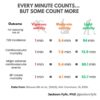
New data using wearables shows 1 type counts up to 9× more. A team led by Emmanuel Stamatakis followed 73,000 UK adults from the UK Biobank study, tracking their movement with wearable devices and linking it to major disease and death outcomes 8 years later on average.
Featured Products