







Image courtesy of the researchers.
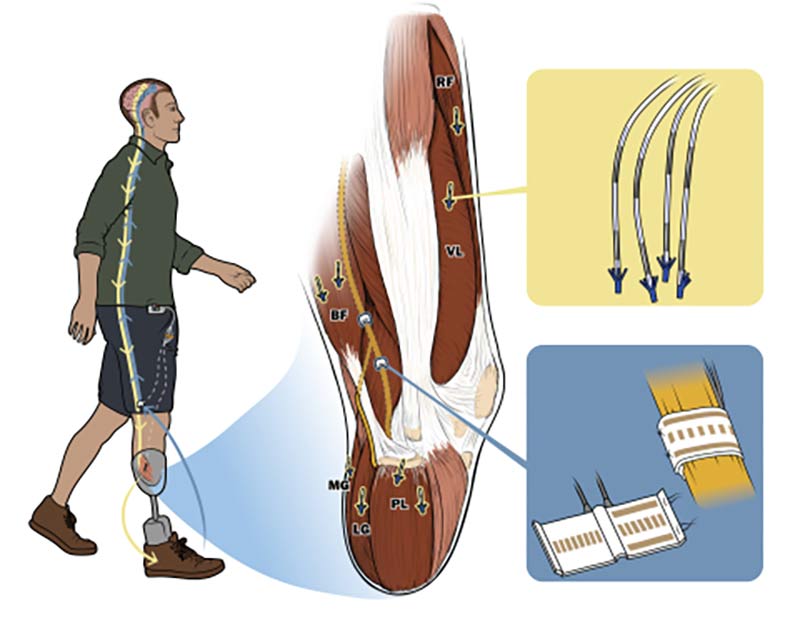
A sensory neuroprosthesis (SNP) developed by researchers at Case Western Reserve University and the Louis Stokes Cleveland Veterans Affairs Medical Center has shown promise in improving balance and reducing fall risk for people with lower limb loss. High-density nerve cuff electrodes are installed around the peripheral nerves in the residual limb. Electrical stimulation through these electrodes elicits sensations that are perceived as originating from the participant’s missing limb.
In 1 area of their work, this technology is incorporated into an SNP. An instrumented prosthesis detects and communicates the pressure profile applied to the prosthetic foot and the electrical stimulation is adjusted to match. With this system, the participant feels sensations corresponding to the foot-floor interactions.
They are also working to restore intuitive control to prosthesis users by interfacing with the remaining muscles in the leg. This is achieved by implanting intramuscular EMG recording electrodes within selected leg and hip muscles.
By interpreting and integrating muscle activity data with a robotic prosthesis, the researchers can create a more intuitive way for users to control their prosthetic limbs. This leads to what they call a ‘bidirectional neuroprosthesis’, combining restored sensation of the foot with natural movement control. Through this reconnection of neural pathways, they can explore improvements in walking, balance, and the ability to handle uneven or challenging terrains. Ultimately, their goal is to enhance overall functionality and quality of life for prosthesis users.
The researchers are also working on quantifying the impact this neural sensory stimulation can have on the health of the residual limb (ie, if it can increase blood flow and oxygen perfusion), which is especially important for those with diabetes, peripheral neuropathy, or other vascular diseases.