








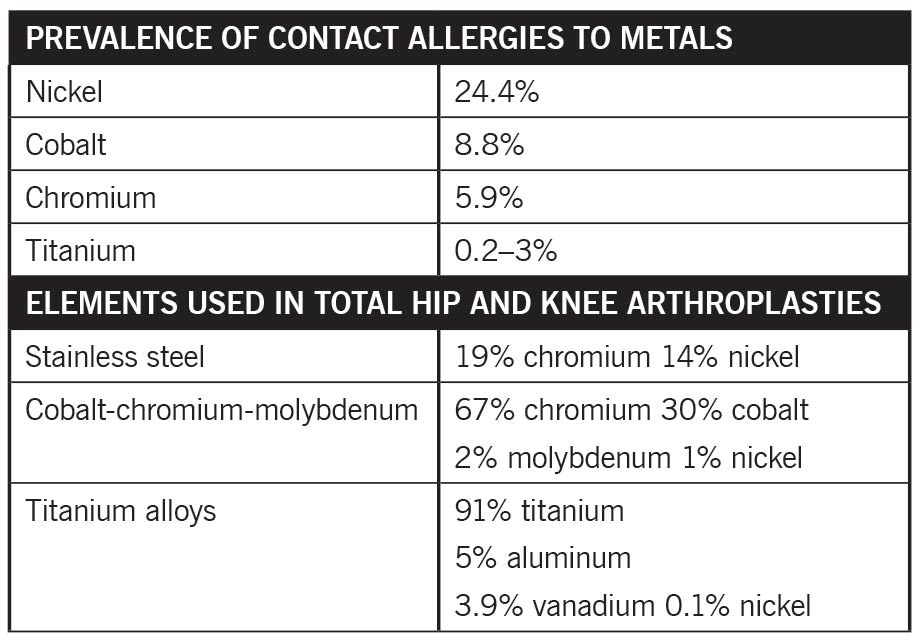
 Metal hypersensitivity (MH) is a controversial topic with limited evidence. It is more commonly observed in failed arthroplasties. The most common metal involved in MH is nickel. Orthopaedic implants contain nickel because of its ability to provide increased strength and durability. MH is a type IV hypersensitive reaction. Women are mostly affected and can present with pain and swelling in the early months after undergoing a joint replacement. Rashes occur in 35% of patients and are more commonly seen with knee replacements. Currently, preoperative screening should be limited to patients with a history of metal sensitivity. A thorough workup should be done post-implantation to rule out the large differential diagnoses for a failed/failing implant. MH is a diagnosis of exclusion. No gold standards exist for testing for MH, but the 2 most commonly used tests are patch testing and lymphocyte transformation tests. Once a diagnosis of MH is made, then treatment should be tailored to nonoperative means mainly, but if the surgeon embarks on surgical treatment, it is crucial to counsel patients appropriately regarding the limited evidence associated with hypoallergenic components to obtain more realistic expectations. Hypoallergenic components should be used in the revision setting ensuring all the metal constituents that demonstrated MH is eliminated. A lot of unknown factors with MH exist, and more research is needed to gain a better understanding of managing this challenging problem.
Source: van der Merwe JM. Metal hypersensitivity in joint arthroplasty. J Am Acad Orthop Surg Glob Res Rev. 2021;5(3):e20.00200. doi: 10.5435/JAAOSGlobal-D-20-00200. Use is per CC BY.