








By Huey-Wen Liang, Rasoul Ameri, Shahab Band, Hsin-Shui Chen, Sung-Yu Ho, Bilal Zaidan, Kai-Chieh Chang, and Arthur Chang
Using computerized posturographic parameters provides a highly quantitative and objective measure without ceiling or floor effect as a classifier or predictor of falls.
 The balance control problem is one of the major contributing factors to falls and may change with aging, medication, or acute illness. Computerized posturography obtained in standing conditions has been applied to classify fall risk for older adults or disease groups. Combining machine learning (ML) approaches is superior to traditional regression analysis for its ability to handle complex data regarding its characteristics of being high-dimensional, non-linear, and highly correlated. The study goal was to use ML algorithms to classify fall risks in community-dwelling older adults with the aid of an explainable artificial intelligence (XAI) approach to increase interpretability.
Methods
A total of 215 participants were included for analysis. The input information included personal metrics and posturographic parameters obtained from a tracker-based posturography of 4 standing postures. Two classification criteria were used: with a previous history of falls and the timed-up-and-go (TUG) test. The study authors used 3 meta-heuristic methods for feature selection to handle the large numbers of parameters and improve efficacy, and the SHapley Additive exPlanations (SHAP) method was used to display the weights of the selected features on the model.
Results
The results showed that posturographic parameters could classify the participants with TUG scores higher or lower than 10 seconds but were less effective in classifying fall risk according to previous fall history (Figure). Feature selections improved the accuracy with the TUG as the classification label, and the Slime Mould Algorithm had the best performance (accuracy: 0.72 to 0.77, area under the curve: 0.80 to 0.90). In contrast, feature selection did not improve the model performance significantly with the previous fall history as a classification label. The SHAP values also helped to display the importance of different features in the model.
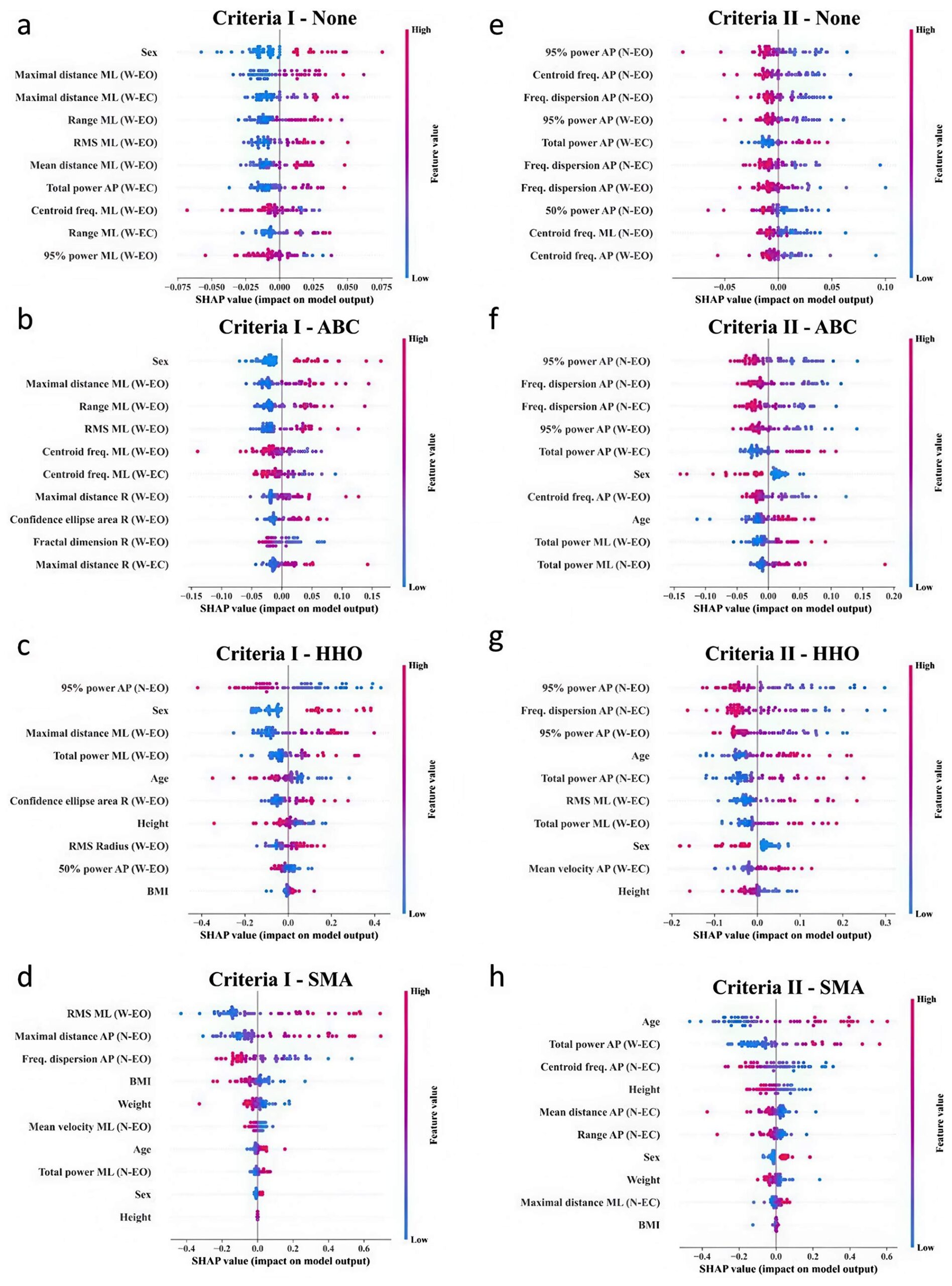
Figure: The SHAP summary visualization of the proposed model. The higher SHAP value of a feature corresponds to the higher prediction and feature importance for the different machine learning models were listed top-down.
Discussion
XAI represents a cutting-edge approach that seeks to establish transparency and trustworthiness in machine learning models. This study contributes to the field by documenting the influence of posturographic parameters derived from various stance conditions and personal metrics on the model’s performance. The main advantage of using SHAP is the transparency to identify which features are driving a model performance and how much each feature is contributing to the model. This study used posturographic data from 4 stance conditions from the combination of stance width and eyes open/closed; the results illustrated the significance of postural control strategies when individuals modify their stance width and rely on visual information cues. This investigation provides valuable insights into the role of these factors in shaping the model’s decision-making process and enhances our understanding of the underlying mechanisms governing postural control in different contexts. Several posturographic and personal metrics demonstrated a high contribution to the fall risk classification, as determined by SHAP’s output based on different feature selection approaches. It seemed that the posturographic parameters obtained during feet apart with eyes open (W-EO) and feet apart with eyes closed (W-EC) conditions attributed more weight to the output with criteria I. The parameters obtained during feet together (E-EC), the most challenging task, had higher attribution to the output with criteria II. It explained that a contribution of increased body sway in these challenging standing tasks, and a declined postural control could be classified effectively. The results highlight the potential utility of these features in classifying fall risk and provide guidance for the development of more robust and accurate fall classification models among community-dwelling older adults.
Conclusion
Posturographic parameters in standing can be used to classify fall risks with high accuracy based on the TUG scores in community-dwelling older adults. Using feature selection improves the model’s performance. The results highlight the potential utility of ML algorithms and XAI to provide guidance for developing more robust and accurate fall classification models. The results highlight the potential utility of these features in classifying fall risk and provide guidance for the development of more robust and accurate fall classification models among community-dwelling older adults.
Huey-Wen Liang is affiliated with the Department of Physical Medicine and Rehabilitation, National Taiwan University Hospital and College of Medicine, Taipei, Taiwan.
Rasoul Ameri, Sung-Yu Ho, and Arthur Change are affiliated with the Department of Information Management, National Yunlin University of Science and Technology, Douliu, Taiwan.
Shahab Band is affiliated with the International Graduate School of Artificial Intelligence and the Future Technology Research Center, both within the National Yunlin University of Science and Technology, Douliu, Taiwan.
Hsin-Shui Chen is affiliated with the Department of Physical Medicine and Rehabilitation, National Taiwan University Hospital Yulin Branch, Douliu, Taiwan.
Bilal Zaidan is affiliated with the International Graduate School of Artificial Intelligence, National Yunlin University of Science and Technology, Douliu, Taiwan, and with the SP Jain School of Global Management, Sydney, Australia.
Kai-Chieh Chang is affiliated with the Department of Neurology, National Taiwan University Hospital Yulin Branch, Douliu, Taiwan.
This article has been excerpted from “Fall risk classification with posturographic parameters in community-dwelling older adults: a machine learning and explainable artificial intelligence approach.” Journal of NeuroEngineering and Rehabilitation (2024) 21:15. https://doi.org/10.1186/s12984-024-01310-3. Editing has occurred, including the renumbering or removal of tables and figures, and references have been removed for brevity. Use is per CC Attribution 4.0 International License.