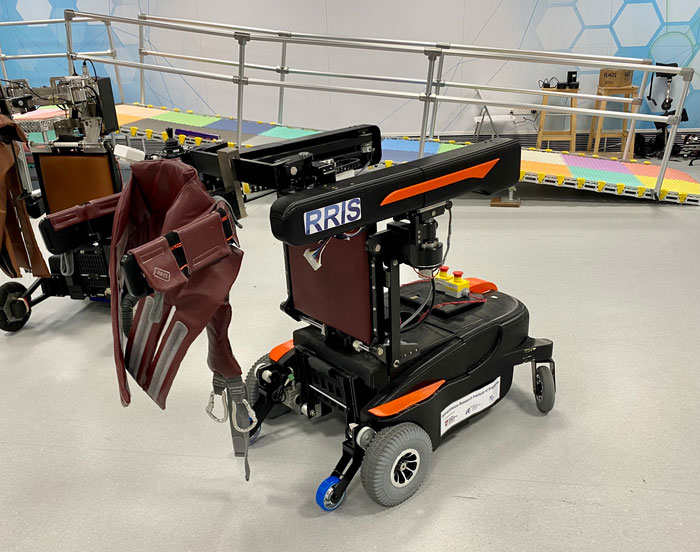
MRBA is a wearable assistive robot that can detect and prevent a fall before it happens, reducing the user’s risk of sustaining injuries. Image courtesy of NTU Singapore.
Researchers at Nanyang Technological University, Singapore (NTU Singapore) and Tan Tock Seng Hospital (TTSH) have developed a wearable assistive robot that can detect and prevent a fall before it happens, reducing the user’s risk of sustaining injuries. The robot can also be used to aid patients’ rehabilitation from their injuries.
Called the Mobile Robotic Balance Assistant or MRBA (pronounced Mister-Bah), the robot uses inbuilt sensors to instantaneously detect a loss of balance and catches the user with its attached safety harness, which is worn around the user’s hips. The device would also help users who have difficulty in walking and balancing to stand up safely from a seated position, and to sit down safely from a standing position. It also uses a depth-sensing camera to observe the user’s movements, while its machine-learning algorithms estimate the balance state of the user in real time to better predict any future imbalances or falls.
Intended for use with minimal caregiver help in both institutional and home settings, MRBA can assist people with limited or reduced mobility in day-to-day tasks, such as entering and exiting elevators, opening doors, getting dressed, and performing simple kitchen chores and tasks such as watering plants.
In clinical trials involving 29 participants, including patients who suffered from stroke, traumatic brain injuries, and spinal cord injuries, the researchers found that MRBA was successful in aiding them with sitting, standing, and walking, as well as assisting in tasks like fetching water. No falls were recorded in the trials, which spanned 3 days per participant.