







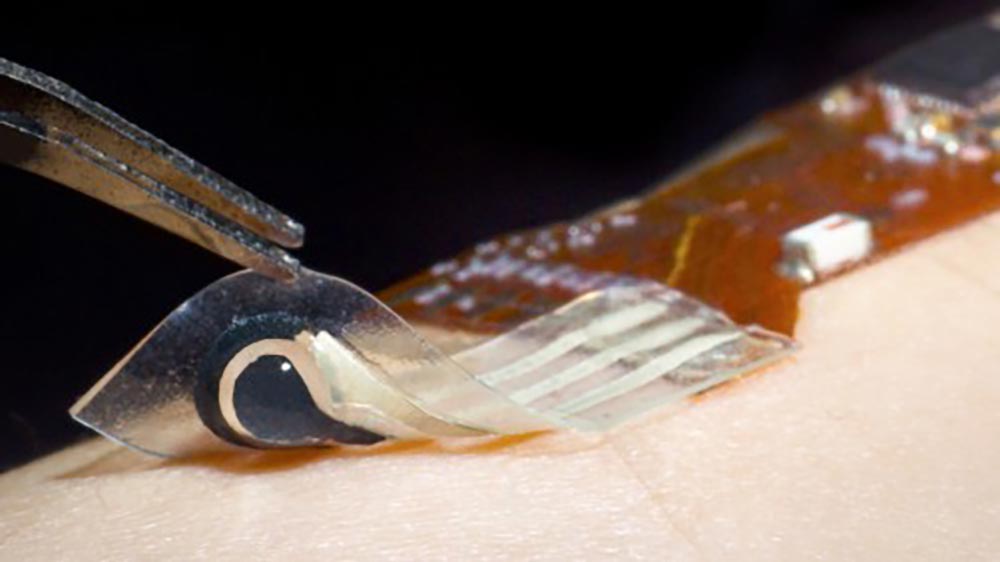
The sensor comprises an ionic electronic bilayer hydrogel that can detect solid state biomarkers from the skin. It is connected to a flexible printed circuit board which transmits data wirelessly to a user interface. Image courtesy of NUS Institute for Health Innovation & Technology.
Researchers from the National University of Singapore (NUS) and the Agency for Science, Technology and Research (A*STAR) have developed a novel sensor, which is produced using a scalable and cost-effective manufacturing process called screen printing. It enables the continuous, real-time detection of solid-state epidermal biomarkers (SEB)—a new category of health indicators. The research team’s innovation offers a noninvasive method to monitor health by detecting biomarkers directly on the skin. These biomarkers, which include cholesterol and lactate, are found in the outermost layer of the skin and have shown strong correlations with diseases such as cardiovascular disease and diabetes. However, detecting these biomarkers directly has been difficult.
The team’s wearable, stretchable, hydrogel-based sensor overcomes the limitations of current methods that rely on biofluid samples, such as blood, urine, and sweat. This makes it a promising alternative for wearable, continuous, and real-time health monitoring, as physiological data is transmitted wirelessly to an external user interface via a flexible printed circuit board, making it valuable for remote patient monitoring. It can also efficiently monitor athletes’ lactate levels, an indication of exhaustion and tissue hypoxia, which affect their performance.
In clinical studies, the sensor demonstrated strong correlations between the biomarkers detected on the skin and those found in blood samples. This validates the sensor’s accuracy and reliability, suggesting it could be an alternative to blood tests for monitoring chronic diseases such as diabetes, hyperlipoproteinemia, and cardiovascular conditions. The sensor’s sensitivity is another advantage, as it can detect solid-state lactate and cholesterol at very low levels. Additionally, the sensor’s design reduces motion artefacts—which occur when the user’s movements affect the placement of the sensor or its contact pressure to the skin—by 3 times compared to conventional counterparts. By minimizing disruptions caused by movement, the bilayer hydrogel ensures consistent and reliable readings, while the stretchable, skin-like nature of the device enhances user comfort.