






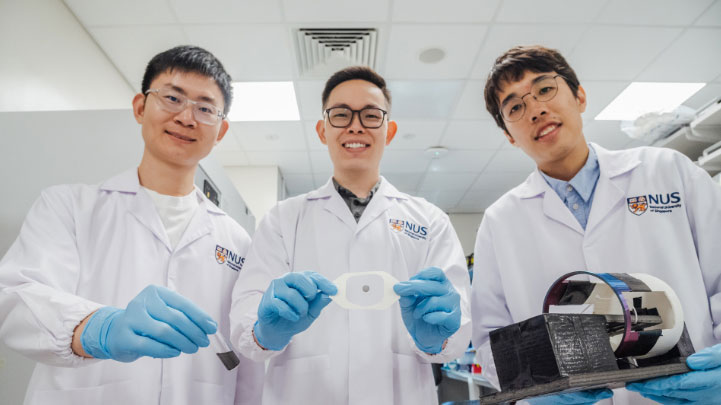
Asst Prof Andy Tay (center) is holding a plaster pre-loaded with magnetic gel, which promises to accelerate the healing of diabetic wounds, while Dr. Shou Yufeng (right) is holding the device for magnetic stimulation. Dr. Le Zhicheng (left) is holding a sample of the magnetic gel in liquid form. Image courtesy of NUS.
A team of researchers from the National University of Singapore (NUS) engineered an innovative magnetic wound-healing gel that promises to accelerate the healing of diabetic wounds, reduce the rates of recurrence, and thus lower the incidents of limb amputations. Each treatment involves the application of a bandage preloaded with a hydrogel containing skin cells for healing and magnetic particles. To maximize therapeutic results, a wireless external magnetic device is used to activate skin cells and accelerate the wound healing process. The ideal duration of magnetic stimulation is about 1 to 2 hours. Lab tests showed the treatment coupled with magnetic stimulation healed diabetic wounds about 3 times faster than current conventional approaches. While the research has focused on healing diabetic foot ulcers, the technology has potential for treating a wide range of complex wounds such as burns.
The unique NUS invention takes a comprehensive all-in-one approach to wound healing, accelerating the process on several fronts. “Our technology addresses multiple critical factors associated with diabetic wounds, simultaneously managing elevated glucose levels in the wound area, activating dormant skin cells near the wound, restoring damaged blood vessels, and repairing the disrupted vascular network within the wound,” said Assistant Professor Andy Tay, who leads the team comprising researchers from the Department of Biomedical Engineering at NUS College of Design and Engineering as well as the NUS Institute for Health Innovation & Technology.
The specially designed wound-healing gel is loaded with 2 types of US Food & Drug Administration–approved skin cells—keratinocytes (essential for skin repair) and fibroblast (for formation of connective tissue)—and tiny magnetic particles. When combined with a dynamic magnetic field generated by an external device, the mechanical stimulation of the gel encourages dermal fibroblasts to become more active. Lab tests showed that the increased fibroblast activity generated by the magnetic wound-healing gel increases the cells’ growth rate by about 240% and more than doubles their production of collagen—a crucial protein for wound healing. It also improves communication with keratinocytes to promote the formation of new blood vessels.
“The approach we are taking not only accelerates wound healing but also promotes overall wound health and reduces the chances of recurrence,” said Tay.