







 The goal of walking 10,000 steps per day is not rooted in science. Rather, it came from a clever Japanese marketing campaign in 1964, for a pedometer called the Manpo-kei: “man” meaning 10,000, “po” meaning steps, and “kei” meaning meter. Despite the origin, this number became a benchmark to achieve while walking for exercise, and it has become a focus of numerous scientific studies. Here we summarize and excerpt a round-up of recent research findings that discuss the correlation of step counts and intensity of those step counts.
Walking for Good Health
Walking doesn’t require any special equipment, except for decent footwear. It is free to engage in and easy to get started. It is also one of the most popular ways for adults to get exercise. The 10,000 steps per day benchmark, however, has been found to be an arbitrary number, with health benefits achieved even at lower thresholds. How low remains a question.
A research team sponsored by the National Cancer Institute, National Institute on Aging, and the Centers for Disease Control used findings from the National Health and Nutrition Examination Survey (NHANES) between 2003-2006 from people age 40 and older who wore an accelerometer for a week.1 They then collected information on deaths for about a decade, specifically tracking deaths from cancer and heart disease. In their analysis, the researchers compared the risk of death over the follow-up period among people who took fewer than 4,000, up to 8,000, or 12,000 or more steps per day. They also tested whether step intensity, measured by cadence, was associated with better health. Compared with people who took 4,000 steps per day, those who took 8,000 steps per day at the start of the study had a 50% lower risk of dying from any cause during follow-up. People who took 12,000 steps per day had a 65% lower risk than those who only took 4,000. Step intensity did not seem to impact the risk of mortality once the total number of steps per day was considered. Only an increased number of steps per day was associated with a reduced risk of death.
Taking 4,000 or fewer steps a day is considered a low level of physical activity. So what happens below that level? A study by Lee et al found that among older women, those who took 4,400 steps per day had a lower risk of dying compared to those who took 2,700 steps per day.2 With more steps per day, mortality rates progressively decreased before leveling at 7,500 steps per day. Thus, a more modest goal of 4,400 steps per day has been shown to produce health benefits. These authors saw no clear association regarding stepping intensity and lower mortality rates.
Another study, presented at the recent 2022 European Society of Cardiology focused on the amount of time spent walking rather than on the number of steps taken. The study population comprised 7,047 Korean adults, age 85 and older.2 The researchers found that those who walked at least 1 hour per week had a 40% lower risk of all-cause mortality and a 39% lower risk of cardiovascular mortality. The takeaway, according to a press release quoting study author Moo-Nyun Jin, MD, is to keep walking throughout life. “Put simply, walk for 10 minutes every day.”3
 Walk Faster for Better Health

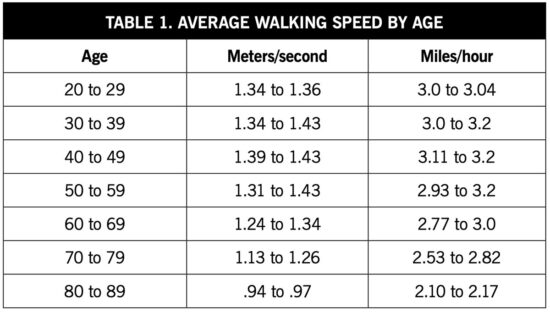
Walking, undeniably, produces marked health benefits. The 10,000-step-per-day benchmark that has often been cited has taken hold, in part, because step counts are an easy goal to understand. But is number of steps the only factor? In recent years, researchers have been taking a deeper look into the association between daily step count and walking intensity. Studies have reported that low walking speed, especially in older adults, is strongly associated with an increased risk of cardiovascular disease (CVD) mortality, all-cause mortality, as well as mortality in cancer survivors. Indeed, walking speed is known to decrease with age, slowing by about 1.2 minutes per kilometer at age 60, compared to age 20 (Table 1).4
And that slow down matters. Williams and Thompson5 found that mortality risk decreases in association with walking intensity and increases substantially in association for walking pace ≥24-minute mile (equivalent to <400m during a 6-minute walk test) even among subjects who exercise regularly.
Aging and Telomere Length: Dempsey et al6 conducted analyses in 405,981 UK Biobank participants for their study, in which they examined the associations of self-reported walking pace with telomere length. Telomeres, the protective caps on the ends of chromosomes, protecting our DNA, are linked to aging and disease. They shorten as we age and due to poor lifestyle choices, such as smoking, alcohol consumption, and eating red or processed meats.
About half of the cohort reported an average/steady walking pace, 6.6% reported a slow walking pace, and 41.1% reported a brisk pace.6 Those who reported being average/steady and brisk walkers were slightly younger, were more likely to have never smoked, and were less likely to be taking cholesterol/blood pressure medications, have a chronic disease, or have mobility limitations, compared to slow walkers. And the slow walkers engaged in less physical activity overall, had a poorer quality of life, and a higher prevalence of obesity compared to average and brisk walkers.6
In support of the importance of walking pace, the researchers showed that more time habitually spent in higher intensity activities such as brisk walking had a stronger association with leucocyte telomere length (LTL) than total activity and overall health. Importantly, a causal link between walking pace and LTL was shown, rather than the other way around.6
Taking this a step further, what is the correlation between a faster gait speed and logging 10,000 steps per day?
Walking Faster and Longer for Better Health

Figure 1. A telomere is a region of repetitive DNA sequences at the end of a chromosome. Telomeres protect the ends of chromosomes from becoming frayed or tangled. Each time a cell divides, the telomeres become slightly shorter. Eventually, they become so short that the cell can no longer divide successfully, and the cell dies. Image courtesy of the National Human Genome Research Institute.
Writing in the journals JAMA Internal Medicine and Jama Neurology, del Pozo Cruz7,8 et al highlight that every 2,000 steps—up to about 10,000 steps per day—lowered mortality due to premature death, CVD, and cancer, and was associated with a lower risk of all-cause dementia. And stepping intensity showed beneficial associations for premature death, CVD, cancer, and dementia over and above total daily steps. Their prospective cohort companion studies, the largest to date to objectively track step count in relation to health outcomes, used UK Biobank data for 78,500 adults (age 40 to 79) with wearable trackers with a median follow-up of 7 years for the first and 78,430 adults (age 40 to 79) with wearable trackers, with 6.9 years of follow-up. Primary exposures were daily step counts, incidental steps (<40 steps/min), purposeful steps(≥40 steps/min), and step intensity, or peak-30 cadence (average steps/min for the 30 highest, but not necessarily consecutive, min/d). Secondary exposures were steps performed at light, moderate, vigorous, and moderate-to-vigorous intensity and walking steps.7
All Cause, Cancer, and CVD Mortality: Higher number of daily steps was associated with a lower risk of all-cause, cancer, and CVD mortality for each 2,000 steps increment. A higher number of incidental steps was associated with a lower risk of all-cause, cancer, and CVD mortality for each +10% incidental steps increment. A higher number of purposeful steps was associated with a lower risk of mortality for all-cause, cancer, and CVD mortality with +10% increase in purposeful steps increment. Consistent associations of a stronger magnitude were found for peak-30 cadences, beyond the benefits of total daily steps for all-cause, cancer, and CVD mortality. For the secondary exposures, the associations were similar except for the analyses of vigorous intensity stepping and cancer and CVD mortality.7
Cancer and CVD Incidence: Increasing numbers of daily steps for each 2,000 steps increments, purposeful steps (+10%), and peak-30 cadence were associated with lower CVD incidence. Similar patterns were observed for cancer incidence. Higher number of walking steps and light intensity steps were associated with a lower risk of cancer and CVD incidence. The researchers also found additional associations between moderate and moderate-to-vigorous intensity steps and risk of incident cancer.7
Dementia: Over the 6.9 median years of follow-up, 866 of the 78,430 participants developed dementia. Younger, healthier female participants took more steps in the sample. The optimal dose for daily steps was 9,826 steps and the minimal dose was 3,826. For incidental steps, the optimal dose was 3,677 steps. For purposeful steps, the optimal dose was 6,315 steps. For peak 30-minute cadence, the optimal dose was 112 steps per minute. Removing participants diagnosed with dementia within the first 2 years of follow-up or further adjustment for relevant biomarkers did not change the results.8
In their conclusion, del Pozo Cruz et al pointed out that even taking as few as 3,800 steps per day can cut the risk of dementia by 25%. Thus, less active adults are not precluded from receiving health benefits so long as step intensity is a main focus. The takeaway, they said, is that stepping intensity showed beneficial associations for all outcomes over and above daily steps.
[Editor’s Note: All of the articles excerpted here are available open access and readers are encouraged to use the doi numbers in the reference list to find and read them fully.]
- Saint-Maurice PF, Troiano RP, Bassett DR Jr, et al. Association of Daily Step Count and Step Intensity With Mortality Among US Adults. JAMA. 2020 Mar 24;323(12):1151-1160. doi: 10.1001/jama.2020.1382. Use is per CC BY.
- Lee IM, Shiroma EJ, Kamada M, Bassett DR, Matthews CE, Buring JE. Association of Step Volume and Intensity With All-Cause Mortality in Older Women. JAMA Intern Med. 2019 Aug 1;179(8):1105-1112. doi: 10.1001/jamainternmed.2019.0899. PMID: 31141585; PMCID: PMC6547157. Use is per CC BY.
- Jin MN. Association of usual walking with mortality in oldest old adults aged 85 years and older: a nationwide senior cohort study. Abstract presented Aug. 28, 2022, at the European Society of Caridology Congress 2022 held in Barcelona, Spain.
- “What Is the Average Walking Speed of an Adult?” Healthline Media Fitness. Reviewed March 2019. Available at https://www.healthline.com/health/exercise-fitness/average-walking-speed Accessed Sept. 1, 2022.
- Williams PT, Thompson PD. The relationship of walking intensity to total and cause-specific mortality. Results from the National Walkers’ Health Study. PLoS One. 2013 Nov 19;8(11):e81098. doi: 10.1371/journal.pone.0081098. PMID: 24260542; PMCID: PMC3834211. Use is per Creative Commons Public Domain declaration.
- Dempsey, PC, Musicha, C, Rowlands, AV, et al. Investigation of a UK biobank cohort reveals causal associations of self-reported walking pace with telomere length. Commun Biol 5, 381 (2022). https://doi.org/10.1038/s42003-022-03323-x. Use is per CC BY.
- del Pozo Cruz B, Ahmadi MN, Lee I, Stamatakis E. Prospective Associations of Daily Step Counts and Intensity With Cancer and Cardiovascular Disease Incidence and Mortality and All-Cause Mortality. JAMA Intern Med. Published online September 12, 2022. doi:10.1001/jamainternmed.2022.4000. Use is per CC BY.
- del Pozo Cruz B, Ahmadi M, Naismith SL, Stamatakis E. Association of Daily Step Count and Intensity With Incident Dementia in 78 430 Adults Living in the UK. JAMA Neurol. 2022;79(10):1059–1063. doi:10.1001/jamaneurol.2022.2672. Use is per CC BY.