







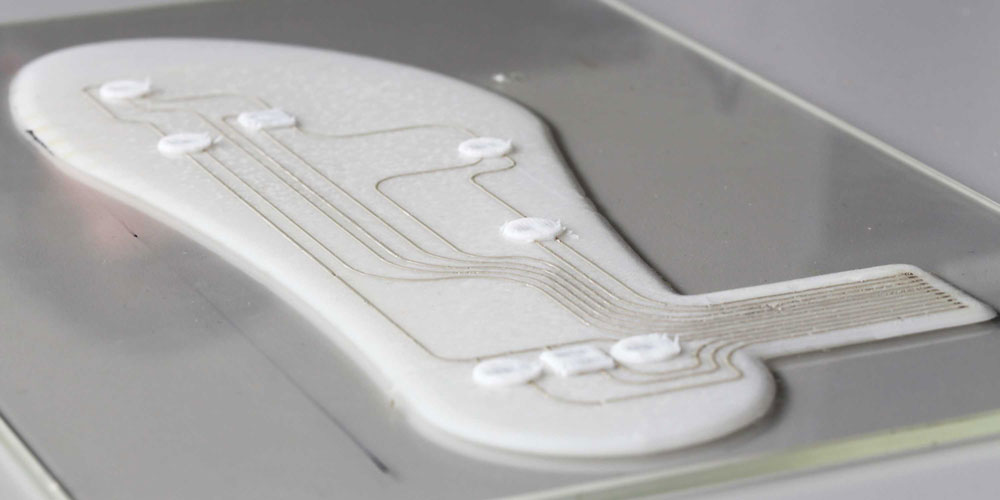
The insoles, together with the integrated sensors and conductive tracks, are produced in just 1 step on a 3D printer. Image courtesy of Marco Binelli / ETH Zurich.
To optimize their performance, athletes may use custom-made insoles. People with musculoskeletal pain also turn to insoles to combat their discomfort. However, before specialists can accurately fit such insoles, they must first create a pressure profile of the feet. To this end, athletes or patients have to walk barefoot over pressure-sensitive mats, where they leave their individual footprints. Based on this pressure profile, foot care professionals then create customized insoles by hand. However, with this approach, optimizations and adjustments take time. Another disadvantage is that the pressure-sensitive mats allow measurements only in a confined space, but not during workouts or outdoor activities.
Now an invention by a research team from ETH Zurich, Empa (Swiss Federal Laboratories for Materials Science and Technology), and École Polytechnique Fédérale de Lausanne could greatly improve things. The researchers used 3D printing to produce a customized insole with integrated pressure sensors that can measure the pressure on the sole of the foot directly in the shoe during various activities. In addition to being easy to use, the insoles are also easy to make.
Tests showed that the additively manufactured insole works well. With data analysis of the pressure patterns detected, the researchers can determine whether someone is walking, running, climbing stairs, or even carrying a heavy load on their back.
At the moment, a cable connection is required to read out the data. However, 1 of the next development steps will be to create a wireless connection.