







 By Simon Bartold
In this presentation, we will look at some of the great paradigms of injury prevention that have underpinned the running shoe industry for more than 40 years: motion control and cushioning. Do these paradigms stand up to scientific scrutiny, and if not, where else should we be looking?
Vibration is considered one of the key input signals in running, and yet it is one of the least investigated in the scientific literature. [In Part II, which will appear next month] we will examine the nature and effect of vibration on human systems during running and pose a possible alternative explanation for running-related injury and performance.
We’ve known for some time that motion control and cushioning are not mechanisms of injury prevention, but we didn’t really focus elsewhere as the [running shoe] industry kept moving in that direction. Then, along comes the Nike React Infinity Run–it turns our whole philosophy on its head and looks at how we might build running shoes with a focus on injury in a completely different way.
That’s something I would applaud, however, I would have to say that when I first saw this data, I was pretty cynical about it all, as most people were. But the more I dive into it, the more I come to believe that this data was accurate and that Nike was actually on to something in terms of injury prevention.
The whole point of these few slides is that I think that the whole concept of a traditionally structured shoe needs to be completely rethought and maybe the Nike React Infinity Run is the first step in this journey toward rethinking the way we build athletic footwear. I do applaud Nike for doing this.
What We Have So Far
So, what have we got so far? Well, in terms of injury prevention for runners, we’ve basically got a house built on sand.
 Confused Marketplace: We’ve got a very confused marketplace. Everybody is confused: retailers are confused, the consumers are confused, sports medicine is confused. It really isn’t a great position to be in.
Repetitive Marketplace: The market has been pretty repetitive in terms of the product that’s been presented. We have had a big shake up with the so-called super shoes. These have certainly brought a spark of interest to the marketplace, but generally there’s been a real lack of innovation for decades and I would say that we were in a real innovation vacuum right up until the Nike Vaporfly 4% hit the market back in 2016. There’s been a bit of a flurry since then.
Category Segmentation: Category segmentation is meaningless. This habit of trying to segment footwear into certain categories such as cushioning category, motion control/stability category—these sorts of things are really quite meaningless and I’ll show you why later.
Reliance on Old Paradigms: Perhaps most importantly, our reliance on very old paradigms, in particular pronation control and cushioning. These 2 paradigms have shaped athletic footwear design for the past almost 50 years. They are really old and yet we cling tenaciously to these and say this is what we must have in athletic footwear. My job is to question this and put forward some information that might open our minds a bit to some other possibilities…
Maybe we need to rethink our foundation for running. Other sports, in particular cycling, are taking a more scientific approach to how they set the athlete up with their equipment [think custom bike fit], remembering that footwear is just equipment for the athlete.
What Are We Missing?
First, we do know that runners get injured: at least 60% of runners—depending on what literature you read—will get injured. We think that at any one point in time about 25% of all runners are injured, but in the history of a runner, about 60% will get injured during the course of their running careers.
It’s very high-load, very high-repetition activity. And the problem is that there are runners going on the same terrain, the same surface, in the same footwear.
 So, when people ask me why do runners get injured, I say, the answer is simple: Runners get up in the morning, they put on their running shorts, they put on their running shoes, they walk out the front door, and they turn right—they always turn right. They never turn left, they turn right, and they run in exactly the same way for every single run.
That’s typical of runners. That’s what they do. They don’t mix up the terrain, they don’t mix up the surface, and they don’t mix up their footwear. That induces a cumulative repetitive load and the human body does not like repetitive load, so that’s one of the big issues.
What We Need to Change
We certainly need to change this course that says motion control is something we should hang our hat on. We need to understand that foot pronation is fundamental to normal human gait—and that we don’t know how much is too little or too much. In other words, we just don’t know where the line in the sand is here for pronation, so to be controlling it or be focusing on it just doesn’t make any sense. That’s because people operate within an envelope of function: Some people deal with a lot of pronation and never get injured. Some people deal with a little bit of pronation and get injured all the time. We simply don’t understand it well enough to start thinking about controlling it.
You can’t control motion any way. You can influence it, you can’t control it. And yet, we’ve got these strategies in place that are based on 40-year-old paradigms. And we find them very, very hard to give up. You can still go into a running shoe shop and see the store has categorized their shoes into motion control or stability. And we still have people, like you and I, who are talking about having to control pronation with an orthotic device and none of this is very well supported in the scientific literature. In fact, most of these paradigms have been largely debunked,v so we need to stop talking about them.

 I put together this infographic [above] a while ago with a motion control shoe in the middle. If you read through, there are a couple of really interesting things in here. The bottom center one from Benno Nigg reads: In relation to “motion control” changes can occur in both directions (increase or decrease), for this reason each runner should be analyzed independently.
The one on the bottom right from Oriwol in 2011 is also interesting:
The concept of dual density as a medial support has barely been considered in footwear biomechanics research and lacks scientific proof of functionality. Yet, dual density midsoles remain the mainstay of motion control in athletic footwear today.
These numerous findings show why maybe we should be moving on from those old paradigms.
Footwear Design
When you’re talking about footwear design, it has to be underpinned by the science of the day—it’s now September 2022. It’s got to be evidence-based, and it must not be based on 40-year-old paradigms. I’ve been making this plea since 1999 that we need to move on because those old paradigms are not supported by the science and we’ve got better options.
Let’s look at what the science tells us about the cushioning example (Figure A). The impact paradigm says that you have to reduce impact forces to prevent impact-related injuries. When you hit the ground, it hits you back. When you run, we know that you are enduring anywhere up to 11 body weights of load going through your system. So, this impact paradigm makes sense.
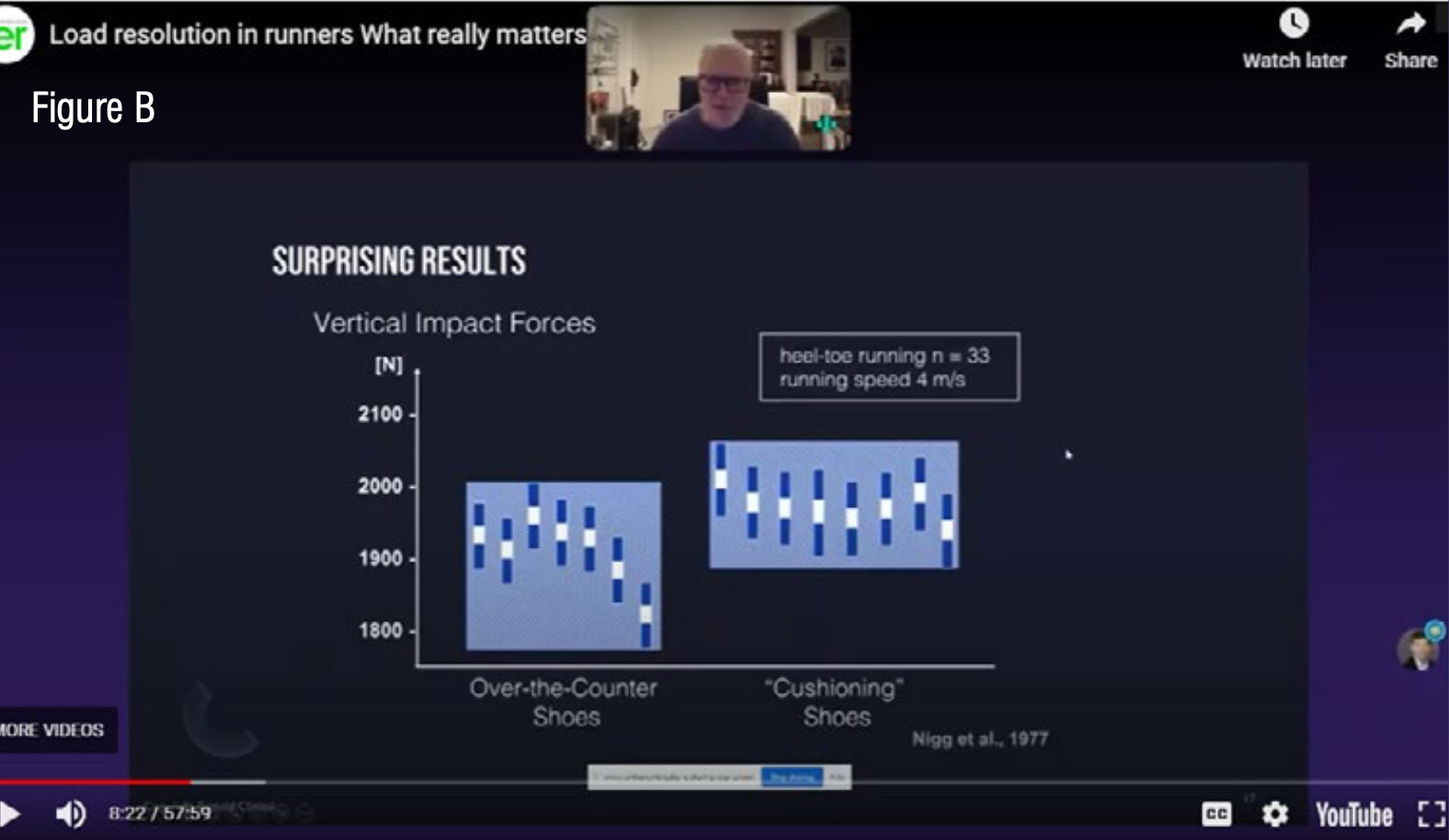 Figure A is a very typical force versus time curve for a running athlete. We’ve got the first peak, FZ1, here [white arrow]. FZ2 [red arrow] over here. FZ1 is sometimes called the passive peak, and FZ2 is the Active peak. This paradigm is saying we need to try to flatten off this first impact peak [FZ1] to reduce it, and we need to try to influence the steepness of this part of the curve [green arrow], which is called the loading rate. This is what we’ve been attempting to be doing this all this time.
Research from Baltich, which is almost 10 years old, says “softer midsole shoes in fact increase the vertical impact peak, contrary to the belief that midsole cushioning can attenuate impact forces.” Let’s repeat that, “softer midsole shoes increase the vertical impact forces” – this is completely counter intuitive. How on Earth can that possibly be?
This work from Benno Nigg (Figure B) looks at the vertical impact forces in Newtons. On the left, we’ve got an over-the-counter shoe and on the right, a cushioning shoe. The over-the-counter shoe used here was the sort of shoe that you might wear to work, like a dress shoe, and the other is a sport shoe. What we saw is that when you went from an over-the-counter shoe to a cushion shoe, the vertical impact forces sure enough increased. This is a cohort of 33 runners running at 4 meters per second. Now, the really extraordinary thing about this study is this was done back in 1977…45 years ago.
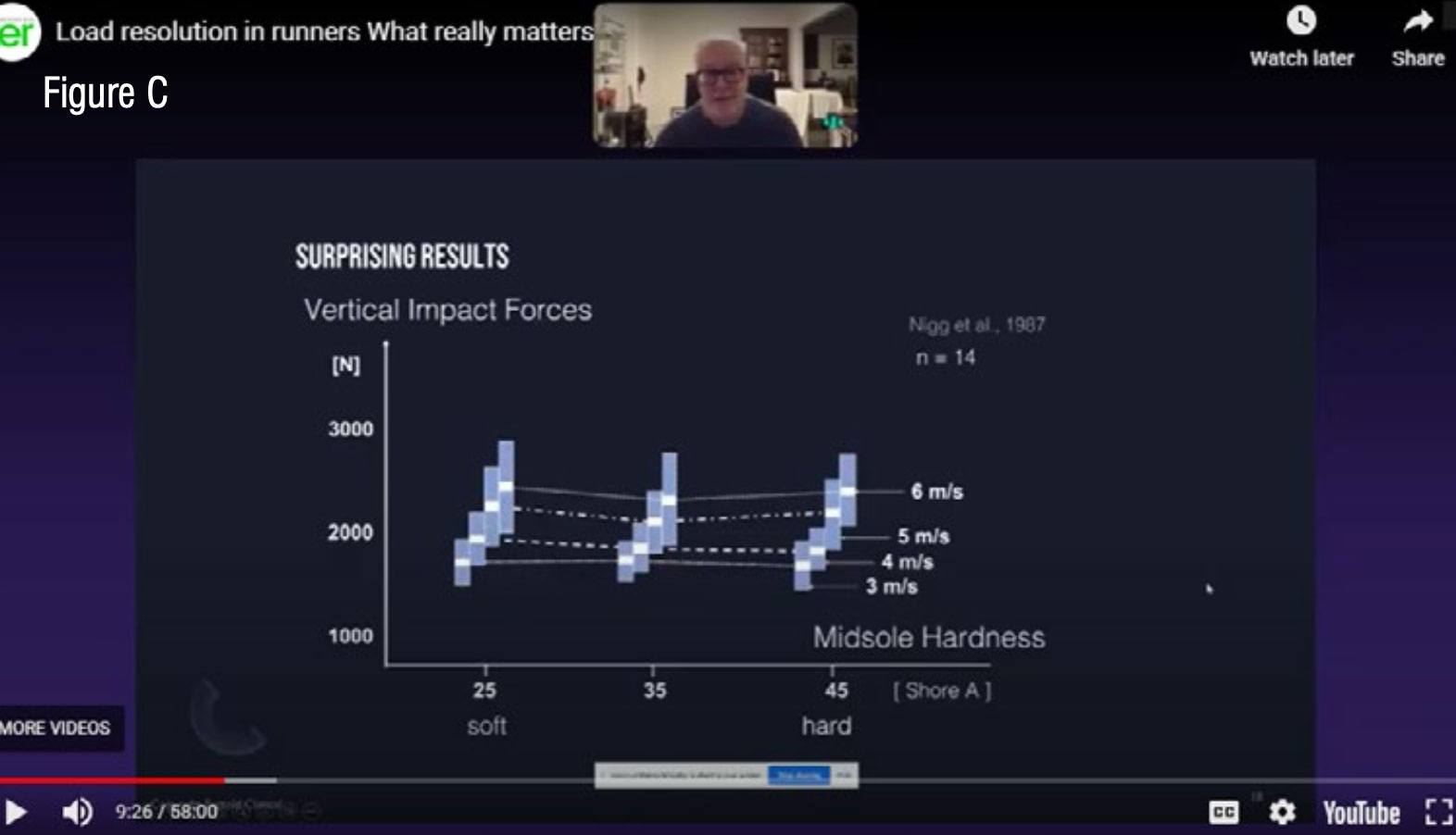
No one took any notice. The industry didn’t take any notice of this at all. So, he sat at his desk for 10 years, and then did exactly the same study in a different way using a smaller sample size. This time, he looked at midsole hardness from very soft at 25 Shore A to quite hard at 45 Shore A. He saw a systematic decrease in the vertical impact forces as the midsole got harder. Very surprising results, very counter intuitive. What was this all about?
Well, what Figure C tells us is that the brain is interpreting the collision between the ground, the shoe, and the support surface. And there must be some sort of active adaptation of the human musculoskeletal system happening as a result of this interpretation. In other words, the lower limb kinematics were changing in response to different shoe hardness: basically, the brain tells the body to modulate the lower limb stiffness. In other words, if you step from a hard surface onto a softer surface, the brain recognizes that and it says you’ve got to model your lower limb as a stiffer spring, so you get less knee flexion and less subtalar joint pronation. And the converse is true: If you go from a soft surface to a hard surface, the brain recognizes that you need a bit more compliance in the spring so you get more knee flexion and more subtalar joint pronation and that means that the peak impact force will reduce.
 If this is what’s really happening, it’s thrown a cat amongst the pigeons for the whole concept of what the importance of cushioning is. Cushioning is of course very important, especially for comfort, but is it important to reduce peak impact forces? Probably not. So, we’ve turned our attention away from midsole testing towards the investigation of what sort of kinematic adaptation could be occurring and why.
What Needs to Change?
We need to change the concept that cushioning reduces injury, because it probably doesn’t. It’s not been proved injury is reduced simply by the human response to the input signal. Rather, injury is reduced by what the brain tells you to do.
Step-in comfort seems to be very, very important. However, the key combination for injury prevention is geometry of the shoe and the characteristics of cushioning.
And finally, on this topic of cushioning, we assume that impact is bad, but it isn’t bad, not at all. We’ve got to understand the biomechanics. We’ve got to be able to understand that at the moment we can’t quantify the relationship between injury in running and impact forces, something we can demonstrate quite easily: if we looked at sprinters, for example, sprinters are going much faster, they’ve got a double float phase so they’re coming down from higher, and they’ve got a much higher impact than recreational joggers. If impact were important, sprinters should be injured all the time.
But they simply aren’t, and we know this from the research from Wright and Nigg from quite a while ago: I think we could put it to bed and say that the exclusive causality between pronation and running injuries or cushioning and running injuries has been shown in neither cross-sectional nor longitudinal study designs with sufficient sample sizes.

Now we’re looking at shoes like this: Salomon Predict on the bottom and Brooks Aurora on top.
As a result, we probably should start to think about other ways and stop talking about these 2 old paradigms: I guess we can say that we’ve buried overpronation/motion control and we’ve burned cushioning at the stake.
What else might be involved? In relation to the link between injury and load… the answer has got to lie elsewhere.
So if it’s not motion control, or cushioning, then what might it be?
- We need to understand that midsole geometry is the key.
- Technical foams are here to stay.
- A very lightweight shoe is important.
- We’ve moved away from rigid footwear as a control strategy to increase flexibility and
- We’ve moved away from this concept of footwear segmentation.
You can see these are heavily decoupled shoes. Look at the Predict’s whole back segment. This is a 2-piece upper where the whole back segment is extremely flexible. In fact, it was not built in a running shoe factory. It was built in the factory that builds the Victoria’s Secrets bras. Yes, it was built in a bra factor because obviously they’re experts at form-fitting. So, the Predict is extremely flexible, extremely decoupled, and the same with the Aurora. This is possibly the way of the future.
A Model Shoe?
Geometry, not additional support components, are the most important things. We’ve got to focus not on whether a runner is pronating or supinating, in other words, frontal plane. We’ve got to try to figure out how the runner moves forward, in other words, forward transition. How do you get from contact to propulsion most efficiently, economically, and effectively? That’s got to be the focus. We’ve got to change our focus away from pronation and supination.
So cushioning is not so much about injury prevention due to impacts, but rather it’s more about comfort. And we know that comfort equals performance and most likely affects fatigue. And when we talk about fatigue, we’re going to change gears here a bit because fatigue in injury may well be the smoking gun and the thing that we really do need to have a look at. It’s something that’s under-researched and not very well understood.
Simon Bartold, an internationally renowned podiatrist, is a performance footwear consultant, researcher, educator, mentor, and innovator who currently works with Xblades footwear. His award-winning website, BartoldClinical.com, offers online clinical education in sports medicine of the lower extremity and footwear design.
*lerEXPO hosted the recent “Pedorthic Runners Forum: A Science-Based Approach to Pedorthic Care of Runners and High-Performance Athletes.” During the 5-hour CEU program, Simon Bartold, the noted sports podiatrist from Australia, gave a presentation titled, Load Resolution in Runners: What Really Matters… This edited transcript presents the first half of his talk, which focused on long-held paradigms of injury prevention. In Part II, which will run next month, the author discusses vibration as one of the key input signals in running, despite being one of the least investigated in the scientific literature. He will examine the nature and effect of vibration on human systems during running and pose a possible alternative explanation for running-related injury and performance. To hear the entire lecture plus other speakers, check out lerEXPO.com/past-events/.