








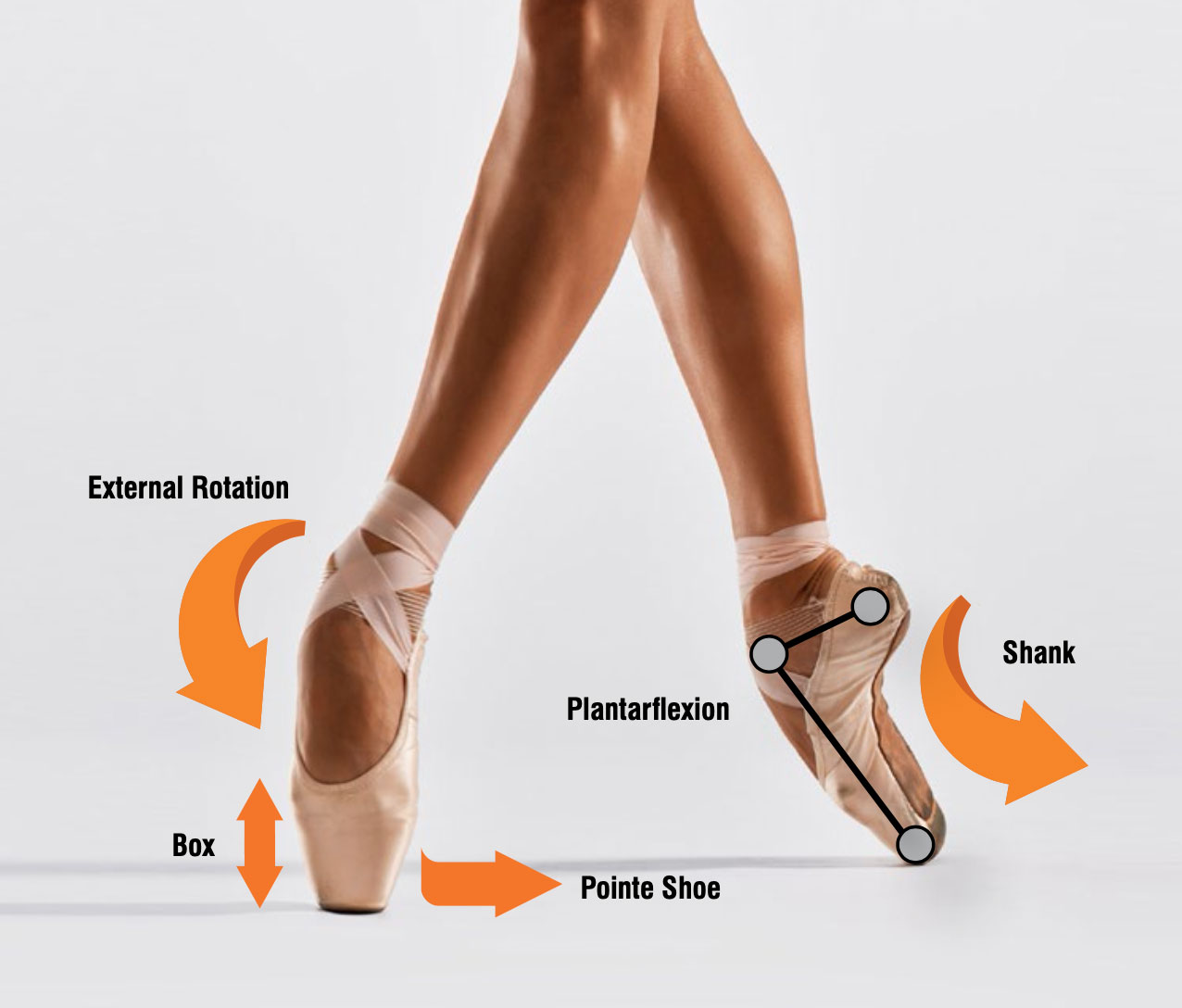
Figure 1. Dancing in the en pointe phase (pointe shoes: the shoes worn by ballet dancers during performance or training; Box: a shoe box that wraps and supports the toes at the front of the shoe; Shank: a piece of rigid shoe bone that reinforces the sole for more support).
By Fengfeng Li, Ntwali Adrien, and Yuhuan He
Dancing is a special competitive sport with dancers performing moves in both open and closed kinetic chains…but is training focused on injury prevention? Is it time for a shoe re-design?
Dancing may be termed a special competitive sport and dancers perform an activity in both open and closed kinetic chains. The open chain suggests that when performing a movement, the foot is not involved in any weight bearing activity but moves freely in the air. The closed chain indicates that in a dance movement the foot is subjected to weight bearing and that all the joints are involved. All dance movements comply with biomechanical rules and laws, otherwise there are consequences in terms of injuries, including both chronic and acute injury. Kinetics analysis can also identify injury status using musculoskeletal modeling. Additionally, in a dance movement, the dancers are required to maintain full ankle plantarflexion and extend through the mid-foot to the toes. This occurs when the foot and ankle are in an abnormal position and increases the flexibility of the ankle (Figure 1). When we consider that foot joints and ligaments are not designed to accept excessive loading, the changes in a dance movement could result in the compression of the soft tissue structure and therefore joint injury.
Injury is common in ballet dancers due to the high-intensity training required and the technical discipline needed to execute the difficult movements in performance. Indeed, all forms of dance contain highly demanding movements with an injury incidence of up to 95% over a dancer’s lifetime, and ballet dancers have a higher incidence of dance injury among all dancers. This study sought to better understand the biomechanical risk factors for foot and ankle injuries in ballet dancers, who are both dance artists and competitive sports performers.
While many studies have focused on the injury of the knee joint and the upper limbs, studies are lacking on the intense physical demands of dancing that exposes dancers’ feet to a high risk of injuries such as hallux valgus, metatarsal injury, and subsequent ankle pain. Among all the reported injuries, foot and ankle injuries account for a large percentage of all musculoskeletal injuries and are particularly vulnerable to secondary damage suffered by dancers. This is primarily caused by the maximum dorsiflexion or a maximum effort in a turned-out position. For example, the excess force of rotation or turnout of the en pointe (Figure 1) can lead to ankle and foot injuries and cause strain of structures around the ankle. However, the full extent of the risk factors for foot and ankle injuries in dancers has not yet been summarized. The purpose of this systematic review was to provide an up-to-date biomechanical assessment of studies on injury prevention among ballet dancers.
This study searched articles in 4 electronic databases for information in peer-reviewed journals. The included articles examined the relationships between biomechanical factors and the relationship between ballet shoes and foot performance. There were 9 articles included in this review. Among these articles, 2 focused on the peak force of the foot using 2 types of pointe shoes, 3 focused on overuse injuries of the ballet dancer’s foot, 1 article focused on the loading of the foot of a dancer, and 3 articles focused on the function and biomechanics of the foot in dancers including gait assessments.
Discussion
To reach a full understanding of the biomechanical risk factors associated with foot and ankle injuries in ballet dancers, knowledge of foot plantar pressure, footwear, and peak force are crucial. This systematic review identified 9 articles that appraised either the effect of pointe shoes or overuse on lower limb injuries in ballet dancers. To determine the incidence of foot injury in ballet dancers, it is important to understand ballet position compensatory strategies. This review found that: (1) the pointe shoe condition is an important factor contributing to a foot injury; (2) overuse injury is related to high-intensity training and affected the ankle and foot; (3) metatarsophalangeal joint injury is related to the function and structure of the foot and results in swelling as the demands on the foot increase; and (4) footwear is also related to overuse injuries in professional ballet dancers. Two articles identified the differences between “new” and “dead” pointe shoes. They used different methods, and a consensus emerged that a worn pointe shoe in a dance movement resulted in a significantly increased swing area, especially in the forefoot and midfoot. Previous studies have found that injuries in ballet dancers can result from inadequate stabilization of the foot and ankle. Pointe shoes are supportive of the foot, which provide stiffness with the compromise of the midfoot ligaments. Having a significant swing in the midfoot area may decrease stiffness and increase the lack of support in the dancer’s foot, increasing the risk of lower limb injury. Previous studies suggested that during some specific dance movements, a repeated impact placed on the foot and ankle may possibly lead to a unique type of injury in a group of dance performers. Although the peak ankle plantarflexion range of motion was not significantly different between dancers and non-dancers, it should be considered that the plantarflexion function and range of motion of ballet dancers’ needs measurably exceeded normative values than non-dancers (0 to 50 degrees). Thus, injury prevention is of great significance.
The human foot is an essential element of the locomotor system. It transports the power and the mass of the whole body while in contact with the ground. Ballet dancers use the foot to reach extreme external rotations and the foot and ankle need to twist in the air. As a result, the intense physical demands of dancing put dancers’ feet at high risk of injuries such as hallux valgus, metatarsal injury, and ankle pain. These injuries in a ballet dancer can result in 2 categories of injury: acute and chronic injury. The structural differences among dancers may change lower limb kinetics and kinematics. The foot has been considered as a triple-arch structure, and the part of the lateral foot performs a rigid arch that supports our weight in a loaded position. Once the weight of the dancer is directed to the midfoot, there will be consequences for the other parts of the foot. Additionally, to reach an extreme position in ballet, external rotation, especially at the ankle joint, is of great importance for dancers. The limitation of range of motion in the ankle may cause foot pronation (rolling in), and subsequently cause the foot to lose medial arch support. If the stability provided by the midfoot begins to fail or decrease, dance performance will compensate to maintain the center of mass. Once the performer cannot compensate to keep the body in a correct position the dancer may fall out of the position, which can result in acute injury. Therefore, the evaluation of dancers’ foot injuries and pain should be included in clinical studies, and superimposed X-rays for assessing ankle and foot contributions to the extreme positions required of female ballet dancers offer insight into how these positions are attained.
Both the first metatarsophalangeal joint and the ankle are attached to the flexor hallucis longus, and flexor hallucis longus tendinopathy is common in ballet dancers. The metatarsophalangeal joints endure a repeated large range of motion and high peak joint moments may be a risk factor that contributes to the injury of the foot and ankle joints in dancing. Mattiussi et al suggested that a greater percentage of injuries were classified as overuse injuries. In addition, Shaw et al noted in their study that older dancers in advanced groups were more likely to be injured. Additionally, the lateral ligament complex of the ankle is the most frequently injured structure of a dancer’s body.
In many sports, ankle sprains do not develop into long-term disabilities, however, many patients do not resolve the problem well, which results in residual symptoms persisting for many years. In the continuous training and performance of dancers, repeatedly jumping and landing as well as the extreme plantarflexion or rotation is required. During these dance movements, the repeated shocks and pressure will impact the injured area, and the commonly reported symptoms in dancers include ankle re-injury and instability. All of the articles reviewed mentioned that wearing a pointe shoe and overuse on their foot may accelerate rates of muscle fatigue and ankle sprains. Once the forefoot strength decreases, the leg will externally rotate, and the support of the hip joint’s muscle will be not stable when the heel is raised. As a result, all the joint chains will be affected, and ankle and foot re-injury is known to occur in many dancers.
In a ballet dance movement, executing the correct motion such as a simple heel raise of relevé when suffering frequent injuries to the lower limb is painful. Biomechanical analysis evaluating the function of muscles, bones, and tendons is essential in developing diagnostic tools to help identify the causes of injuries for any type of dancer, particularly ballet dancers. It has been suggested that ballet dance footwear manufacturers should consider biomechanical design features in shoe manufacturing. In support of this, ground reaction force analysis has been seen as a variable of interest because of its potential correlation with increased injury rates. A reasonable design of dance footwear can reduce impact force and improve the stability of a dancer.
Biernack et al suggested that lower limb strength is also an important factor leading to injuries in the lower extremities. The long-term and intense extreme demands of the musculoskeletal system are relative to plantar pressure distribution in ballet dancers. Therefore, the dancers and dance trainers should reach a consensus that enhancing the controllability of the ankle and foot can reduce ankle restrains to a certain extent. In particular, the flexor hallucis longus and muscle strength enhancement can decrease tenosynovitis probability. Dancers also create abnormal dynamic biomechanical forces when using various dance forms. A thorough determination of these forces may inform the physician about the cause of the injures, especially specific overuse injuries.
Conclusions
Our study systematically reviewed research focused on the risk factors of ankle and foot injuries in ballet dancers. The elements of pointe shoes, overuse of the lower extremity, and the biomechanics and function of the foot are associated with lower limb injury. Strengthening the lower extremity muscle is also a recommendation to improve muscle coordination and reduce injuries. Improving the design of the shoes to provide stiffness with the compromise of the mid-foot ligaments to reduce injuries seems to be important. Moreover, we suggest studying the corresponding dynamic effects for pointe shoes in further research. This will provide a better understanding of ballet and promote ballet dancing to the public while preventing the injury of ballet dancers.
This article has been excepted from “Biomechanical Risks Associated with Foot and Ankle Injuries in Ballet Dancers: A Systematic Review,” by the authors noted above, which was published online on April 18, 2022, in International Journal of Environmental Research and Public Health 2022;19(8):4916. doi: 10.3390/ijerph19084916. Editing and summarization have occurred, and references have been removed for brevity. Use is per CC BY 4.0.