







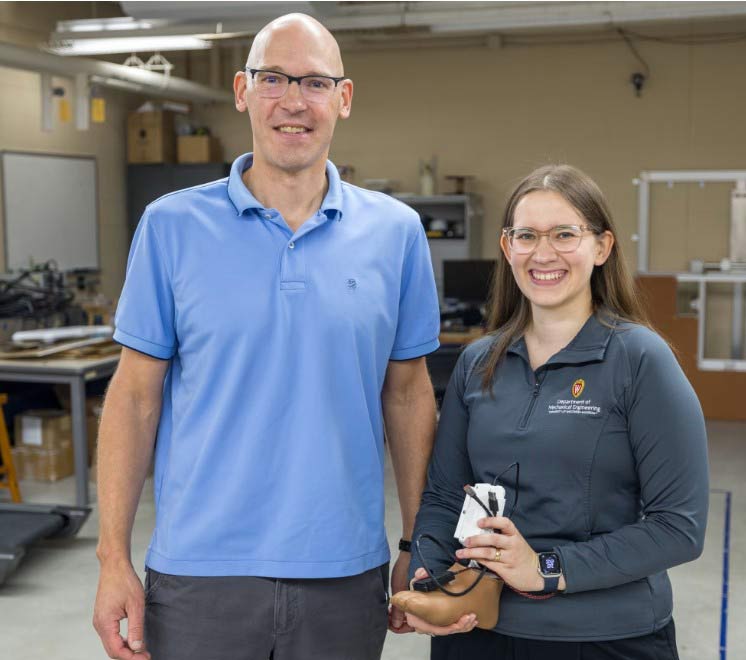
Associate Professor Peter Adamczyk and PhD student Katherine Heidi Fehr, holding a prosthetic foot, in the UW BADGER Lab. Image courtesy of Tom Ziemer.
Using a wearable sensor similar to those used in smartwatches and fitness bands, University of Wisconsin-Madison (UW-Madison) engineers have developed a new, easy and low-cost method that goes beyond step counts: It allows researchers to see how a person walks in daily life.
In their method, people go about their daily activities with a small motion sensor attached to their shoe. Graduate student Yisen Wang developed an improved method for reconstructing the motion of that sensor accurately enough to measure the details of its 3D movement, including rotation and height. The researchers combine the sensor data of the foot’s movement with a 3D scan of the person’s shoe. The resulting model allows the researchers to reconstruct and analyze the movement of the whole foot. That’s in contrast with other techniques that only consider the tip of the toe when the foot is swinging, providing a surrogate measure of foot clearance that might not be accurate.
Being able to analyze the movement of the whole foot provides a more accurate measurement of the real-world foot clearance and a better understanding of an individual’s risk of tripping. In particular, the researchers measure foot clearance while in the swing phase of walking. That’s crucial for understanding and reducing the risk of trip-and-fall incidents for people with gait difficulties.
The method also could draw on a single low-cost sensor and a phone with 3D scanning capabilities, making it widely accessible. The team is now using their method to study how different assistive devices help people with multiple sclerosis and how different prosthetic feet can improve users’ gait.