







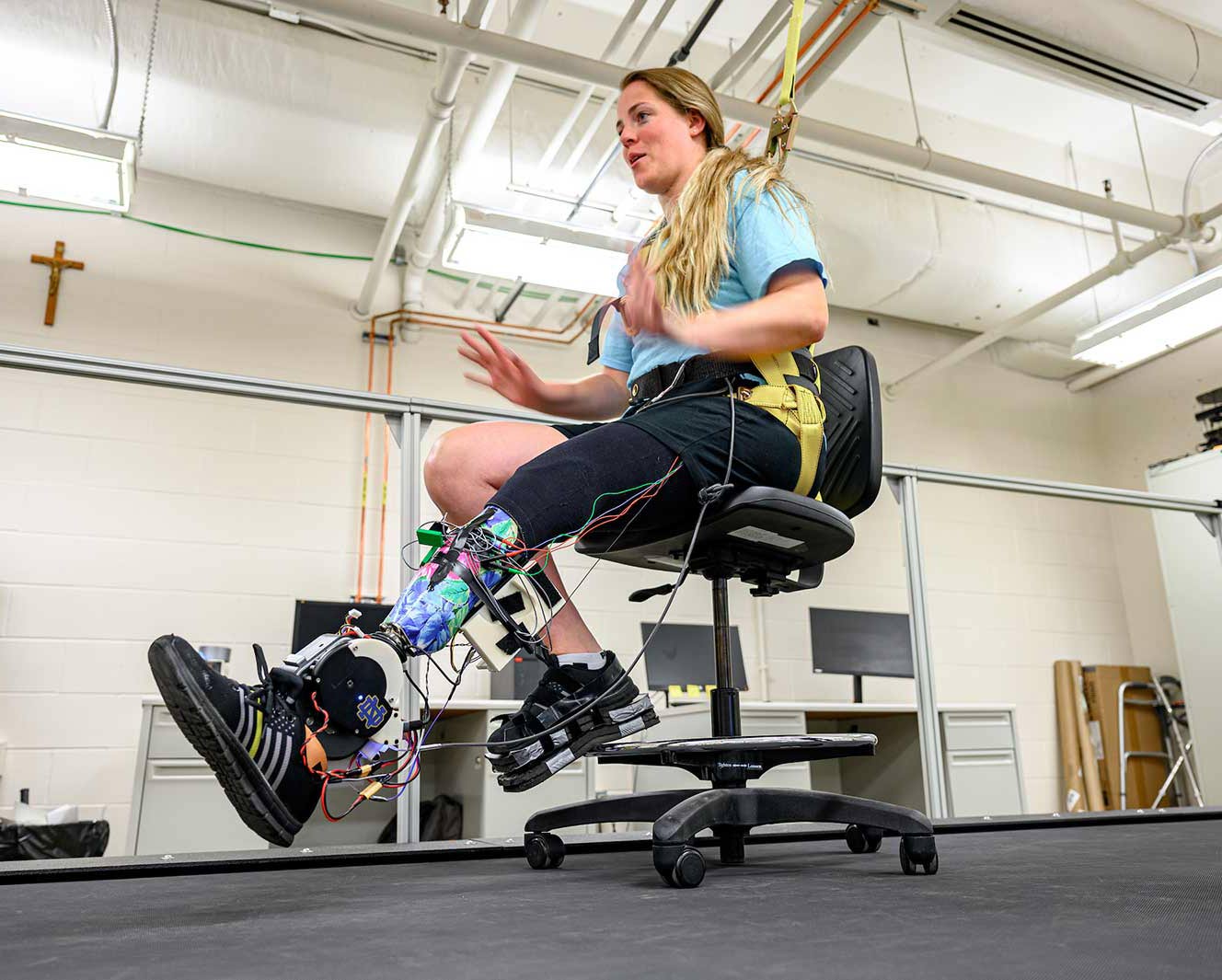
Light helps test out and give feedback on the powered prosthesis. Photograph courtesy of Notre Dame.
A team from the University of Notre Dame’s Robotics, Optimization and Assistive Mobility (ROAM) lab has tested 3 different control mechanisms designed to advance the human-machine interface of a powered prosthetic ankle. While current lower limb prostheses can be given a motor assist, the team is advancing the human-machine interface so that users can control the ankle movement, giving them a crucial “sense of volition” while improving comfort and safety. The study subject, Laura Light, has worn a transtibial prosthesis since she was 18 months old.
The first control mechanism—volitional—is based on myoelectric sensors that allowed Light to control the rollover movement of the ankle. The second—autonomous—automatically boosts ankle roll based on pre-programmed angles in the way that some already available motorized prostheses work. The third, the team’s latest experiment, combines the advantages of the first 2. The electrode sensors read electrical twitch signals from Light’s muscle contractions in different spots on her residual calf, allowing her to fully control, for the first time, the forward roll of a motorized ankle device—and to ultimately stand on her toes.
Light walked on the treadmill for 2 minutes with each system, while her gait was videotaped to evaluate how natural it appeared, and data was gathered on how well the myoelectric sensors picked up and responded to her muscle signals. She practiced rolling the foot forward and back, standing on tiptoes, and sitting with it flat on the floor.
“This has gone better than we imagined,” said ROAM’s director, Patrick Wensing, PhD. “There are lots of myoelectric solutions out there for prosthetic hands. But there are less for legs because you have to avoid falls to ensure safety.”