









 By Mathias B. Forrester, BS
Background: Fireworks are commonly used in the United States (US) for festive or recreational purposes. Consumer fireworks sales have increased over the last several decades. Injuries, some of which may be potentially serious, can occur to both the individual using the fireworks and spectators or bystanders. This study characterized fireworks-related lower extremity injuries treated at US emergency departments (EDs).
Methods: An analysis was performed of fireworks-related lower extremity injuries using data from the National Electronic Injury Surveillance System (NEISS) of the US Consumer Product Safety Commission (CPSC) during 2000-2021.
Results: An estimated 33,770 fireworks-related lower extremity injuries treated at US hospital EDs during 2000-2021 were identified, representing 15.0% of the total estimated fireworks-related injuries. While the annual estimated number of injuries ranged between 855 and 1,694 (mean 1,343) during 2000-2015, the estimated annual number of injuries was higher during 2016-2021, ranging between 1,856 and 2,347 (mean 2,048). 87.9% of the estimated injuries were treated during June-August with 78.2% treated during July. Patients age 0-19 years accounted for 48.6% of the estimated injuries; 56.0% of the patients were male. Thermal burns were reported in 58.8% of the estimated injuries, and 91.4% of the patients were treated or examined at the ED and released.
Conclusions: The number of fireworks-related lower extremity injuries have increased during 2016-2021. The majority of these injuries were treated during June-August, particularly July, and most injuries involved children and males. The majority of the injuries were thermal burns, and most patients were treated or examined at the ED and released.
Fireworks are devices designed to produce visible or audible effects by combustion, deflagration, or detonation.1 They typically consist of a casing filled with combustible material; the devices can be handheld (e.g., sparklers) or can be detonated from a distance.2 Fireworks are commonly used in the United States (US) for festive or recreational purposes.3 The American Pyrotechnic Association reported that estimated consumer fireworks sales in the United States increased during 2000-2021, reaching a total of $2.2 billion in 2021.4 Fireworks consumption likewise increased from 152.6 million pounds in 2000 to 428.8 million pounds in 2021.5
Injury can occur to both the individual using the fireworks and spectators or bystanders in the vicinity.6 These injuries can be serious, resulting in pain and permanent disability. Fireworks are responsible for thousands of hospital emergency department (ED) visits each year.1,3,5,7-9 The majority of persons injured are children and male.1-3,6-9,10-15
Although the body part most often injured by fireworks is the hand, followed by the head and face, the lower extremities also may be injured.1,6,7,9,11,15 The objective of this study was to characterize fireworks-related lower extremity injuries treated at US EDs.
Methods
 Data for this retrospective epidemiologic study was obtained from the National Electronic Injury Surveillance System (NEISS) at https://www.cpsc.gov/cgibin/NEISSQuery/home.aspx. Operated by the US Consumer Product Safety Commission (CPSC), the NEISS collects data on consumer product-related injuries from the EDs of a stratified random sample of 100 hospitals from the more than 5,000 hospitals in the US. The random sample is stratified by hospital size, geographic location, and hospital type (general and pediatric hospitals). Professional NEISS coders view the medical charts at participating hospitals and, for patients with injuries that meet NEISS inclusion criteria, collect and code information such as treatment date; patient age, sex, and race; injury diagnosis and body part injured; discharge disposition; consumer product(s) involved in the injury; location where the incident occurred; and a brief narrative describing the incident.16,17 Previous studies have used NEISS data to examine fireworks-related injuries; however, these studies examined injuries to all body parts,1,6,7,11 included only pediatric patients,9,15 or focused on body regions other than the lower extremity.2,3,10,12-14 Data are publicly available and de-identified; thus, the study is exempt from institutional review board approval.
Cases were fireworks-related lower extremity injuries reported to the NEISS database during 2000-2021. The publicly available NEISS database contains three numeric fields for coding the product involved in the injury (Product_1, Product_2, Product_3). These three fields were searched for the product code 1313 (fireworks). That the injury involved a lower extremity was based on either the Body_Part or Body_Part_2 numeric fields containing codes for a lower extremity (upper leg, knee, lower leg, ankle, foot, toe). The NEISS Coding Manual indicates that the Product_3 and Body_Part_2 fields were added in 2018,17 although these fields do not appear to have been used until 2019.
The variables examined were treatment year, month, and day of week; patient age and sex; location where the incident occurred; type of injury (diagnosis); affected body part; and disposition. As with the Product_3 and Body_Part_2 fields, the NEISS Coding Manual indicates that the Diagnosis_2 field was added in 2018 but not used until 2019.17 Diagnoses and body parts documented in these second sets of fields during 2019-2021 were included in the analysis.
Analyses were performed using Microsoft 365 Personal Access and Excel (Microsoft Corporation, Redmond, Washington, US). The distribution of cases and national injury estimates were determined for each variable. National injury estimates were calculated by summing the values in the Weight numeric field in the publicly available NEISS database, and 95% confidence intervals (CIs) were calculated for the estimates. The CPSC considers an estimate unstable and potentially unreliable when the number of records used is <20 or the estimate is <1,200.16 For those variable subgroups where the estimate was <1,200, 95% CIs were not calculated.
Results
During 2000-2021, 881 fireworks-related lower extremity injuries were reported to a sample of US hospital EDs, resulting in a national estimate of 33,770 such injuries, representing 15.0% of the 224,989 total estimated fireworks-related injuries involving any body part. Figure 1 (page 51) shows the annual estimated number of fireworks-related lower extremity injuries. The estimated number of injuries varied from year to year with no clear trend over the 22-year period. However, while the annual estimated number of injuries ranged between 855 and 1,694 (mean 1,343) during 2000-2015, the annual estimated number of injuries was higher during 2016-2021, ranging between 1,856 and 2,347 (mean 2,048).
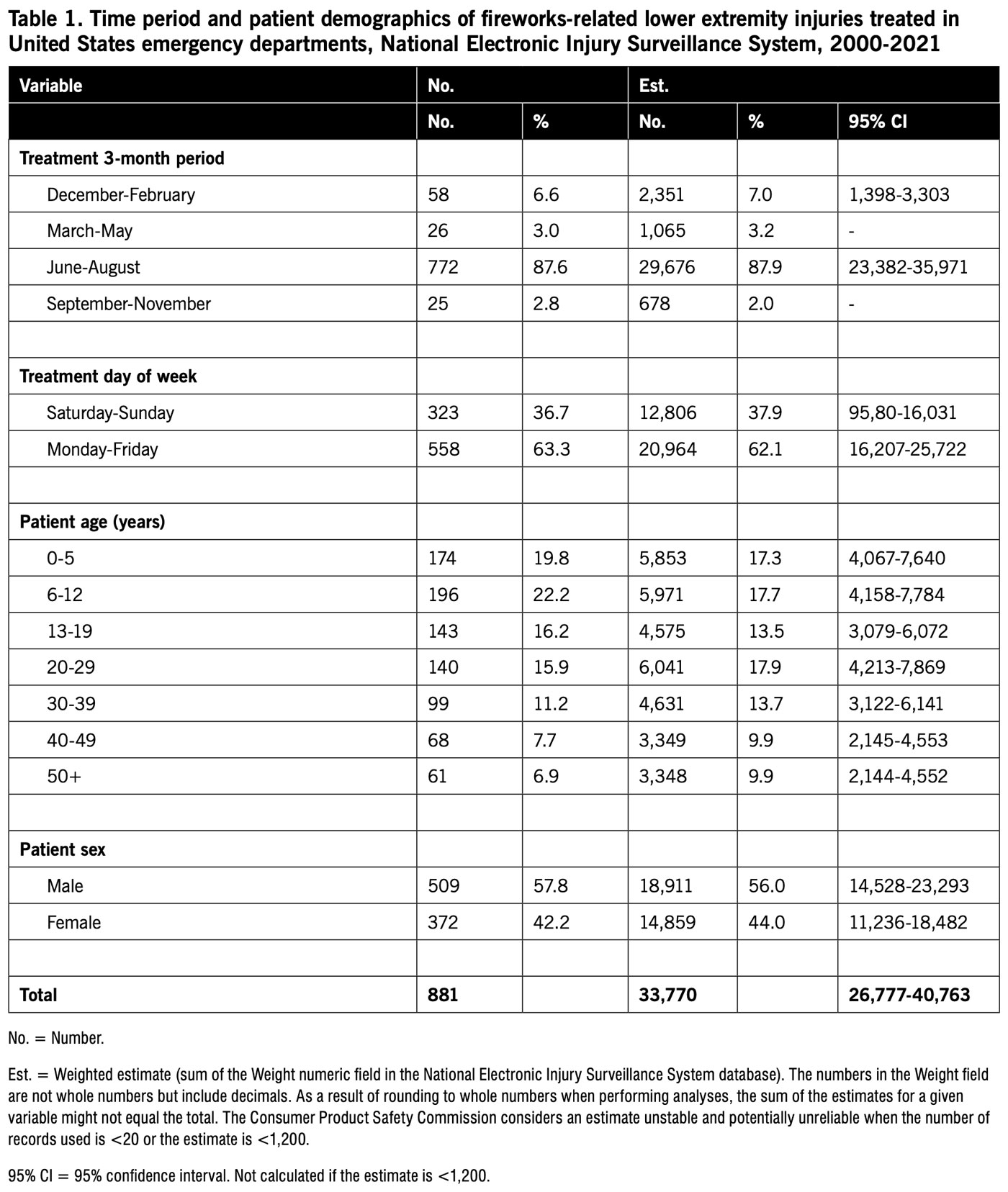
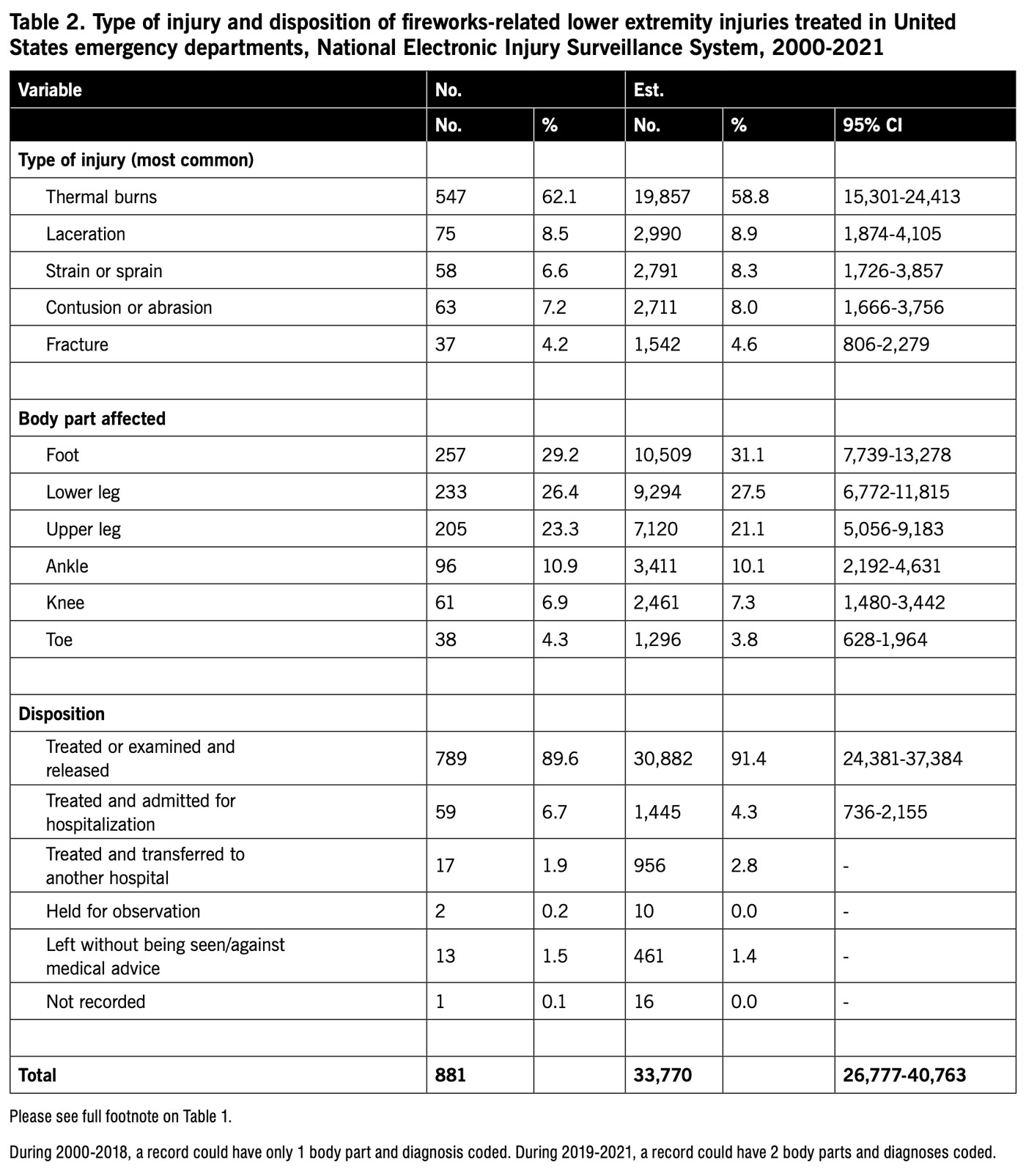 Table 1 (page 44) presents the distribution of fireworks-related lower extremity injuries by time period and patient demographics. Almost 90% of the injuries were reported during June-August with 676 (76.7%) of the cases and 26,421 (78.2%) of the estimated injuries treated during July. While the single age group with the highest proportion of estimated injuries was patients age 20-29 years, patients age 0-19 years accounted for 48.6% of the estimated injuries. The majority of patients were male. Of the 19,708 estimated injuries where the location of the incident was recorded, 14,637 (74.3%) occurred at home, 2,104 (10.7%) at other public property, 2,012 (10.2%) at a place of recreation or sports, 804 (4.1%) at a street or highway, 136 (0.7%) at a farm or ranch, and 15 (0.1%) at school.
Table 2 (page 49) provides the distribution of fireworks-related lower extremity injuries by type of injury, body part, and patient disposition. Thermal burns accounted for the majority of injuries. The most commonly affected part of the lower extremity was the foot followed by the lower leg. Most of the patients were treated or evaluated in the ED and released. No deaths were reported.
Discussion
This study examined fireworks-related lower extremity injuries treated in US hospital EDS over a 22-year period. While lower extremity injuries account for only a fraction of all fireworks-related injuries (15% in the present study), fireworks result in an estimated 1,000-2,000 lower extremity injuries each year.
Although US consumer fireworks sales and consumption increased during 2000-2021,4,5 the estimated number of fireworks-related lower extremity injuries did not demonstrate a similar increase during 2000-2015. However, the mean annual estimated number of injuries during 2016-2021 was 53% higher than during the previous time period. This increase might be due to the increase in fireworks sales and consumption. It also may be due to the addition of a third product code field and a second field for documenting an injured body part. However, these changes affected records collected during 2019 and later while the increase in injuries started 3 years earlier. Furthermore, of the 152 cases treated during 2019-2021, none had the product code for fireworks in the Product_3 field, only 20 would have been excluded if the second body part field had not been included in the analysis.
This study found that most of the injuries were treated during June-August, particularly July. Furthermore, fireworks-related lower extremity injuries most commonly affected children and males. This is consistent with the literature.1-3,6-9,10-15 However, most of these previous studies likewise used data from NEISS, although they examined all fireworks-related injuries or injuries to other parts of the body, so the similarities in patterns might be expected.

Approximately 60% of the injuries were thermal burns, with smaller proportions involving lacerations, strains or sprains, contusions or abrasions, and fractures. Previous studies reported similar patterns of injuries.1,7,9,12-15 Although thermal burns can be potentially serious, approximately 90% of the patients were treated or examined in the ED and released.
 There are ways to prevent fireworks-related injuries. The Center for Disease Control and Prevention (CDC) recommends that fireworks only be used by trained professionals and that no individuals attempt to use firework explosives at home.18
There are several limitations to this study. The NEISS database only includes injuries treated at an ED. Studies that include information on injuries not evaluated at hospital EDs would provide a more complete view of fireworks-related lower extremity injuries. In addition, state laws regarding the regulation of fireworks vary throughout the US.2 Therefore, the pattern of fireworks-related injuries may vary from state to state. However, the publicly-available NEISS database does not provide information on the state where a particular injury occurred. As a result, this study was not able to examine state differences in fireworks-related lower extremity injuries. As mentioned in the Methods, the Product_3, Body_Part_2, and Diagnosis_2 fields were only added and used after 2018; thus, more cases were included in 2019-2021 than if these fields were not included in the analysis.
In conclusion, the number of fireworks-related lower extremity injuries have increased during 2016-2021. Most of these injuries were treated during June-August, particularly July, and most affected patients were children and males. The majority of the injuries were thermal burns, and most patients were treated or examined at the ED and released.
Mathias B. Forrester, BS, is an independent researcher in Austin, Texas. He has been involved in public health research for 38 years.
- Moore JX, McGwin G, Griffin RL. The epidemiology of firework-related injuries in the United States: 2000-2010. Injury. 2014;45(11):1704-1709.
- Serra López VM, Cheema AN, Gray BL, Pirruccio K, Kazmers NH. Epidemiology of fireworks-related injuries to the upper extremity in the United States from 2011 to 2017. J Hand Surg Glob Online. 2020;2(3):117-120.
- Shiuey EJ, Kolomeyer AM, Kolomeyer NN. Assessment of firework-related ocular injury in the US. JAMA Ophthalmol. 2020;138(6):618-623.
- American Pyrotechnics Association. U.S. Fireworks Industry Revenue Figures Breakdown by Industry Segment 2000-2021. Available at https://www.americanpyro.com/assets/docs/FactsandFigures/2022/Fireworks%20Revenue%20by%20Industry%20Segment%202000-21.pdf. Accessed May 1, 2023.
- American Pyrotechnics Association. Fireworks-Related Injury Rates, 1976-2021. Available at https://www.americanpyro.com/assets/docs/FactsandFigures/2022/Fireworks%20Related%20Injuries%20%28table%29%201976%20-2021.pdf. Accessed May 1, 2023.
- See LC, Lo SK. Epidemiology of fireworks injuries: the National Electronic Injury Surveillance System, 1980-1989. Ann Emerg Med. 1994;24(1):46-50.
- United States Consumer Product Safety Commission. 2017 Fireworks annual report: fireworks-related deaths and emergency department-treated injuries during 2017. June 2018. Available at https://www.cpsc.gov/s3fs-public/Fireworks_Report_2017.pdf. Accessed May 1, 2023.
- Canner JK, Haider AH, Selvarajah S, et al. US emergency department visits for fireworks injuries, 2006-2010. J Surg Res. 2014;190(1):305-311.
- Witsaman RJ, Comstock RD, Smith GA. Pediatric fireworks-related injuries in the United States: 1990-2003. Pediatrics. 2006;118(1):296-303.
- Tanenbaum Z, Prasad N, Bhardwaj P, Welschmeyer A, Harley EH. Fireworks injuries to the head and neck: A retrospective analysis between 2008 and 2017. J Burn Care Res. 2022;43(1):202-206.
- Maassel N, Saccary A, Solomon D, et al. Firework-related injuries treated at emergency departments in the United States during the COVID-19 pandemic in 2020 compared to 2018-2019. Inj Epidemiol. 2021;8(1):65.
- Morrissey PJ, Scheer RC, Shah NV, Penny GS, Avoricani A, Koehler SM. Increases in firework-related upper extremity injuries correspond to increasing firework sales: An analysis of 41,195 injuries across 10 years J Am Acad Orthop Surg. 2021;29(13):e667-e674.
- Straughan AJ, Pasick LJ, Gupta V, Benito DA, Goodman JF, Zapanta PE. Feel the burn! Fireworks-related otolaryngologic trauma. Ann Otol Rhinol Laryngol. 2021;130(12):1369-1377.
- Mehta NK, Cowan B, Hojjat H, Johnson J, Chung MT, Carron M. Sparking the debate: Facial injury patterns from fireworks. Facial Plast Surg. 2020;36(5):659-664.
- Billock RM, Chounthirath T, Smith GA. Pediatric firework-related injuries presenting to United States emergency departments, 1990-2014. Clin Pediatr (Phila). 2017;56(06):535-544.
- United States Consumer Product Safety Commission. National Electronic Injury Surveillance System (NEISS). Available at https://www.cpsc.gov/Research–Statistics/NEISS-Injury-Data/Explanation-Of-NEISS-Estimates-Obtained-Through-The-CPSC-Website. Accessed May 1, 2023.
- United States Consumer Product Safety Commission. NEISS Coding Manual. January 2021. Available at https://www.cpsc.gov/s3fs-public/January-2021-NT-CPSC-only-NEISS-Coding-Manual.pdf?xa_nMM1kB4SGpuSMOwf0NHkkkIqNcn8F. Accessed May 1, 2023.
- Centers for Disease Control and Prevention (CDC). Injuries associated with homemade fireworks – selected states, 1993-2004. MMWR Morb Mortal Wkly Rep. 2004;53(25):562-563.