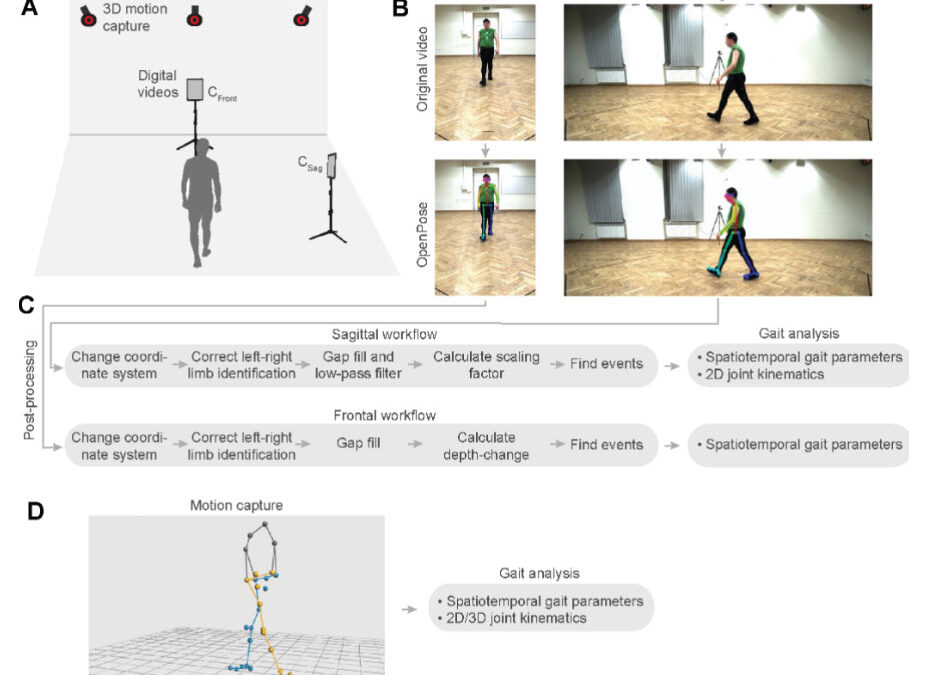








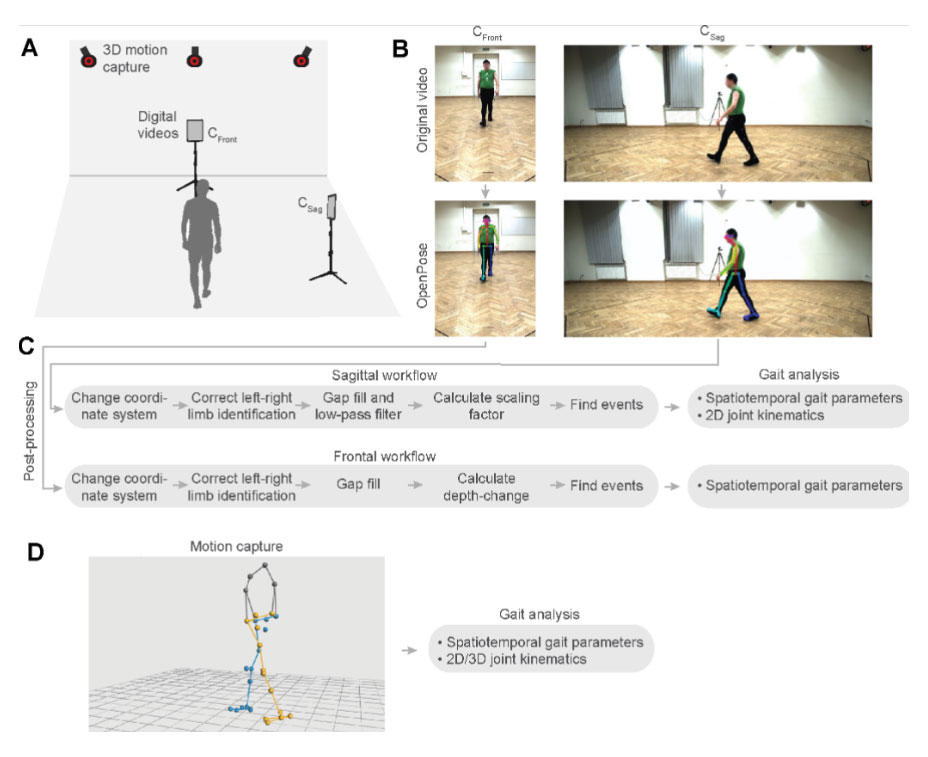
(A) 3D motion capture and digital videos of gait trials were performed by persons post-stroke and persons with PD. (B) Digital videos of the frontal (CFront) and sagittal (CSag) planes with OpenPose were analyzed to track anatomical key points. (C) Workflows were developed to perform a gait analysis, independently, for videos of the CFront and CSag planes. (D) Spatiotemporal gait parameters and joint kinematics from the workflows were compared to parameters obtained with 3D motion capture.
Researchers at Kennedy Krieger Institute and Johns Hopkins University (JHU) School of Medicine have developed a new, accessible approach to analyze a patient’s walking ability and stances more effectively. Following numerous tests, they determined that a simple video recorded on a a smartphone or tablet can be used to measure gait at a clinical, high-quality level.
“Patients that have gait problems resulting from diverse conditions such as Parkinson’s disease (PD), cerebral palsy, lower extremity injury or amputation, recovery from a stroke, and more, could benefit from this,” said Ryan Roemmich, PhD, a research scientist at Kennedy Krieger and an assistant professor of physical medicine and rehabilitation at the JHU School of Medicine.
Clinicians use cutting-edge software in the assessment to record a cellphone video that captures the patient’s walking pattern from any 1 of multiple perspectives. The videos could be recorded as the patient walks toward the camera, away from the camera, or from a profile angle depending on the condition being treated. The researchers use algorithms and their software to analyze the recorded data, marking the movement of patients’ knees and ankles and step length. Their approach is also based on tracking the size of the person as they appear in the video image. Patients were observed walking on the ground and treadmill.
With the ability to record these videos anywhere, they are not limited to testing in a physician’s office. However, clinicians will first need to be trained in how to effectively use this technology to produce the best results. But eventually, the researchers want patients to be capable to shoot the videos at home themselves.
Code for the workflow can be accessed at https://github.com/janstenum/GaitAnalysis-PoseEstimation/tree/Multiple-Perspectives.