







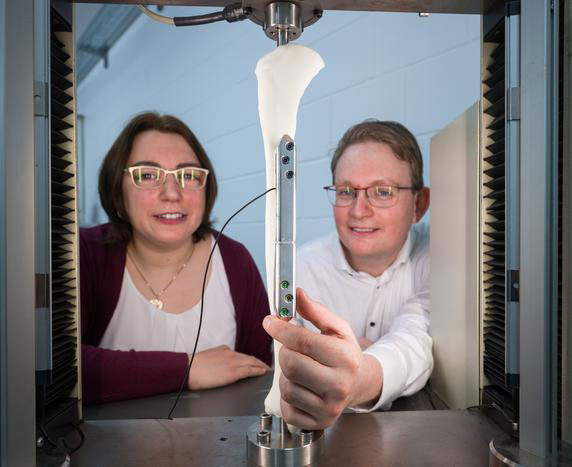
Doctoral research students Susanne-Marie Kirsch (l.) and Felix Welsch (r.) are working on the prototype implant.
An interdisciplinary team of medical specialists, engineers, and computer scientists at Saarland University, Saarbrücken, Germany, are developing smart implants that can continuously monitor and actively promote bone healing—by, for example, micro-massaging the fracture site. The team of engineers led by Stefan Seelecke, Prof. Dr.-Ing., iMSL, chair of intelligent material systems and Paul Motzki, Prof. Dr., chair of smart material systems for innovative production, have equipped the implant with smart “artificial muscles.” Fabricated from shape memory wires, these muscles provide a way to control the fracture repair process via smartphone.
As soon as the fixation plate has been attached and the wound sutured, the implant begins providing a continuous stream of information on how the fracture is healing. If the patient puts too much pressure on the fracture, the smart implant will give a warning. At the fracture gap, where the bone fragments have been realigned with each other, the implant can be made more or less rigid as required; it can even undergo tiny motions to deliver a micro-massage to the fracture site. This kind of “micro-manipulation” at the surface of the bone actively promotes healing by stimulating growth. And these processes can all be fully automated using a smartphone.
Ultrafine nickel-titanium “shape memory” wires are used as mechanical actuators that can alter the local rigidity of the implant and make it move or exert a force. They also are used as sensors to monitor processes taking place at the fracture site. The wires can contract or relax like real muscle fibers depending on whether an electric current is flowing or not. The engineers fabricated bundles of these wires, just as muscle fibers are grouped into bundles. By alternately tensing and relaxing the wires, the engineers can simulate the movement of flexor or extensor muscles. The wires are able to exert a substantial force over a very short distance. These artificial muscles also have their own intrinsic sensor properties. When the wires change shape, so does their electrical resistance, allowing the researchers to precisely assign resistance values to even the smallest of deformations, which allows them to extract sensory data. The data allow the team to monitor minute changes occurring in the gap between the bone fragments. This close monitoring of the fracture gap enables the medical team to assess whether fracture site stiffness increases over time. By careful data modelling and programming, the researchers are able to choreograph highly precise motion sequences for the fixation plate to perform. In the future, this sensor data will be transmitted wirelessly to a smartphone.
These electrically responsive fibers can be positioned above the fracture site. Electrical signals can then be applied to control whether the artificial muscles fibers elongate, contract, or remain unchanged, thus determining the local rigidity of the fixation plate at the fracture site. The researchers can control the artificial muscles that span the fracture gap so that they expand and contract at the required frequency. Due to their intrinsic sensor properties, these bundles of shape memory wires also serve as the implant’s nervous system. If it becomes harder to contract the artificial muscles positioned across the fracture gap, this is a good indication that the bone tissue in this region is becoming harder and the healing process is progressing. The system is controlled by a semiconductor chip. Once in place, the implants can be left do their work. Even charging is carried out remotely: “The implant will be fitted with a powerful battery that can be recharged in situ via wireless induction,” said Motzki.