








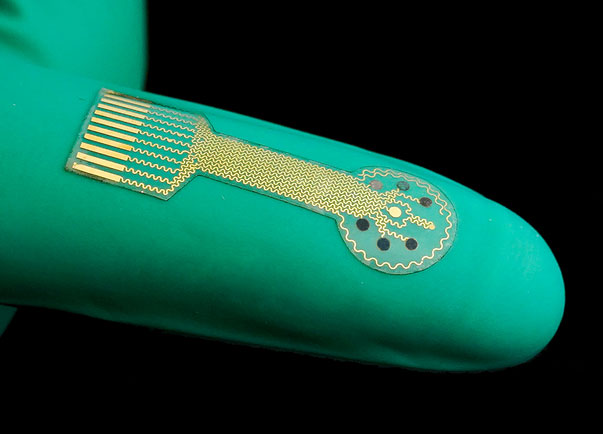
Photo of the smart bandage courtesy of CalTech.
A new kind of smart bandage developed at California Institute of Technology (Caltech) may make treatment of chronic wounds—such as burns and diabetic foot ulcers—easier, more effective, and less expensive. These smart bandages were developed in the lab of Wei Gao, PhD, assistant professor of medical engineering, Heritage Medical Research Institute Investigator, and Ronald and JoAnne Willens Scholar.
The smart bandages are made from a flexible, stretchy polymer containing embedded electronics and medication. The electronics allow the sensor to monitor for molecules like uric acid or lactate and conditions like pH level or temperature in the wound that may be indicative of inflammation or bacterial infection.
The bandage can respond in 1 of 3 ways: First, it can transmit the gathered data from the wound wirelessly to a nearby computer, tablet, or smartphone for review by the patient or a medical professional. Second, it can deliver an antibiotic or other medication stored within the bandage directly to the wound site to treat the inflammation and infection. Third, it can apply a low-level electrical field to the wound to stimulate tissue growth resulting in faster healing.
In animal models under laboratory conditions, the smart bandages showed the ability to provide real-time updates about wound conditions and the animals’ metabolic states to researchers, as well as speed healing of chronic infected wounds similar to those found in humans.