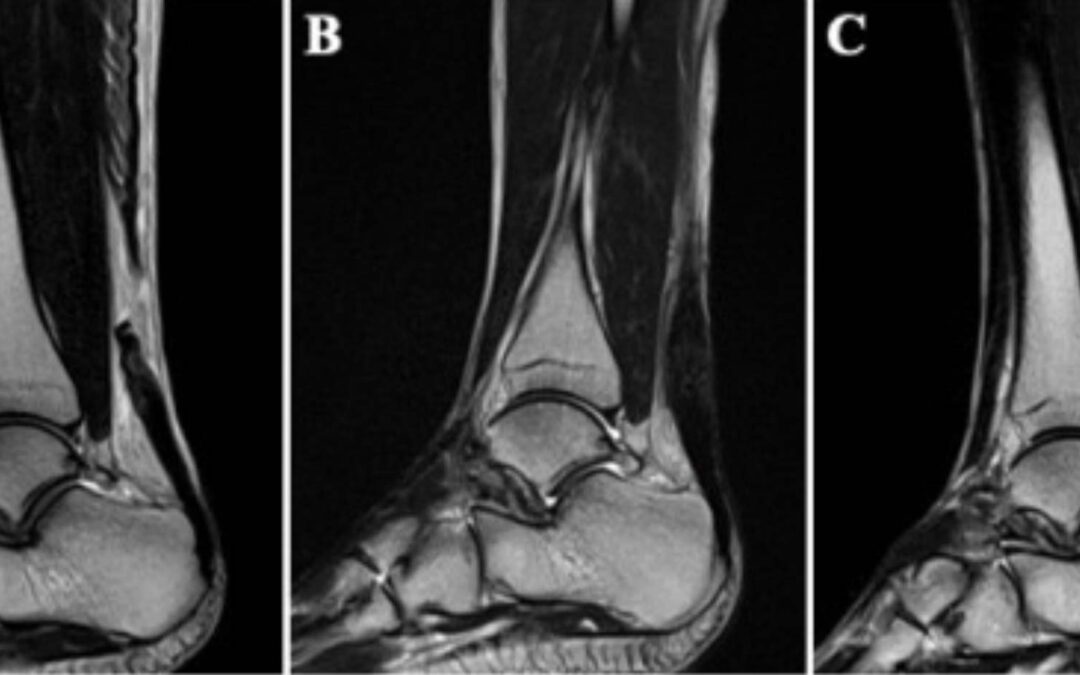








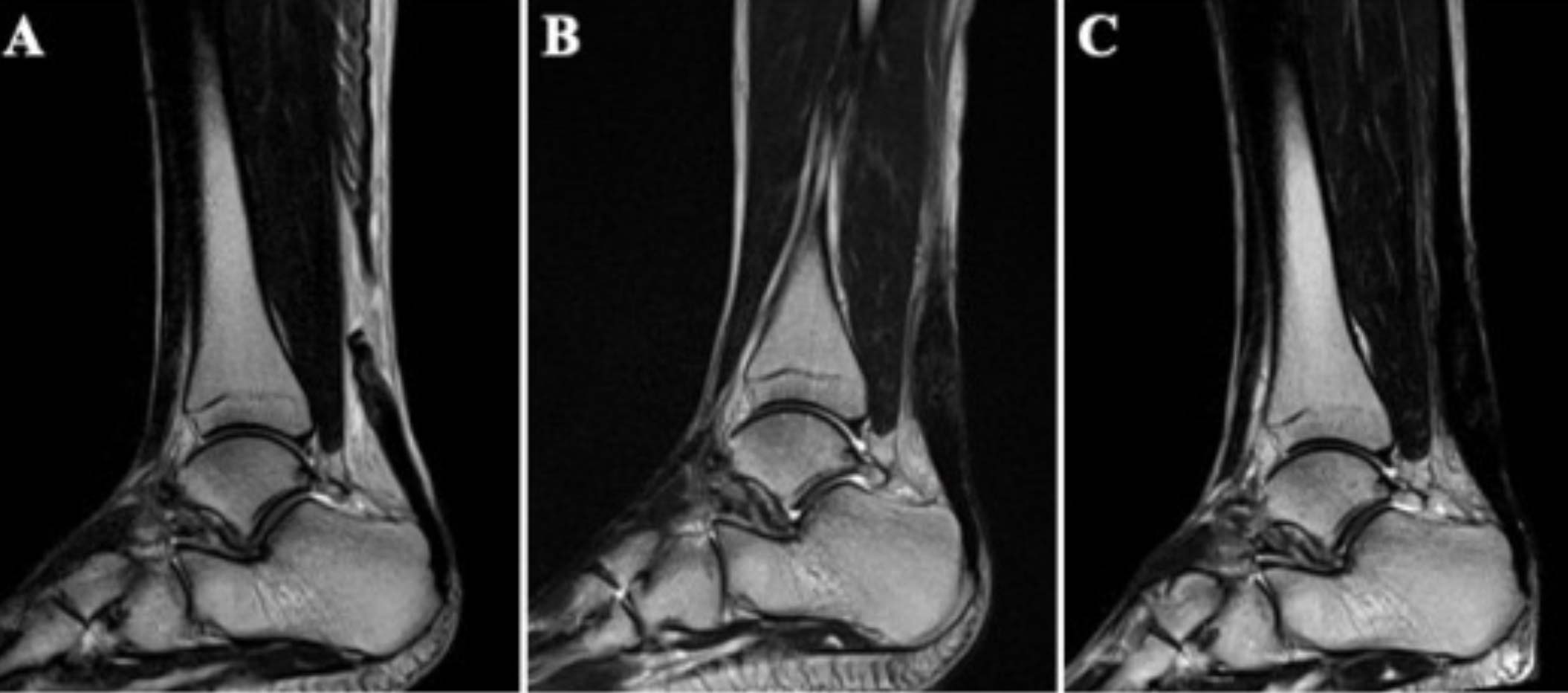
Figure. MRI evaluation detected high signal intensity of the sutured tendon in 25% (2 of 8 patients) at 12 weeks postoperatively and in 0% (0 of 8 patients) at 24 weeks postoperatively. MRI of case 2. Preoperative MRI revealed that the Achilles tendon was ruptured in the mid-substance of the tendon (A). The high signal intensity at the repaired site of the Achilles tendon revealed by MRI taken 12 weeks postoperatively (B) had improved by 24 weeks postoperatively (C).
Achilles tendon ruptures (ATRs) often occur in competitive athletes. Various studies have been conducted to improve the treatment outcomes for ATRs, but the results remain unsatisfactory for athletes. The purpose of this study was to clarify the clinical outcomes of the addition of Freeze-dried Platelet-derived Factor Concentrate (FD-PFC) injection to surgical treatment with an early rehabilitation protocol for ATR in high-level athletes. It was hypothesized that this combination of treatments, with the inclusion of FD-PFC injection, would provide satisfactory results for high-level athletes with ATR, enabling them early return to their original sports at preinjury level. Researchers retrospectively analyzed 8 high-level athletes (Tegner activity score ≥8) with ATR, who received postoperative injection of FD-PFC in addition to surgical treatment with an early rehabilitation protocol between May 2019 and November 2021. In all patients, surgery was performed using the modified side-locking loop suture technique, and an early rehabilitation protocol was implemented postoperatively. The pared FD-PFC was injected into the Achilles tendon suture site under ultrasound guidance at 4 weeks postoperatively. Evaluation of the clinical outcomes included the following factor: the American Orthopedic Foot and Ankle Society ankle-hindfoot scale (AOFAS) score measured preoperatively and at 1 year postoperatively, time to ability to perform 20 continuous double- and single-leg heel raises (DHR/SHR), time to return to the original sport, and complications related to surgery or FD-PFC injection. In addition, magnetic resonance imaging (MRI) was performed for all patients at 12 and 24 weeks postoperatively to evaluate Achilles tendon maturation.
The 8 patients consisted of 7 male and 1 female athletes with a mean age of 28.5 ± 5.2 years (range, 23-39 years) at the time of surgery. All patients were high-level athletes with a mean Tegner activity score of 9.0 ± 0.5 (range, 8-10). The mean AOFAS score improved significantly from 36.0 ± 9.4 preoperatively to 96.8 ± 3.6 at 1 year postoperatively (P< 0.001). The mean time to be able to perform 20 continuous DHR and 20 continuous SHR was 6.8 ± 0.8 weeks and 10.1 ± 1.6 weeks, respectively. All patients could return to their original sport at preinjury levels with the mean time of 18.3 ± 2.7 weeks. Also, there were no complications related to surgery or injection. Furthermore, T2-weighted MRI showed the high signal intensity of the sutured tendon in 25% (2 of 8 patients) at 12 weeks and 0% (0 of 8 patients) at 24 weeks postoperatively.
The addition of FD-PFC injections to surgical treatment with an early rehabilitation protocol could provide satisfactory results for high-level athletes with ATRs, enabling them early return to their original sports at preinjury level. This treatment option may be useful for athletes with ATRs.
Source: Morimoto S, Morio F, Matsumae Y, Nakamura M, Nakao Y, Tachibana T, Iseki T. Clinical outcome of adding injection of freeze-dried platelet-derived factor concentrate to operative treatment accompanied by an early rehabilitation for achilles tendon rupture in high-level athletes. Regen Ther. 2025 28;30:107-111. doi: 10.1016/j.reth.2025.05.007. Use per CC BY.