







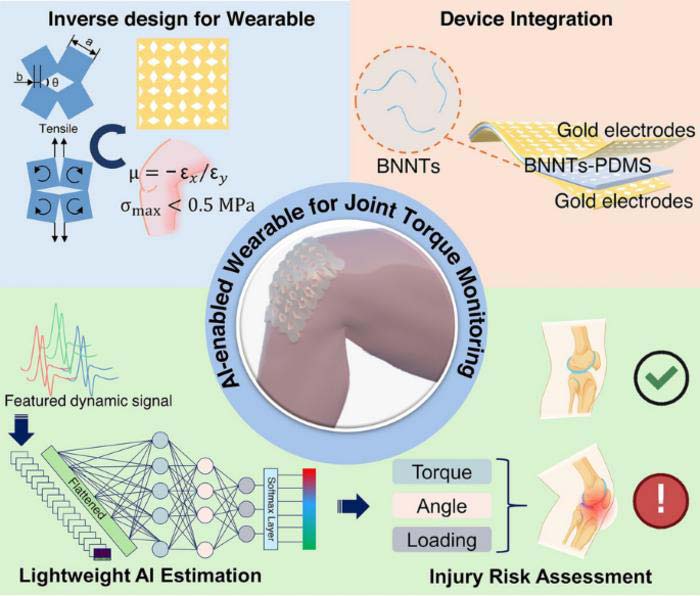
The device’s high-sensitivity BNNTs/polydimethylsiloxane composite enables precise and dynamic knee motion signal detection, while the lightweight neural network processes complex signals for accurate torque, angle, and load estimation, providing reliable data for joint health assessment. Image courtesy of the researchers.
Researchers from the University of Oxford and University College London have collaborated on the development of an artificial intelligence (AI)–enabled piezoelectric wearable device for accurate joint torque sensing, leveraging the unique properties of boron nitride nanotubes (BNNTs).
This new wearable device offers a portable, non-invasive solution for continuous joint torque monitoring, crucial for evaluating joint health, guiding interventions, and monitoring rehabilitation progress. The device’s high-sensitivity BNNTs/polydimethylsiloxane composite enables precise and dynamic knee motion signal detection, while the lightweight neural network processes complex signals for accurate torque, angle, and load estimation, providing reliable data for joint health assessment. The compatibility of the materials and design with low-power, resource-limited settings makes this wearable device a cost-effective and accessible solution for diverse populations across regions with varying levels of development, potentially revolutionizing joint health monitoring on a global scale.
The wearable device employs an inverse-designed structure with a negative Poisson’s ratio, precisely matched to the biomechanics of the knee joint. This design ensures optimal biomechanical compatibility, enhancing motion tracking fidelity and enabling detailed sensing of complex loading conditions during knee movements. The integration of a lightweight on-device artificial neural network allows for real-time processing and analysis of the complex piezoelectric signals generated during movement. The AI algorithm accurately extracts targeted signals and maps them to corresponding physical characteristics, such as torque, angle, and loading, providing valuable insights into joint health.
By providing real-time, continuous torque assessment and risk assessment of joint injury, the device can play a crucial role in rehabilitation programs, ensuring safe and effective recovery. It can also help in preventing injuries by alerting users to potentially harmful joint movements or excessive torque.