







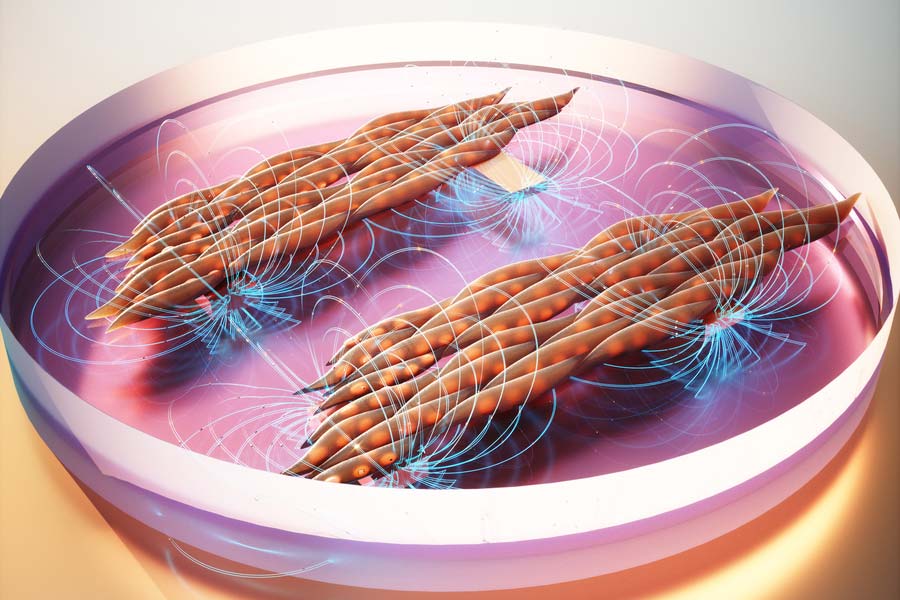
Image courtesy of Ella Marushchenko.
Engineers at the Massachusetts Institute of Technology (MIT) have designed a sort of workout mat for cells that can help scientists zero in, at the microscopic level, on exercise’s purely mechanical effects. The new design is not so different from a yoga mat: Both are rubbery, with a bit of stretch. In the case of the MIT mat, it’s made from hydrogel—a soft, gel-like material that is about the size of a quarter and is embedded with magnetic microparticles.
To activate the gel’s mechanical function, the researchers used an external magnet underneath the mat to move the embedded particles back and forth, wobbling the gel in turn like a vibrating mat. They controlled the frequency of the wobbling to mimic the forces that muscles would experience during actual exercise. They next grew a carpet of muscle cells on the gel’s surface and activated the magnet’s motion. Then, they studied how the cells responded to being “exercised” as they were magnetically vibrated.
So far, the results suggest that regular mechanical exercise can help muscle fibers grow in the same direction. These aligned, “exercised” fibers can also work, or contract, in sync. The findings demonstrate that scientists can use the new workout gel to shape how muscle fibers grow. With their new device, the team plans to pattern sheets of strong, functional muscles, potentially for use in soft robots and for repairing diseased tissues.
“We hope to use this new platform to see whether mechanical stimulation could help guide muscle regrowth after injury or lessen the effects of aging,” said Ritu Raman, PhD, the Brit and Alex d’Arbeloff Career Development Professor in Engineering Design at MIT. “Mechanical forces play a really important role in our bodies and lived environment. And now we have a tool to study that.”