







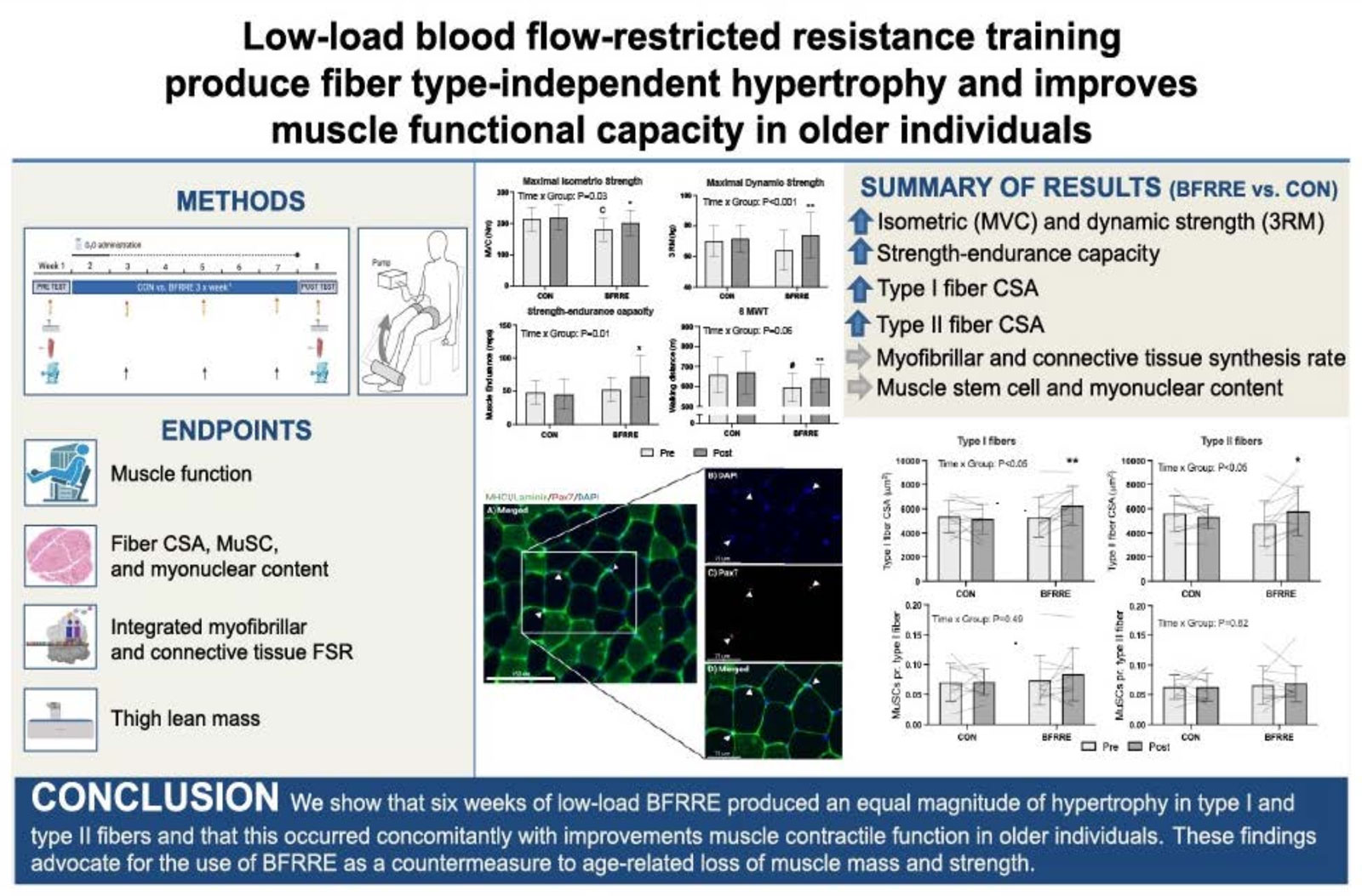
 Low-load blood flow-restricted resistance exercise (BFRRE) constitutes an effective means to produce skeletal muscle hypertrophy in as little as 6 weeks. Its applicability to counteract the age-related skeletal muscle decay at a cellular level, however, is not clear. Danish researchers investigated the effect of BFRRE on muscle fiber morphology, integrated muscle protein synthesis, muscle stem cells (MuSCs), myonuclear content, and muscle functional capacity in healthy older individuals. Twenty-three participants with a mean age of 66 yr (56–75 yr) were randomized to 6 wks of supervised BFRRE (3 sessions per week) or non-exercise control (CON). Biopsies were collected from the vastus lateralis before and after the intervention. Immunofluorescent microscopy was utilized to assess muscle fiber type-specific cross-sectional area (CSA) as well as MuSC and myonuclear content. Deuterium oxide was orally administered throughout the intervention period, enabling assessment of integrated myofibrillar and connective tissue protein fractional synthesis rate (FSR). BFRRE produced uniform ~20% increases in the fiber CSA of both type I and type II fibers (P < 0.05). This occurred concomitantly with improvements in both maximal muscle strength and strength-endurance capacity but in the absence of increased MuSC content and myonuclear addition. The observed muscle fiber hypertrophy was not mirrored by increases in either myofibrillar or connective tissue FSR. In conclusion, BFRRE proved effective in stimulating skeletal muscle growth and increased muscle function in older individuals, which advocates for the use of BFRRE as a countermeasure of age-related deterioration of skeletal muscle mass and function.
Source: Wang J, Mogensen A-M G, Thybo F, et al. Low-load blood flow-restricted resistance exercise produces fiber type-independent hypertrophy and improves muscle functional capacity in older individuals. J Appl Physiol. 2023;134(4):1047-1062. doi: 10.1152/japplphysiol.00789.2022.