







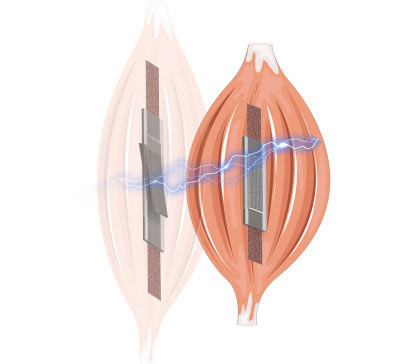
Self-sensing electric artificial muscles with variable stiffness.
Muscle contraction hardening is essential for enhancing strength and also enables rapid reactions in living organisms. Taking inspiration from nature, researchers at Queen Mary’s School of Engineering and Materials Science in London have successfully created an artificial muscle that seamlessly transitions between soft and hard states while also possessing the remarkable ability to sense forces and deformations. This innovative technology has the potential to revolutionize soft robotics and medical applications.
The cutting-edge artificial muscle exhibits flexibility and stretchability similar to natural muscle, making it ideal for integration into intricate soft robotic systems and adapting to various geometric shapes. With the ability to withstand over 200% stretch along the length direction, this flexible actuator with a striped structure demonstrates exceptional durability. By applying different voltages, the artificial muscle can rapidly adjust its stiffness, achieving continuous modulation with a stiffness change exceeding 30 times. Additionally, this technology can monitor its deformation through resistance changes, eliminating the need for additional sensor arrangements and simplifying control mechanisms while reducing costs.
The potential applications of this flexible variable stiffness technology range from soft robotics to medical applications. The seamless integration with the human body opens up possibilities for aiding individuals with disabilities or patients in performing essential daily tasks. By integrating the self-sensing artificial muscle, wearable robotic devices can monitor a patient’s activities and provide resistance by adjusting stiffness levels, facilitating muscle function restoration during rehabilitation training.