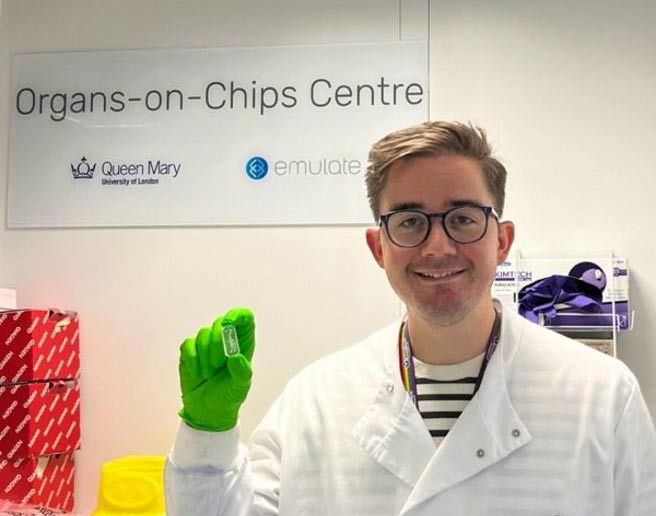
Hopkins holding an organ-chip in the lab. Image courtesy of Hopkins.
Researchers at Queen Mary University of London have developed a new organ-on-a-chip model of the human synovium, a membrane-like tissue that lines the joints. The model could help researchers to better understand the mechanisms of arthritis, such as knee osteoarthritis, and to develop new treatments for this group of debilitating diseases.
The new synovium-on-a-chip model is a 3D microfluidic device that contains human synovial cells and blood vessel cells. The device is subjected to mechanical loading, which mimics the forces applied to the synovium during joint movement. The developed synovium-on-a-chip model was able to mimic the behavior of native human synovium, producing key synovial fluid components and responding to inflammation. This suggests that the new platform has immense potential to help researchers understand disease mechanisms and identify and test new therapies for arthritic diseases.
“Our model is the first human, vascularized, synovium-on-a-chip model with applied mechanical loading and successfully replicates a number of key features of native synovium biology,” said Timothy Hopkins, PhD, Versus Arthritis Foundation Fellow. “The model was developed upon a commercially available platform (Emulate Inc.) that allows for widespread adoption without the need for specialist knowledge of chip fabrication. The vascularized synovium-on-a-chip can act as a foundational model for academic research, with which fundamental questions can be addressed, and complexity (further cell and tissue types) can be added. In addition, we envisage that our model could eventually form part of the drug discovery pipeline in an industrial setting. Some of these conversations have already commenced.”