
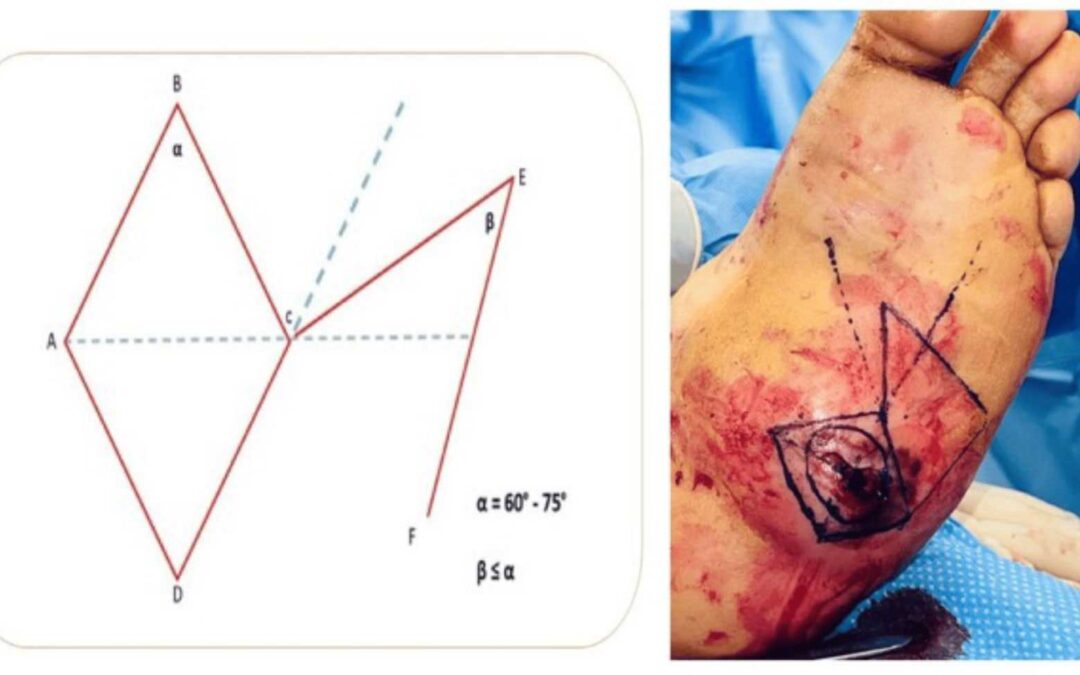








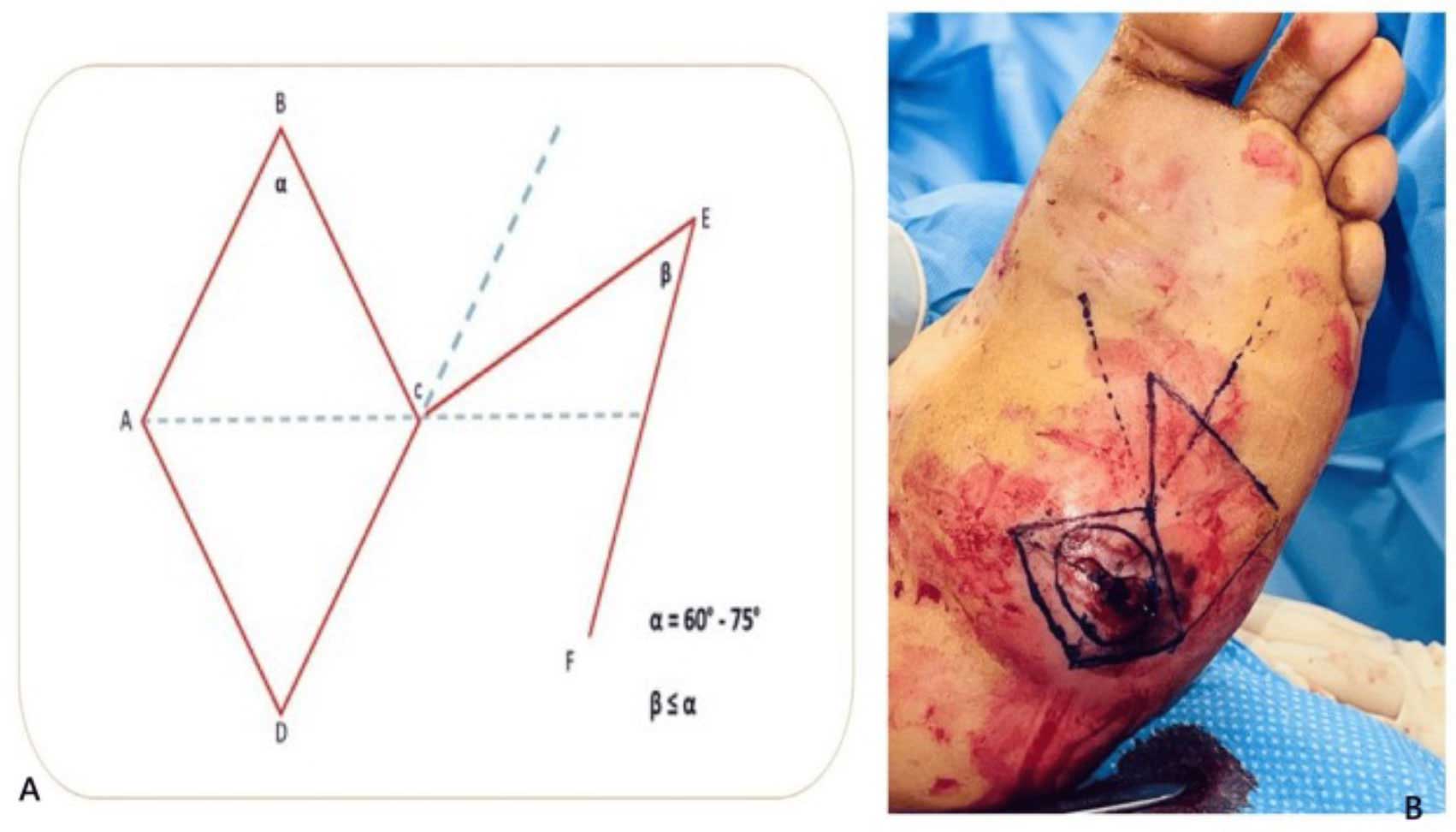
Dufourmentel rhomboid flap design and clinical execution. (A) Illustration showing rhomboid flap planning. Red solid lines indicate surgical incisions for wound excision and flap elevation. Blue dotted lines represent imaginary guides for flap orientation and angle planning. The flap pivot (D-F) was later depicted intraoperatively in the right using a solid marker line. (B) Intraoperative biogeometric skin markings replicating the schematic design, demonstrating translation of the flap plan to clinical application. The illustration is created by the authors of this study.
Chronic plantar ulcers in Charcot neuropathic osteoarthropathy (CNO) present a significant challenge in limb salvage due to biomechanical instability, poor tissue quality, and high mechanical stress at weight-bearing sites. Traditional surgical techniques, such as exostectomy and tendo-Achilles lengthening (TAL), effectively redistribute plantar pressure but often fail to provide durable soft tissue coverage. This study describes the first documented use of a Dufourmentel rhomboid flap for reconstructing a chronic plantar midfoot ulcer in a 59-year-old female with CNO and poorly controlled diabetes. The patient presented with a non-healing ulcer over a prominent osseous deformity, complicated by advanced neuropathy and a rocker-bottom foot. Surgical intervention included TAL, exostectomy, and meticulous wound debridement, followed by primary closure using a Dufourmentel flap to achieve tension-free, durable coverage. Postoperatively, the patient was managed with strict immobilization using a total contact cast and transitioned to a Charcot Restraint Orthotic Walker (CROW) boot. Despite partial non-compliance with weight-bearing restrictions, the wound healed completely by 6 months, with no recurrence. This case highlights the Dufourmentel flap as an innovative and effective reconstructive option for complex plantar ulcers in CNO, offering enhanced soft tissue resilience and long-term stability. The integration of TAL, exostectomy, and biomechanically optimized wound closure provides a comprehensive approach to limb salvage in high-risk diabetic patients. Further research is warranted to evaluate the flap’s long-term outcomes and broader applicability in Charcot foot reconstruction.
Source: Elhaddad M, Carrillo-Kashani A, Tavakalyan K, Massaband BD. Dufourmentel rhomboid flap for plantar charcot midfoot ulcer: a novel reconstructive approach. Cureus. 2025 30;17(3):e81484. doi: 10.7759/cureus.81484.






Another excellent article trying to explain a very difficult lower extremity pathology