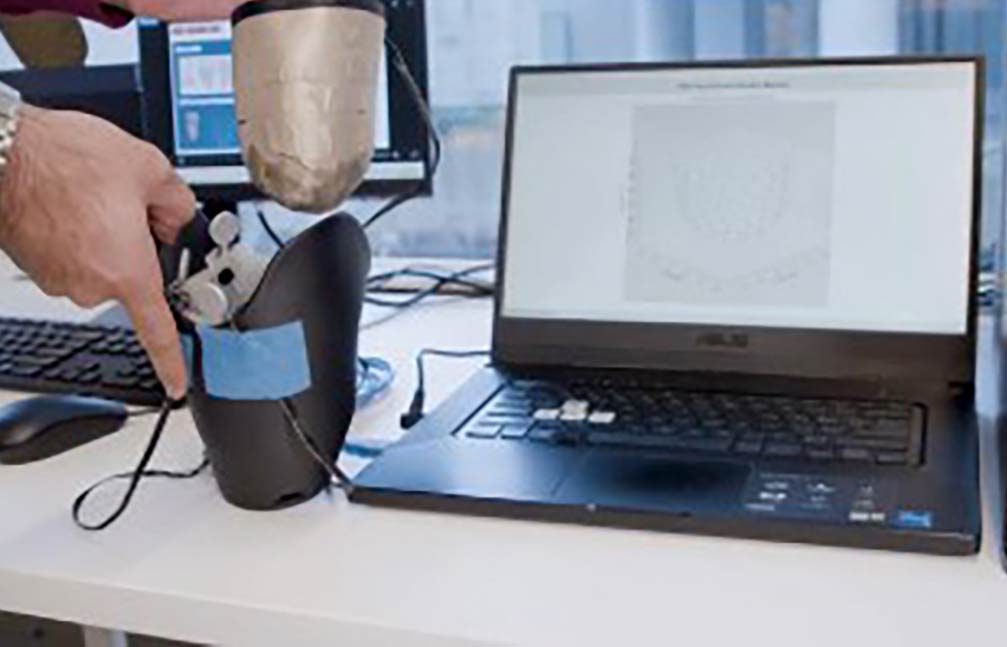
SFU researchers are working on a new, fully customizable 3D printed socket design set to transform the prosthetics industry. Image courtesy of SFU.
A reimagined limb socket interface combines highly personalized pressure mapping with artificial intelligence (AI) software and a lighter infill, creating a customized prosthesis that’s more comfortable to wear, for much longer, said researchers at Simon Fraser University (SFU).
“For the first time, this 3D-printing technology is capturing unique pressure and force distribution data from a patient and using that data to design a custom prosthetic device and fabricate a much lighter, more breathable and pressure-responsive socket,” said Woo Soo Kim, professor at the School of Mechatronic Systems Engineering.
According to key study findings, the 3D-printed sockets with lightweight lattice infill showed 1,600% more energy absorption compared to solid infills when standing and 1,290% more energy absorption compared to solid infills when walking.
Traditional prosthetic fittings use casts or digital scans of the residual limb to make a mold for the final socket. These molds are very precise in terms of measurements and shape, but don’t account for individualized pressure points and force distribution unique to each person, explained Kim.
In the study, researchers embedded a silicone liner with a miniature 3D-printed pressure sensing mat with a network of origami sensors to measure pressure and force. The test patient wore the pressure mapping liner inside a temporary socket while standing, walking on a flat surface, walking down a ramp, and leaning left and right, to mimic everyday activity. Customized AI software translated this data into a personalized 3D-printed socket design using a custom lattice structure–a highly organized, repeating 3D pattern often found in nature and biology, like a honeycomb or the inside structure of human bone. Researchers said their new 3D-printed sockets improve comfort and quality of life for prosthesis wearers, and may also reduce common complications like ulcers, pain, instability, musculoskeletal issues, and osteoarthritis by absorbing more energy.