
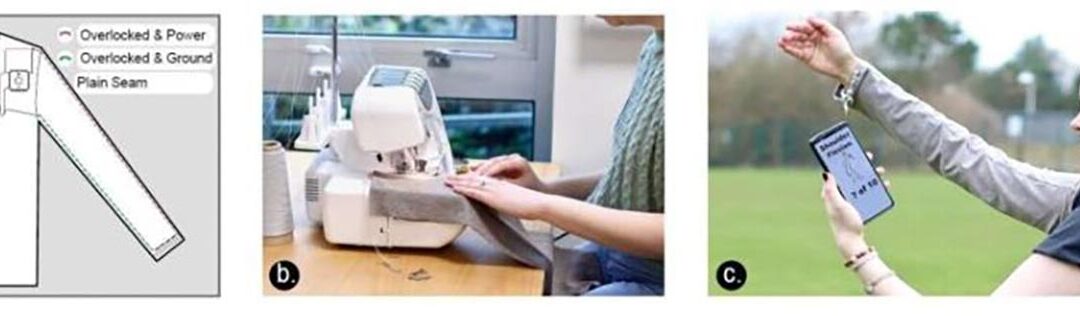








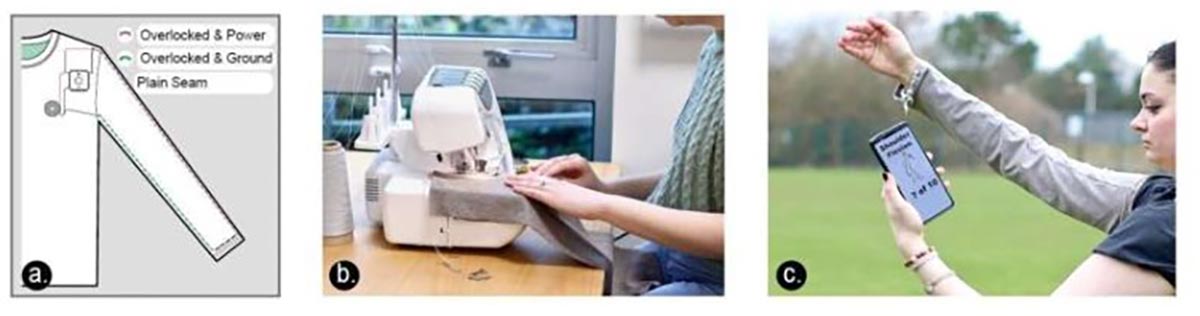
SeamSleeve is a novel sensing mechanism that uses powered seams as sensing channels, retaining traditional fabric design benefits for comfortable and robust motion capture. (a) The researchers empirically evaluate and compare different designs to determine the optimal placement of seams and sensing channels; (b) they demonstrate that their approach can effectively train and classify arm movements; (c) they propose SeamSleeve for rehabilitation exercises beyond the clinic. Image courtesy of Olivia Ruston.
Everyday clothing may soon be able to capture and record body movements according to new research from the Universities of Bristol and Bath, United Kingdom. Harmless low voltages are passed through conductive threads that are stitched into garment seams to create electrical circuits. Their resistance changes with the movement of the wearer’s body. The work opens up new possibilities to make digital clothing that senses and captures movements much more accurately than is possible using current phones and smart watches. The work lays the foundations for e-textile designers and clothing manufacturers to create cutting edge garments that could enhance exercise, physiotherapy, and rehabilitation.
“We’ve shown that common overlocked seams in standard garment constructions can do a good job of sensing movement,” said Professor Mike Fraser, PhD, of the University of Bristol’s School of Computer Science “The design avoids the need for a separate power source by pairing the seam with a charging coil, drawing the energy wirelessly from a mobile phone placed in the pocket. This means advanced motion sensing garments could be made without altering existing manufacturing processes.”
Additionally, Fraser said that he and his colleagues have shown that smartphone apps using advanced artificial intelligence techniques can use this movement data to match body movement to specific postures or gestures such as physiotherapeutic exercises.