







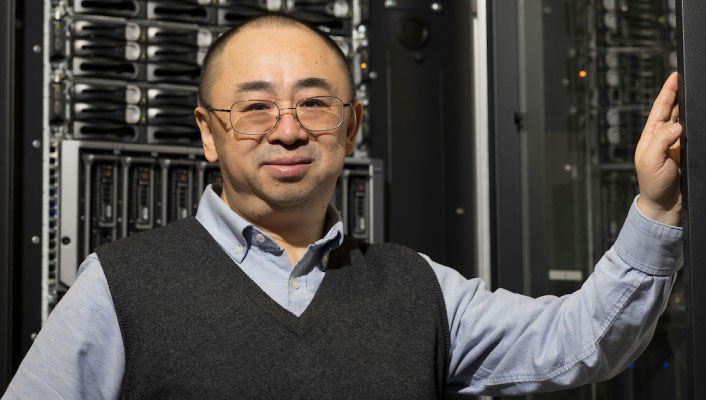
Yu Chen, a faculty member in the Department of Electrical and Computer Engineering at the Thomas J. Watson College of Engineering and Applied Science, in the Data Center of the Engineering and Science Building at Binghamton University’s Innovative Technologies Complex. Image courtesy of Jonathan Cohen.
New research from Binghamton University, State University of New York, aims to cut reaction times with a human action recognition (HAR) algorithm that uses local computing power to analyze sensor data and detect abnormal movements without transmitting to a processing center offsite. Professor Yu Chen, PhD, and PhD student Han Sun from the Thomas J. Watson College of Engineering and Applied Science’s Department of Electrical and Computer Engineering, designed the Rapid Response Elderly Safety Monitoring (RESAM) system to leverage the latest advancements in edge computing.
Their work shows that the RESAM system can run using a smartphone, smartwatch, laptop or desktop computer with 99% accuracy and a 1.22-second response time, ranking among the most accurate methods available today.
Chen said the research is important for an underserved population—senior citizens—who need more help but normally do not have sufficient resources or the opportunity to tell high-tech developers what they need. By using devices already familiar to older people, rather than a full smart home setup, he thinks it gives them a better sense of control over their health—without the need to learn new technology for the system to be effective.
Also, to protect people’s privacy, RESAM reduces the monitored images to skeletons, which still allows analysis of key points such as arms, legs, and torso to determine if someone has fallen or suffered a different accident that could lead to injury.
Chen sees the RESAM system as a cornerstone for a wider concept he’s calling “Happy Home,” which could include thermal or infrared cameras and other sensors to remotely assess other aspects of a person’s environment and well-being. “Adding more sensors can make our system more powerful, because we are not only monitoring someone’s body movements—we can monitor someone’s health with 1 more dimension, so we better predict if something’s going to happen before it happens,” he said.