







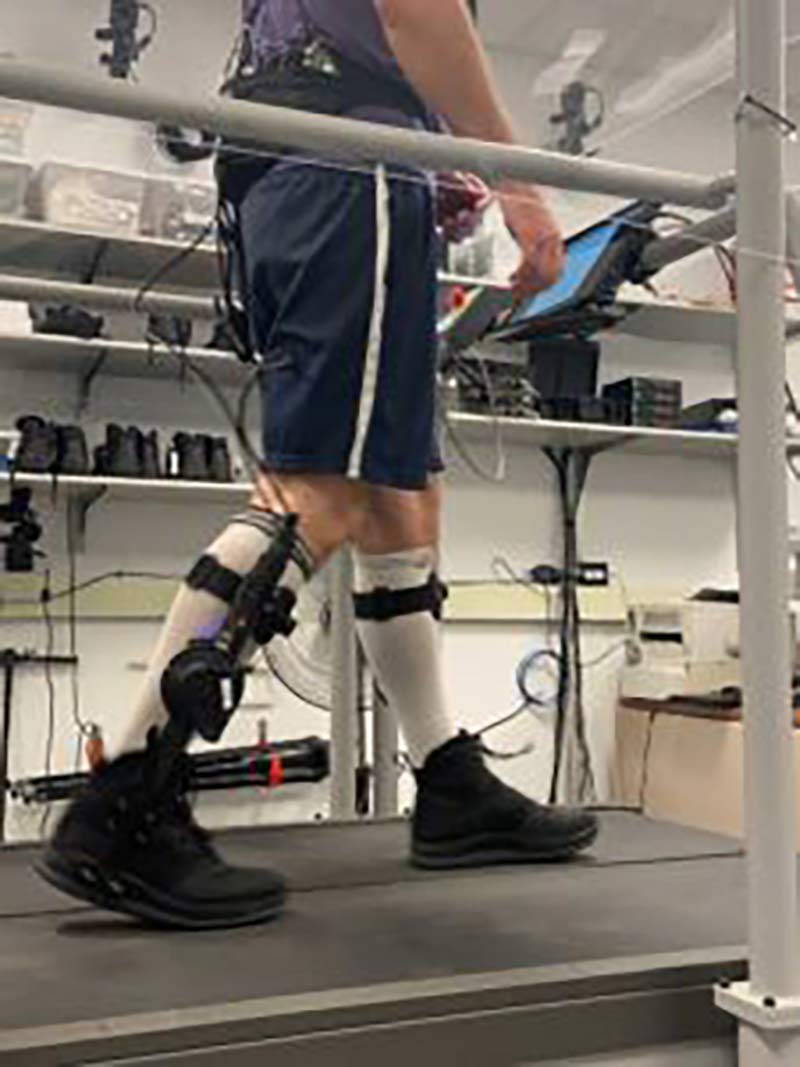
A study participant walks on a treadmill with a tablet that allows them to change the timing and torque of the exoskeleton they are wearing. Image courtesy of Kim Ingraham.
Exoskeletons need to interact seamlessly with their user, providing the right level of assistance at the right time to cooperate with muscles as the user moves. To help achieve this, University of Michigan researchers gave users direct control to customize the behavior of an ankle exoskeleton. Not only was the process faster than the conventional approach, in which an expert would decide the settings, but it may have incorporated preferences an expert would have missed. For instance, user height and weight, which are commonly used metrics for tuning exoskeletons and robotic prostheses, had no effect on preferred settings.
Experts usually tune powered exoskeletons to consider the varied characteristics of human bodies, gait biomechanics, and user preferences. This can be done by analyzing quantifiable data to minimize energy expenditure from a user, or more simply by asking the user to repeatedly compare between pairs of settings to find which feels best. However, what minimizes energy expenditure, may not be the most comfortable or useful. And asking the user to select between choices for numerous settings is time consuming and also obscures how those settings might interact with each other to affect the user experience.
By allowing the user to directly manipulate the settings, preferences that are difficult to detect or measure could be accounted for by the users themselves. Users could quickly and independently decide what features are most important—for example, trading off comfort, power, or stability, and then selecting the settings to best match those preferences.
Tests have shown that when told to find their preference while walking on a treadmill, the users who had no previous experience with an exoskeleton were, on average, able to confirm their optimal settings in just under 2 minutes. In addition, user preference changed over the course of the experiment. As the first-time users gained more experience with the exoskeleton, they preferred a higher level of assistance. And those already experienced with exoskeletons preferred a much greater level of assistance than the first-time users.
These findings could help determine how often an exoskeleton needs to be retuned as a user gains experience and supports the idea of incorporating direct user input into preferences for the best experience.