








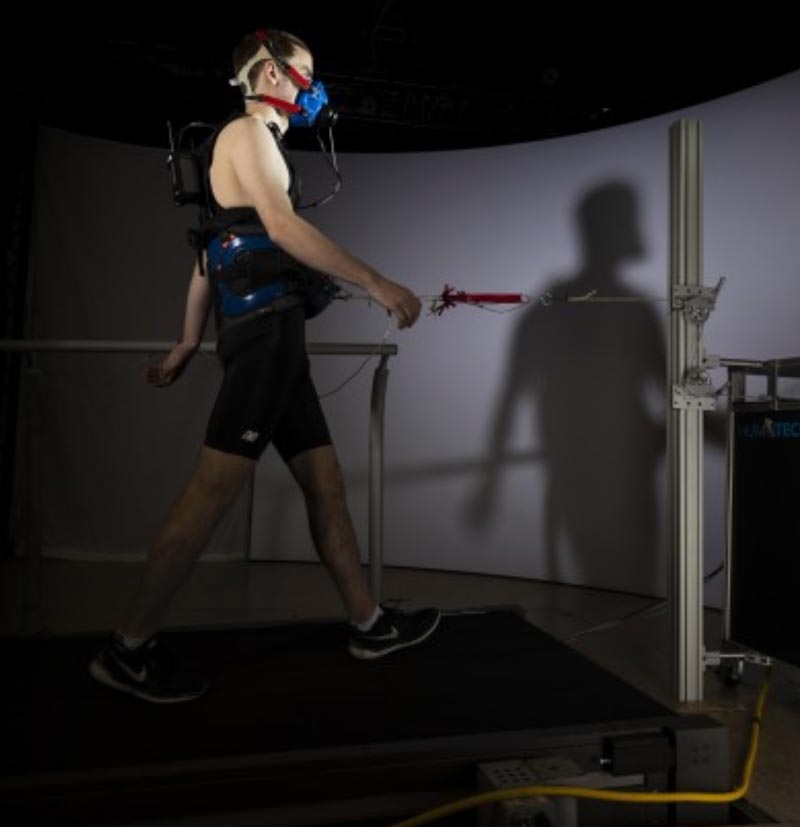
Based on previous literature, the researchers believed they would see the highest energy savings by pulling when the individual is trying to propel forward against the ground. However, they found the best time to apply force is when both feet are on the ground.
Findings by researchers at the University of Nebraska at Omaha (UNO) describe a novel way to reduce the energy people spend to walk, as much as by half, which could have applications for therapy received by patients with impaired walking abilities. This research shows that a strategically timed pull from a waist belt connected to a pulley can help an individual use less energy for each step while walking. However, the optimal timing of that forward pull was what came as a surprise.
“When we walk, there is a short period between steps where one foot is stopping its forward motion while the other is preparing to accelerate to take the next step forward,” said Philippe Malcolm, PhD, an assistant professor in biomechanics at UNO. “Our research shows that this brief window where both feet are on the ground is the best time to apply force to assist walking most efficiently.”
The device works by providing timed pulls from a motorized pulley while an individual walks on a treadmill. Since it only requires wearing a waist belt, it is relatively easy to make individualized adjustments compared to more complicated devices. The findings about optimal timing could have applications for exercise therapists in clinical settings providing care for patients with conditions such as peripheral artery disease.