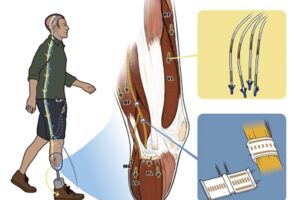










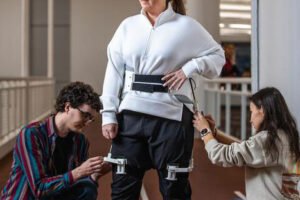
The exoskeleton wraps around the lower and upper calf as well as the lower and upper thigh, with a motor at the knee joint.
Building on the success of projects to boost strength by adding motors to conventional knee, hip, and ankle braces, a University of Michigan (U-M) team is exploring how well this approach could work for relieving knee pain from osteoarthritis (OA).
“This could create an entirely new class of orthotic interventions that don’t exist today, which could potentially delay surgery or spare people from having to undergo it,” said Robert Gregg PhD, U-M professor of robotics and leader of the project funded with $2 million from the National Institutes of Health.
In earlier work, exoskeletons developed by Gregg’s team reduced the effort expended by study participants by 14.5% in quadriceps effort, 19.1% in lower ankle torque, and 25% in work done by the hip.
Before inviting study participants to the lab, the researchers will optimize their exoskeletons for arthritis pain reduction. Gregg’s team is very experienced at modeling muscle effort and joint torque, but they have not previously gone into the details of what is happening inside the joints. Now, they will dig into musculoskeletal models to quantify how exoskeleton assistance reduces the bone-on-bone contact forces—and therefore the pain—inside arthritic joints. They will use this information to adapt the exoskeleton control algorithm to reduce contact forces rather than just muscle effort and ultimately assess the effects on participants’ self-reported pain across a variety of activities. The control algorithm will be based on the “energy shaping” approach championed by Gregg’s group, which looks at the user’s current motion and predicts how much force is needed in the next fraction of a second. The predictions come from models of human movement made with motion capture data and physics.
The design of the exoskeletons themselves will be very similar to the previous effort to boost strength. The team uses “pancake” motors popularized by the drone industry. The key advantage of these motors is high torque at low speeds, providing a force similar to human joint. Pancake motors provide both the power and smooth operation needed for compatibility with human motion while being nearly silent.
Related posts:
Solution Offers Hope for Treating Intertrochanteric Femur Fractures in the Elderly
Comparison of Single Use and Negative Pressure Wound Therapy Devices in LEUs
AI Algorithm Trained to Recognize DVT

Exploring How Near-Infrared Light Therapy Could Help Diabetic Wounds Heal Faster
Robotic Hip Exoskeleton Promising for Stroke Patients