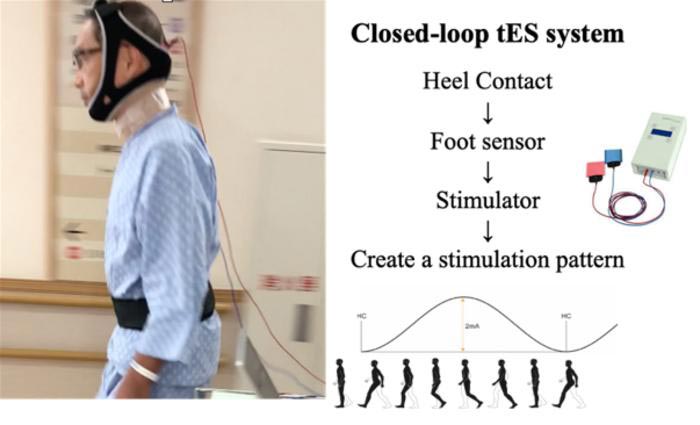
Patient with Parkinsonian gait disturbances seeking brain stimulation to improve walking dynamics. A sinusoidal waveform was utilized to deliver electrical current on the cerebellum. The initiation of each current coincided with the moment of heel contact on the affected side during a self-paced 4-minutes gait.
Using a novel neuromodulation approach that incorporates gait-combined closed-loop transcranial electrical stimulation (tES), a team of researchers from Japan demonstrated significant gait improvements in patients with various neurological disorders including Parkinson’s disease (PD).
While non-pharmacological approaches like transcranial direct current stimulation show promise in improving motor function, recent research focuses on gait-combined closed-loop stimulation, which synchronizes brain stimulation with the individual’s gait rhythm.
To this end, the clinical researchers from from Shinshu University and Nagoya City University recruited 23 patients with PD or Parkinson’s syndrome. All study participants were randomly assigned to receive either the active treatment or a “sham” treatment that mimics the active treatment but does not offer any therapeutic benefit. During the course of the trial, an electrode carrying a low current (up to 2mA) was externally affixed to the occipital region of the head. A reference electrode was then placed in the neck region to establish a stable electrical reference point and to complete the electrical circuit. The treatment included performing tES on the cerebellum in a non-invasive manner. The brain side showing severe impact was specifically targeted during the electrotherapy.
The therapy showed encouraging results after just 10 repetitions. The treatment group showed a significant improvement in gait parameters including speed, gait symmetry, and stride length. Although the study has certain limitations, it suggests that the personalized brain stimulation, synchronized with individual gait rhythm, can effectively enhance gait function in PD and has the potential to be used as an adjunct therapy for gait rehabilitation.