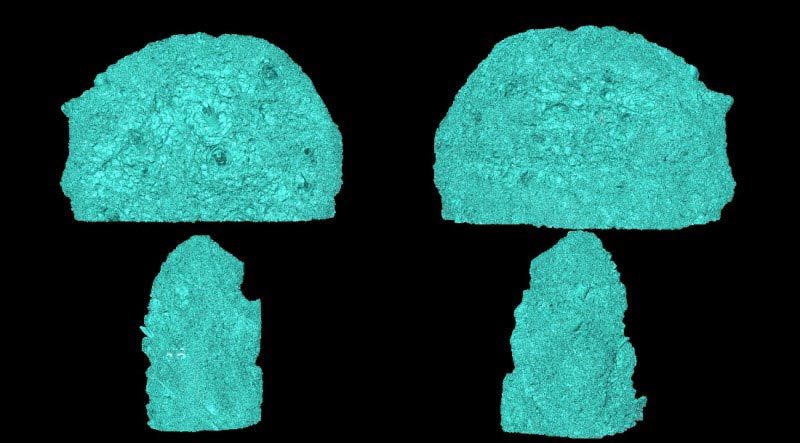
Three-dimensional mesh of the ADS generated from image segmentation: (a) epidermal interface, (b) dermal interface, (c) left lateral view, and (d) right lateral view.
Researchers from the anatomy and pharmacology departments at the University of Pretoria, South Africa, have addressed the limitations of traditional skin grafting by merging biological sciences with engineering and computational methods to create a solution for wound healing.
“Decellularized acellular dermal scaffolds (ADS) are an alternative to skin grafts and are developed by removing cells from the skin of a donor or an animal; this reduces the potential for rejection,” explained Alison Ridel, PhD, of the Department of Anatomy. “Traditional decellularization processes have various limitations, and may produce ADS with altered 3D structure, damaged proteins, and decreased tensile strength.” Emerging technologies like 3D bioprinting can overcome the challenges posed by traditional methods.
The research team integrated the 3D bioprinting technology of ADS with advanced technologies like micro-x-ray computed tomography scanning and Amira-Avizo software. This interdisciplinary approach bridges the gap between biological sciences and cutting-edge 3D imaging and bioprinting technologies.
This research on developing artificial dermal substitutes through 3D bioprinting is significant for several reasons. “This improves the healing process for patients with chronic and complex wounds, addressing a critical need in reconstructive medical engineering,” Hafiza Parkar, PhD, said. “Secondly, 3D bioprinting enables us to create customizable acellular dermal scaffolds that can be tailored to the specific size, depth and nature of each patient’s wound. This personalized approach enhances the efficacy of the treatment and ensures a better fit, potentially leading to faster and more efficient healing…”