







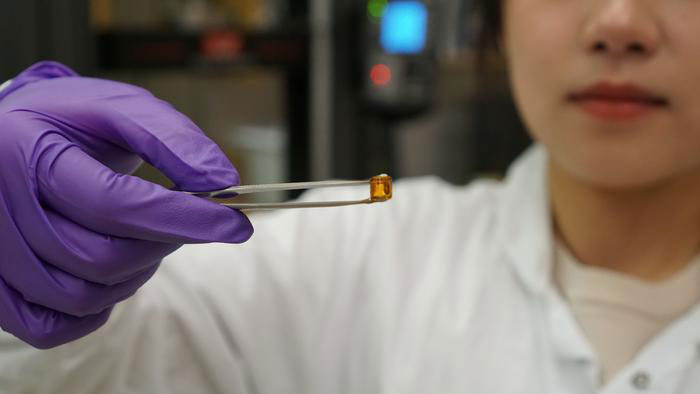
Fu holding the gel. Image courtesy of Alex Walls.
A gel that combines both stiffness and toughness is a step forward in the bid to create biodegradable implants for joint injuries, according to new research from the University of British Columbia (UBC).
Hongbin Li, PhD, a professor in the UBC department of chemistry, and his team developed a new approach to stiffen a protein gel without sacrificing toughness, by physically tangling together the chains of a particular protein that made up the gel’s network. “These entangled chains can move, which allows energy, for instance, the impact from jumping, to be dissipated, just like shock absorbers in bikes,” said Linglan Fu, PhD, who conducted the research as a doctoral student at UBC’s department of chemistry. “In addition, we combined this with an existing method of folding and unfolding proteins, which also allows for energy dissipation.”
The resulting gel was super tough, able to resist slicing with a scalpel, and was more stiff than other protein hydrogels. Its ability to resist compression was among the highest achieved by any such gels and compared favorably with actual articular cartilage. And the gel was able to rapidly recover its original shape after compression, as real cartilage does after jumping.
Rabbits implanted with the gel showed notable signs of repair of articular cartilage 12 weeks after implantation, with no hydrogel remaining and no rejection of the implant by the animals’ immune system. The researchers observed bone tissue growth similar to the existing tissue, and regenerated tissue close to existing cartilage for the gel implant group—much better results than they saw with a control group.