







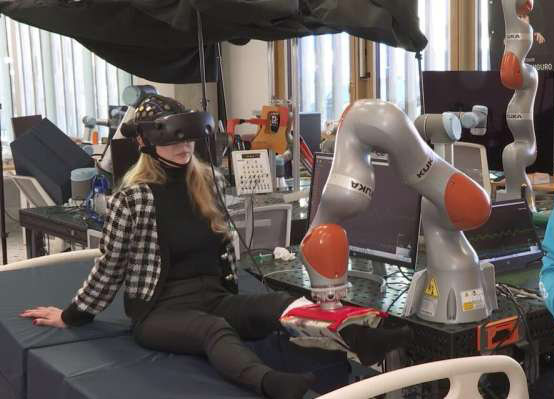
Image courtesy of the Skolkovo Institute of Technology.
Researchers at the Skolkovo Institute of Technology, Russia, have devised a novel method for leg rehabilitation after injury or stroke that uses a brain-computer interface (BCI) and electrical stimulation of the spine delivered through the skin. Created by scientists from the institute’s neuro and engineering centers, the solution incorporates virtual reality (VR) and enables paralyzed patients to regain control of their lower limbs and master natural movements by reestablishing the connection between motion and intention.
The neural interface used by the researchers is an off-the-shelf device, a cap with electrodes picking up the electrical activity of the brain. However, the software part has been augmented by the scientists, who modified the protocol responsible for identifying an intention to move. The robot is an industrial collaborative manipulator equipped with highly accurate torque sensors. It is capable of guiding the patient’s leg in the direction corresponding to the goal they choose in the VR. Specially written software enables the robot to emulate natural limb movements, reproducing the trajectory that the leg of a healthy person would follow.
The VR goggles display multiple targets that a patient attempts to move their leg toward. Once the intended motion has been read out from the brain by the BCI and the robot performs the motion, the patient can actually see their limb moving in the VR, but the robotic assistant is invisible. This causes the motion to be perceived as initiated and controlled by the brain, helping bridge the brain-muscle divide.
The last component of the system is noninvasive electrical stimulation of the spinal cord through electrodes taped to the back of the patient. The idea behind this is that neurons might be getting so-called subthreshold signals from the brain that are not strong enough to result in activation. External electrical stimulation allows this barrier to be overcome and leads to the formation of reliable neural connections that eventually will function without this artificial support.