







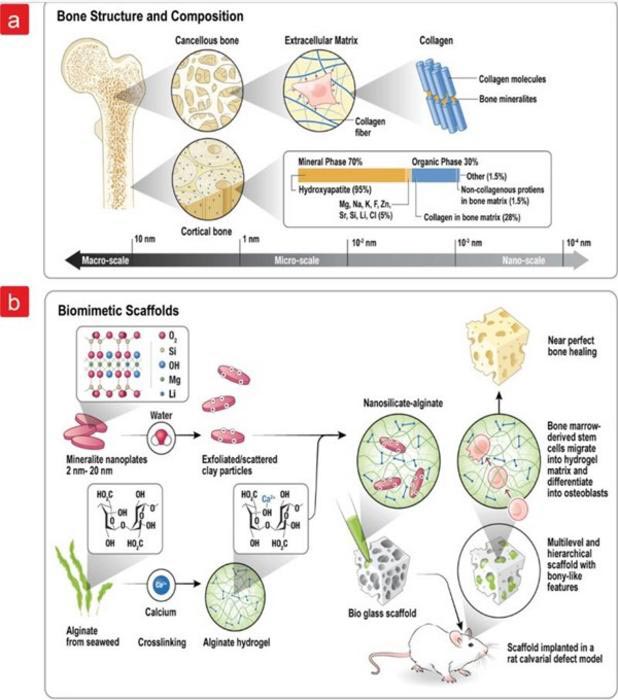
(a) Schematic representation of the (a) bone structure and its composition ranging from nanometers to micrometers and (b) development of biomimetic scaffolds containing the various steps for preparing a combinatorial hydrogel/scaffold.
A team at Technical University of Denmark (DTU) Health Tech led by Associate Professor Alireza Dolatshahi-Pirouz, PhD, have made a leap forward in tissue regeneration by creating a multi-leveled scaffold that encompasses properties of native bone on the nano-, micro-, and macroscale. The researchers have described the discovery of near-perfect bone healing in a rat model after only 8 weeks, using their scaffold—and without using growth factors. In addition, the scaffold is combinatorial and can simultaneously release several essential bone minerals while covering mechanical properties, ie, the compressive strength needed to match those of cancellous human bone.
“The implications of these results are enormous, and our aim is now to lower the healing time to 4 weeks and reach almost instant tissue regeneration without using endocrine factors and cells,” said Dolatshahi-Pirous. “We will also be looking into whether this could be used for other tissues.”
By incorporating stem cells, more bioactive components such as collagen and gelatin coatings that increase native cell migration into the scaffolds, and electromagnetic stimulation, it could pave the way for rapid healing of soldiers suffering from critical musculoskeletal fractures or civilians suffering from traumatic injuries. These people are hospitalized for months, with a long road to recovery.
Notably, this new scaffold was made primarily from glass, alginate and nano silicate—already US Food & Drug Administration —approved materials, which significantly reduces hurdles for regulatory clearance. This means the scaffold can be used more confidently and efficiently in clinical settings, accelerating development and improving patient outcomes.